Sodium Intake: How Much You Need, Where It Hides, and How to Cut Back
Sodium intake is the total milligrams of sodium you eat in a day, from every source: the salt you add yourself, the salt a manufacturer added before you bought the food, and the sodium hiding in ingredients you would never call salty. It is one of the most important numbers in nutrition, because it directly affects your blood pressure, and blood pressure affects your risk of heart disease and stroke.
Most people get this number badly wrong in both directions. They think they eat little sodium because they rarely pick up the saltshaker, while their actual sodium intake is nearly double the recommended limit. Or they hear that salt is dangerous and try to cut it to almost nothing, which is unnecessary and hard to sustain. This guide gives you the real picture: the recommended limits, the difference between sodium and salt, where sodium hides, how to read labels, how to cut back without ruining your food, and when to get medical guidance first.
What Is Sodium Intake?
Sodium intake is the amount of sodium, measured in milligrams, that you consume in a day. Sodium is a mineral your body needs in small amounts. It helps control fluid balance, it helps your nerves send signals, and it helps your muscles contract. Without any sodium at all, your body could not function.
The key word is small. Your body needs less than 500 mg of sodium a day to run all of those jobs. That is roughly the amount in a fifth of a teaspoon of salt. Almost nobody eats that little, and nobody needs to aim for it. The recommended sodium intake limits are set well above the minimum, because food naturally contains some sodium and because a realistic diet needs room to breathe.
Sodium intake is not the same as salt intake, and confusing the two is the first mistake most people make. Salt, the white crystals in your shaker, is sodium chloride: about 40 percent sodium and 60 percent chloride by weight. When a label says a food contains 400 mg of sodium, it does not contain 400 mg of salt. It contains more salt than that, because only part of salt is sodium. The conversion matters, and this guide works through it with full math in the next sections.
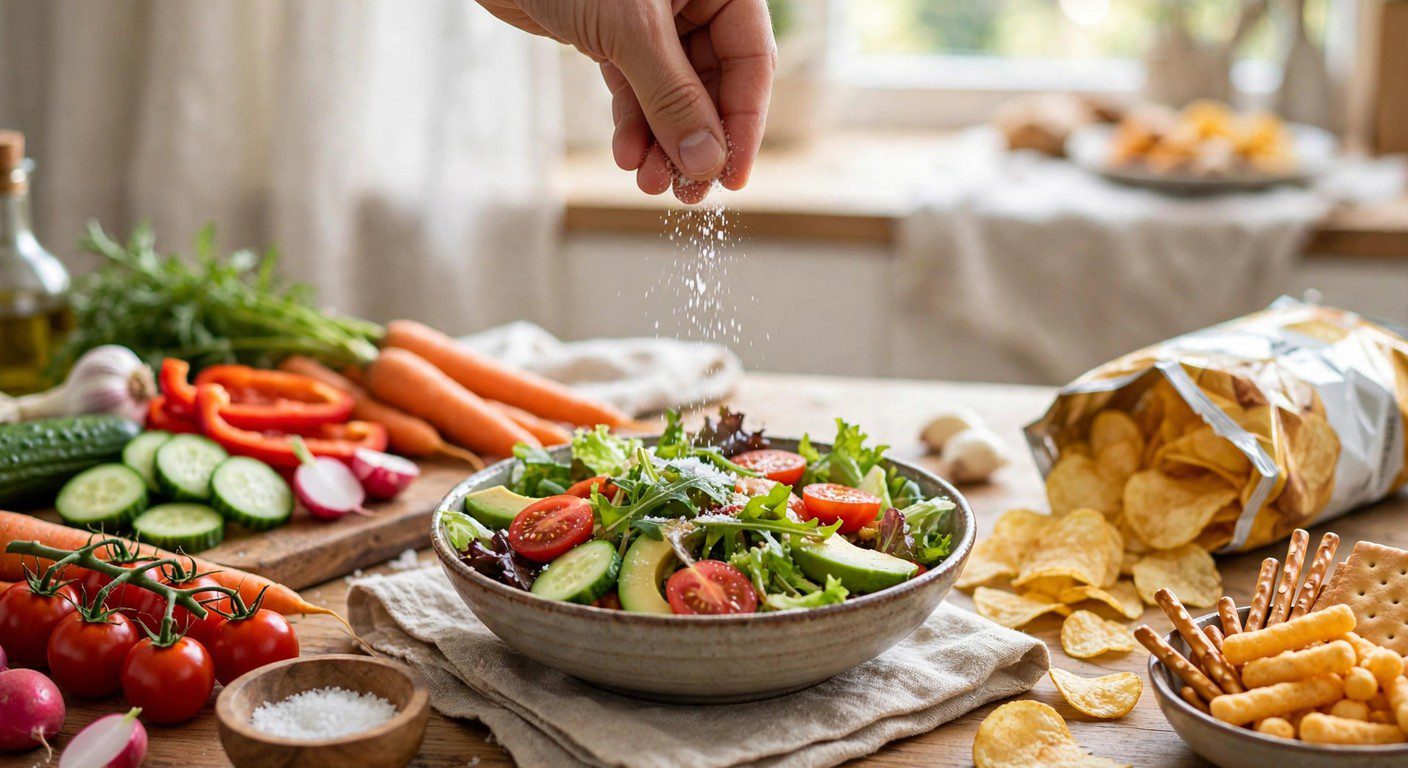
Most of your sodium intake does not come from your own hand. More than 70 percent of American sodium intake comes from packaged, prepared, and restaurant foods, before the food ever reaches the table. The saltshaker accounts for only a small share. That is why “I never add salt” is not a reliable defense, and why label reading and cooking at home matter far more than willpower at the dinner table.
How Much Sodium Intake Do You Need Each Day?
For most adults, the American Heart Association recommends a sodium intake of no more than 2,300 mg a day, and moving toward an ideal limit of no more than 1,500 mg a day. You can read the guidance in full from the American Heart Association. The 2,300 mg figure is also the Daily Value printed on every Nutrition Facts label in the United States, which is why it shows up as 100 percent on labels.
The gap between the recommendation and reality is large. The average American eats about 3,400 mg of sodium a day. Compare that with the limits. Against the 2,300 mg ceiling, the average intake is 1,100 mg over: 3,400 minus 2,300 equals 1,100. Against the 1,500 mg ideal, it is 1,900 mg over: 3,400 minus 1,500 equals 1,900. In percentage terms, 3,400 divided by 2,300 equals about 1.48, so the average person eats roughly 48 percent more sodium than the ceiling, and more than double the ideal.
That sodium intake gap is fixable, and you do not need to close it in one jump. The American Heart Association notes that cutting sodium intake back by 1,000 mg a day can improve blood pressure for most people. Going from 3,400 to 2,400 mg is a cut of 1,000 mg, and it already moves you close to the ceiling. From there, a second step toward 1,500 mg is a further cut of 900 mg: 2,400 minus 1,500 equals 900. Two steps, each one realistic, take you from average to ideal.
A few groups have different sodium intake targets, and this is where personal guidance matters. People with high blood pressure, kidney disease, heart failure, or diabetes are often advised to aim for the 1,500 mg end of the range or lower, by their own doctor. Children need a lower sodium intake than adults, and their limits scale down with age and calorie needs. Endurance athletes who sweat heavily for hours may temporarily need a higher sodium intake than the general limits, because sweat carries sodium out of the body. For most adults reading this guide, though, the two numbers to remember are 2,300 mg as the ceiling and 1,500 mg as the ideal.
What Is the Difference Between Sodium and Salt?
Sodium and salt are related but not identical, and the distinction changes every number in this guide. Salt is sodium chloride, a compound of two elements. By weight, table salt is about 39 percent sodium and 61 percent chloride. To be precise, the atomic weight of sodium is about 23 and the atomic weight of sodium chloride is about 58.4, so sodium makes up 23 divided by 58.4, which equals about 0.394, or 39.4 percent of salt by weight.
That fraction gives you the conversion in both directions. To convert sodium to salt, divide by 0.394. The daily ceiling of 2,300 mg of sodium becomes 2,300 divided by 0.394, which equals about 5,840 mg of salt, or about 5.8 grams of salt. The ideal limit of 1,500 mg of sodium becomes 1,500 divided by 0.394, which equals about 3,810 mg of salt, or about 3.8 grams of salt. A single teaspoon of table salt weighs about 5.9 grams, and 5.9 grams times 0.394 equals about 2,320 mg of sodium, which is why one teaspoon of salt is routinely quoted as about 2,300 mg of sodium.
The conversion also explains a common label surprise. A food that lists 600 mg of sodium contains about 1,520 mg of salt: 600 divided by 0.394 equals about 1,523. But you do not need to do this conversion when you shop. Labels list sodium, recommendations are written in sodium, and the Daily Value is in sodium. The conversion matters mainly for one reason: so you understand that “one teaspoon of salt a day” and “2,300 mg of sodium a day” are the same limit stated two ways, not two separate limits.
One more distinction worth knowing: not all sodium in food comes from salt. Ingredients such as monosodium glutamate, sodium bicarbonate (baking soda), sodium nitrate and sodium nitrite (in cured meats), sodium benzoate (a preservative), and sodium caseinate (in dairy products) all contribute sodium without tasting like salt. The sodium intake figure on a label already includes all of them. That is why the label number, not your sense of saltiness, is the trustworthy measure of your sodium intake.
Why Does Too Much Sodium Intake Raise Blood Pressure?
Sodium intake raises blood pressure through a simple mechanism: water follows sodium. When your sodium intake exceeds what your body needs, your body holds extra water in the bloodstream to keep the sodium concentration balanced. More water in the same blood vessels means more volume pushing against the vessel walls, and that push is blood pressure. Over time, consistently high pressure damages artery walls, stiffens vessels, and forces the heart to work harder.
The effect is not theoretical. In trials, cutting sodium intake lowers blood pressure in most people, and the effect is larger in people who already have high blood pressure, in older adults, and in people whose blood pressure is sensitive to salt. High blood pressure itself usually has no symptoms, which is why it is called a silent condition. You can have it for years without feeling anything, while it quietly raises your risk of heart attack, stroke, heart failure, and kidney disease.
Sodium intake is linked with more than blood pressure. Consistently high sodium intake is associated with higher risk of stroke and heart disease, with kidney damage, and in some research with weaker bones and higher stomach cancer risk. The blood pressure pathway explains most of the heart and stroke risk, but the kidney connection runs both ways: high sodium intake harms kidneys, and damaged kidneys handle sodium worse, which raises blood pressure further. It is a cycle worth breaking early.
Sodium intake and fluid balance are tightly linked, which is why water intake matters in this picture too. Drinking enough water does not cancel out a high sodium intake, and it does not flush excess sodium away on its own. Your kidneys regulate sodium over hours and days, not minutes. But staying well hydrated keeps the system working normally, and our guide on how much water a day explains how to judge your own fluid needs. The main lever on blood pressure is still your sodium intake itself: eat less of it, and the fluid retention eases.
One honest note: not everyone responds to sodium intake equally. Some people are salt sensitive, meaning their blood pressure rises more sharply with sodium, while others respond less. You cannot reliably tell which group you are in without testing, and sensitivity tends to rise with age. The practical advice is the same either way: most adults benefit from moving their sodium intake toward the recommended limits, and people with high blood pressure benefit the most.
Where Does Sodium Intake Hide in Everyday Food?
Sodium hides in foods that do not taste salty, and that is the whole problem. Bread is the top contributor to sodium intake in the American diet, not because a slice is very salty, but because almost everyone eats bread every day and the milligrams add up. Sauces are the opposite case: a single tablespoon can carry nearly half the daily limit. The table below uses typical values per serving, so you can see both patterns.
| Food | Serving | Sodium |
|---|---|---|
| White or whole wheat bread | 1 slice | 130 to 250 mg |
| Deli turkey breast | 2 oz, about 6 slices | About 560 mg |
| Cheddar cheese | 50 g, about 2 slices | About 311 mg |
| Canned chicken noodle soup | 1 cup | 800 to 1,200 mg |
| Soy sauce | 1 tablespoon | About 900 mg |
| Low-sodium soy sauce | 1 tablespoon | About 590 mg |
| Pizza, pepperoni | 1 slice | 500 to 900 mg |
| Fast food burger | 1 burger | 700 to 1,000 mg |
| Canned tomato sauce for pasta | Half a cup | About 652 mg |
| Ketchup | 1 tablespoon | About 150 mg |
| Potato chips | 1 small bag | About 229 mg |
| Breakfast cereal, sweetened | 1 serving | 200 to 300 mg |
Now watch how an ordinary day adds up without any obviously salty food. Lunch is a deli sandwich: 2 slices of bread at about 150 mg each gives 300 mg, plus deli turkey at 560 mg, plus cheddar at 311 mg, plus a tablespoon of mayonnaise-style dressing at about 90 mg. Add them: 300 plus 560 equals 860, plus 311 equals 1,171, plus 90 equals 1,261 mg in a single lunch. Dinner is two slices of pepperoni pizza at about 700 mg each, which is 1,400 mg. Lunch plus dinner already total 1,261 plus 1,400 equals 2,661 mg, above the 2,300 mg ceiling, before breakfast, snacks, or drinks are counted at all.
Restaurant and takeout meals are usually the biggest single hits. A fast food burger alone can carry 700 to 1,000 mg, and the full meal with fries and a sauce easily passes the whole daily limit. Restaurant cooking adds salt at several stages: in marinades, in sauces, in cooking water, and at finishing. That is why one restaurant dinner can undo a week of careful home cooking, and why the restaurant tactics in the cut-back section matter as much as anything you do at home.
A few more hiding places deserve a mention. Breakfast cereals, especially sweetened ones, often carry 200 to 300 mg per serving behind a sweet taste. Cottage cheese and other processed cheeses run higher than most people expect. Canned vegetables and beans carry the salt of their packing liquid, which is why rinsing matters. Store-bought chicken is sometimes injected with a salt solution to keep it juicy, so even plain-looking poultry can surprise you. And seasoning packets, gravy mixes, and instant noodle flavor sachets are among the most concentrated sodium sources in any pantry.
How Do You Read a Label for Sodium Intake?
Label reading is the single most powerful sodium intake skill, because it turns guessing into arithmetic. The Nutrition Facts label lists sodium in milligrams per serving, and right beside it, the percent Daily Value. The Daily Value for sodium is 2,300 mg, so the percent tells you what share of the whole day one serving represents.
Two thresholds make the percent easy to use. A percent Daily Value of 5 percent or less counts as low sodium for that food. Multiply it out: 5 percent of 2,300 equals 115 mg, so a food with 115 mg or less per serving is low. A percent Daily Value of 20 percent or more counts as high. That is 20 percent of 2,300, which equals 460 mg, so a food with 460 mg or more per serving is high. Between 115 and 460 mg is the middle ground, where portion size and the rest of your day decide whether the food fits.
The serving trap is where most label mistakes happen. A can of soup may list 800 mg of sodium per serving and contain 2 servings, so eating the whole can gives 1,600 mg: 800 times 2 equals 1,600. A bag of chips may list 3 servings. A bottle of sauce may list 20 servings per container, and nobody measures a single tablespoon perfectly. Always multiply the listed sodium by the number of servings you actually eat, not the number the package assumes.
The ingredients list is your second check. Look for any word starting with sodium, plus the words salt, soda, and brine. Sodium benzoate, sodium bicarbonate, sodium nitrate, sodium nitrite, sodium caseinate, and monosodium glutamate all add sodium. A product can claim “no salt added” and still contain sodium from other ingredients, though usually much less. The total on the Nutrition Facts panel already includes every source, so trust that number over any claim on the front of the pack.
Marketing words need decoding too. “Reduced sodium” only means the product has at least 25 percent less sodium than the original version. A soup cut from 1,000 mg to 750 mg per serving is reduced sodium, and it is still high: 750 is well above the 460 mg high threshold. “Low sodium” has a stricter legal meaning, 140 mg or less per serving, and “no salt added” means no salt was added during processing, leaving only the sodium naturally present in the ingredients. A can of regular diced tomatoes might carry about 200 mg of sodium, while the no-salt-added version carries about 10 mg. That is a difference of 190 mg from a single label choice, and it repeats across your whole pantry.
The same label skill applies to calories and the rest of the panel, and our guide on how to find calories in food walks through reading labels in full. Sodium is simply one more line on the same label, and once you check it routinely, your sodium intake starts falling without any other change.
How Can You Cut Your Sodium Intake Without Bland Food?
Cutting sodium intake fails when people try to do it all at once and their food turns bland overnight. It works when you cut your sodium intake gradually, swap the biggest sources first, and replace salt with flavor from other directions. Taste buds adapt. Foods that taste flat in week one taste normal within a few weeks, because your palate recalibrates to lower salt. That adaptation is the reason a gradual plan beats a cold-turkey plan.
The 3-step cut-back plan
Step 1: find your biggest source. For one week, just read labels on the foods you already eat and note the worst offenders. Most people find one or two items doing most of the damage: a daily deli sandwich, a canned soup habit, a soy sauce bottle, or a takeout routine. Fixing one of those beats trimming a little salt everywhere.
Step 2: cut 1,000 mg a day. That is the step the American Heart Association links with blood pressure improvement. If your sodium intake is around the 3,400 mg average, a 1,000 mg cut takes you to 2,400 mg, close to the ceiling. One practical way to find 1,000 mg: swap a deli sandwich lunch (about 1,261 mg from the earlier example) for a homemade chicken sandwich with fresh chicken, which saves roughly 500 mg, and swap a canned soup for a homemade or no-salt-added version, which saves another 400 to 800 mg. Two swaps, about 1,000 mg gone.
Step 3: push toward 1,500 mg. Once the first cut feels normal, usually after 2 to 3 weeks, make the next round of swaps: low-sodium soy sauce instead of regular (saves about 310 mg per tablespoon: 900 minus 590 equals 310), no-salt-added canned tomatoes instead of regular (saves about 190 mg per can), and one more home-cooked dinner per week instead of takeout (saves 500 mg or more per meal). Small swaps, stacked over weeks, close the remaining gap without a single miserable meal.
Swaps that save the most sodium
| Instead of this | Try this | Sodium saved |
|---|---|---|
| Deli turkey sandwich (about 1,261 mg) | Fresh grilled chicken sandwich (about 475 mg) | About 786 mg |
| Canned soup, 1 cup (about 900 mg) | Homemade or no-salt-added soup (about 100 mg) | About 800 mg |
| Regular soy sauce, 1 tablespoon (about 900 mg) | Low-sodium soy sauce, 1 tablespoon (about 590 mg) | About 310 mg |
| Regular canned tomatoes (about 200 mg) | No-salt-added tomatoes (about 10 mg) | About 190 mg |
| Canned beans, unrinsed (about 400 mg) | Canned beans, drained and rinsed (about 240 mg) | About 160 mg |
| Restaurant burger meal (about 1,500 mg) | Home-cooked burger with fresh beef (about 500 mg) | About 1,000 mg |
Check the rinsing math, because it surprises people: rinsing canned beans and vegetables under water for about 30 seconds cuts their sodium by up to 40 percent. For a 400 mg serving, 40 percent off leaves 60 percent behind: 400 times 0.60 equals 240 mg. That is 160 mg saved for 30 seconds of work, and it works for canned beans, canned vegetables, and canned tuna.
Flavor without salt
Salt is one flavor tool, not the only one. Acid brightens food the way salt does: a squeeze of lemon or lime over fish, chicken, or roasted vegetables, or a splash of vinegar in soups and dressings, adds the lift that makes food taste finished. Heat does similar work: black pepper, chili flakes, and hot sauce stimulate the same satisfaction pathways as salt, which is why spicy food rarely tastes underseasoned. Umami adds depth: mushrooms, tomatoes, roasted garlic, and nutritional yeast give savory richness without sodium. Herbs and spices add character: cumin and smoked paprika for warmth, basil and oregano for Mediterranean dishes, cilantro and lime for tacos, dill for fish and yogurt sauces.
Cooking method matters too. Roasting, grilling, searing, and caramelizing bring out natural flavors that boiling and steaming leave flat, so the same vegetables need less salt when they are roasted. Cooking pasta, rice, and grains without salt in the water is an easy win, because sauces and toppings carry the flavor anyway. And when you do use salt, add it at the end of cooking rather than at the start: salt on the surface of food tastes stronger than salt dissolved through it, so you get more perceived saltiness per milligram.
Eating out without blowing the day
Restaurant tactics are simple and they work. Ask for the dish to be made without added salt, and ask for sauces, dressings, and gravies on the side so you control the portion. Taste the food before adding salt, and if it needs a lift, try lemon or pepper first. Watch for menu words that signal high sodium: pickled, brined, cured, smoked, barbecued, au jus, teriyaki, miso, and soy sauce dishes. Foods described as steamed, grilled, baked, poached, or roasted are usually safer bets. Splitting a restaurant entree or taking half home also halves the sodium intake hit, which is often the difference between a day that fits the limit and a day that doubles it.
Can I Cut My Sodium Intake by Rinsing Canned Foods?
Yes, and it is one of the easiest wins available. Draining and rinsing canned beans, vegetables, and tuna under water for about 30 seconds cuts their sodium by up to 40 percent. A 400 mg serving of canned beans falls to about 240 mg after rinsing: 400 times 0.60 equals 240. Choosing no-salt-added versions saves even more: no-salt-added diced tomatoes carry about 10 mg, compared with about 200 mg for the regular version.
What Does a Low-Sodium Day Look Like?
Here is a full day built to sit near the 1,500 mg ideal, with every milligram shown so you can check the math and see how ordinary the food is.
Breakfast: oatmeal cooked without salt, with a banana, walnuts, and black coffee. Oatmeal 5 mg, banana 1 mg, walnuts 0 mg, coffee 5 mg. Breakfast total: 5 plus 1 plus 0 plus 5 equals 11 mg.
Lunch: homemade chicken sandwich. Two slices of bread at 150 mg each gives 300 mg, grilled chicken breast 75 mg, a tablespoon of mayonnaise 90 mg, lettuce and tomato 10 mg. Lunch total: 300 plus 75 equals 375, plus 90 equals 465, plus 10 equals 475 mg.
Snack: plain yogurt with an apple. Yogurt 65 mg, apple 1 mg. Snack total: 65 plus 1 equals 66 mg.
Dinner: grilled salmon with rice cooked without salt, steamed broccoli, and a stir-fry sauce made with a tablespoon of soy sauce. Salmon 60 mg, rice 5 mg, broccoli 30 mg, soy sauce 900 mg. Dinner total: 60 plus 5 equals 65, plus 30 equals 95, plus 900 equals 995 mg.
Day total: 11 plus 475 equals 486, plus 66 equals 552, plus 995 equals 1,547 mg. That is just above the 1,500 mg ideal and well below the 2,300 mg ceiling, and it includes a full tablespoon of soy sauce. Notice where the sodium sits: the soy sauce alone is 900 mg, which is about 58 percent of the whole day (900 divided by 1,547 equals about 0.58). Everything else combined is only 647 mg.
That single fact is the most useful lesson in this guide. A day of fresh, home-cooked food naturally keeps sodium intake low. One processed sauce or one restaurant meal can contribute more sodium than the rest of the day combined. If you swap the regular soy sauce for low-sodium soy sauce at 590 mg, dinner falls to 685 mg and the day falls to 1,237 mg: 1,547 minus 900 plus 590 equals 1,237. If you skip the soy sauce entirely and use lemon and chili instead, the day falls to 647 mg. The lever is almost always one item, not the whole diet.
How Does Potassium Change Your Sodium Intake Picture?
Sodium intake is only half of the blood pressure story. The other half is potassium, a mineral that helps your body excrete sodium, relax blood vessel walls, and balance fluid. People who eat more potassium tend to have lower blood pressure, and the ratio between the two minerals predicts cardiovascular risk better than either mineral alone.
The adequate intake for potassium is 2,600 mg a day for women and 3,400 mg a day for men. The DASH eating pattern, Dietary Approaches to Stop Hypertension, was designed around potassium-rich foods and provides about 4,700 mg of potassium a day. In DASH trials, that pattern lowered blood pressure by about 11 mmHg in people with hypertension and about 3 mmHg in people with normal blood pressure, and combining DASH with sodium reduction lowered it further. The two levers multiply each other.
A useful way to think about the ratio: an ideal balance is roughly 3 parts potassium to 1 part sodium by weight. At the recommended limits, that would mean about 4,700 mg of potassium against 1,500 mg of sodium, a ratio of about 3.1 to 1 (4,700 divided by 1,500 equals about 3.13). The typical American diet runs the other way: about 3,400 mg of sodium against only about 2,500 mg of potassium, a ratio of about 0.74 to 1 (2,500 divided by 3,400 equals about 0.74). Flipping that ratio is the real goal, and it happens by doing both things at once: eating less sodium and eating more potassium-rich food.
Potassium-rich foods are mostly the foods already in a healthy diet. A banana carries about 420 mg. A medium baked potato carries about 900 mg. A cup of cooked spinach carries about 840 mg. A cup of white beans carries about 1,000 mg. A cup of plain yogurt carries about 380 mg. Add those four plant foods together: 420 plus 900 equals 1,320, plus 840 equals 2,160, plus 1,000 equals 3,160 mg, which already approaches the men’s adequate intake before the rest of the day is counted. You do not need supplements to reach these numbers. You need vegetables, beans, fruit, and dairy in regular rotation.
One important caution belongs here, and it is not optional. People with kidney disease, or people taking medicines that raise potassium such as ACE inhibitors, ARBs, or potassium-sparing diuretics, should not load up on potassium or use potassium-based salt substitutes without medical guidance. Damaged kidneys clear potassium poorly, and too much potassium in the blood is dangerous. The potassium advice in this guide is for generally healthy adults. If you have kidney disease or take blood pressure medicine, the potassium section is a conversation with your doctor, not a do-it-yourself project.
Does Potassium Help With Sodium Intake?
Yes. Potassium helps your body excrete sodium and relax blood vessel walls, and the sodium to potassium ratio predicts cardiovascular risk better than either mineral alone. The adequate intake for potassium is 2,600 mg a day for women and 3,400 mg for men, and the DASH eating pattern provides about 4,700 mg. Good sources include bananas (about 420 mg), potatoes (about 900 mg), spinach (about 840 mg per cooked cup), and white beans (about 1,000 mg per cup). People with kidney disease or those taking potassium-raising medicines should get potassium guidance from their doctor, not from general advice.
Who Should Get Medical Guidance Before Changing Sodium Intake?
Most healthy adults can safely move toward the 2,300 mg ceiling and the 1,500 mg ideal on their own, using the food strategies in this guide. Some people should talk to a doctor first, because their sodium target is personal rather than general, or because changing sodium interacts with their treatment.
People with kidney disease top the list. Kidneys regulate both sodium and potassium, and damaged kidneys do both jobs worse. A sodium target for kidney disease is often stricter than the general limits, and the potassium advice flips: high-potassium foods and potassium salt substitutes that are fine for healthy people can be risky. If you have kidney disease, get your sodium and potassium targets from your care team, not from a general article.
People taking blood pressure medicine need a related warning: do not change, skip, or stop your medication because you cut sodium. Lower sodium intake can improve blood pressure, and over time your doctor may adjust your dose, but that is the doctor’s decision based on your readings. Stopping a blood pressure medicine suddenly can cause a dangerous rebound rise. Cut the sodium, keep taking the medicine, track your readings, and let your doctor decide about dose changes.
People with heart failure also need personal targets, because their fluid balance is fragile and their sodium and fluid limits are often set together by their cardiology team. People with liver disease, adrenal disorders, or conditions that cause low blood sodium need guidance too, because for them the usual advice can point the wrong way. And endurance athletes training for hours in heat should replace some of the sodium they lose in sweat, rather than chasing the lowest possible intake during heavy training blocks.
Salt substitutes deserve a specific warning. Products labeled “salt substitute” usually replace sodium chloride with potassium chloride. For a healthy adult, they cut sodium while adding potassium, which sounds ideal. For someone with kidney disease or someone taking potassium-raising medicines, they can push blood potassium too high. They are also not sodium-free: they still contain some sodium, and they taste different enough that some people use more of them. If you have any kidney or blood pressure condition, ask your doctor before using a salt substitute, and read its label for both sodium and potassium.
The bottom line is simple. For most adults, moving your sodium intake toward 2,300 mg and then toward 1,500 mg is safe, helpful, and achievable with food changes alone. If you have kidney disease, heart failure, liver disease, or take blood pressure medicine, treat your sodium target as a medical number: ask your doctor what it is, then use the food strategies in this guide to hit that number rather than a general one.
Should I Stop My Blood Pressure Medication If I Cut Sodium?
No. Never stop, skip, or change a blood pressure medicine because you reduced your sodium intake. Cutting sodium can improve blood pressure, and your doctor may adjust your dose over time based on your readings, but stopping suddenly can cause a dangerous rebound rise. Keep taking your medicine exactly as prescribed, track your blood pressure, and discuss any dose change with your doctor. The same caution applies to potassium-based salt substitutes if you have kidney disease or take potassium-raising medicines.
Frequently Asked Questions
How much sodium intake do I need per day?
For most adults, no more than 2,300 mg of sodium a day, moving toward an ideal of no more than 1,500 mg a day. The average American eats about 3,400 mg a day, which is 1,100 mg above the ceiling and 1,900 mg above the ideal. Cutting back by 1,000 mg a day is a realistic first step that can improve blood pressure. People with kidney disease, heart failure, or high blood pressure may have personal targets set by their doctor.
What is the difference between sodium intake and salt intake?
Sodium is one element in salt. Table salt is sodium chloride, about 39 percent sodium and 61 percent chloride by weight. To convert sodium to salt, divide by 0.394. The 2,300 mg sodium ceiling equals about 5.8 grams of salt, and the 1,500 mg ideal equals about 3.8 grams of salt. One teaspoon of table salt weighs about 5.9 grams and contains about 2,300 mg of sodium. Labels and recommendations use sodium, so you can shop by the sodium number directly.
Where does most sodium intake come from?
More than 70 percent comes from packaged, prepared, and restaurant foods, not from the saltshaker. The biggest contributors are bread, processed and cured meats, cheese, canned soups, sauces, pizza, and restaurant meals. A single deli sandwich can carry about 1,261 mg, and two slices of pepperoni pizza about 1,400 mg. Reading labels and cooking at home are the two most effective ways to cut sodium intake, because they attack the real sources.
How do I read a label for sodium intake?
Check the sodium milligrams per serving and the percent Daily Value beside it. The Daily Value is 2,300 mg. A value of 5 percent or less (115 mg or less) counts as low, and 20 percent or more (460 mg or more) counts as high. Always multiply by the servings you actually eat: a soup listing 800 mg per serving with 2 servings per can gives 1,600 mg if you eat the whole can. Check the ingredients for any word starting with sodium, and remember that “reduced sodium” only means 25 percent less than the original, which can still be high.
Does low sodium food have to taste bland?
No, though it can taste flat for the first week or two while your palate adjusts. Replace salt with acid (lemon, lime, vinegar), heat (black pepper, chili, hot sauce), umami (mushrooms, tomatoes, roasted garlic), and herbs and spices (cumin, basil, oregano, smoked paprika). Roasting and grilling bring out natural flavors that need less salt. Adding salt at the end of cooking, on the surface of food, gives more perceived saltiness per milligram than salt dissolved through a dish.