Calories in Food: How to Find Them in Any Food (Labels, Databases, Estimates)
Calories in food are the first number most people look for when they start eating with a goal in mind. Yet finding calories in food is not always simple. Some foods carry a label. Some do not. Restaurant meals hide their numbers behind sauces and cooking oil. And two foods that look almost identical can carry very different calorie counts.
The good news is that calories in food can be found for every food. You just need to know where to look. Packaged foods print it on the Nutrition Facts label. Whole foods and ingredients live in the free USDA database. Chain restaurants must post it on their menus. And when none of those exist, you can estimate it well enough to track with confidence.
This guide shows you all four methods for finding calories in food, with worked examples and every calculation step shown. You will learn how to read a label without falling for the serving size trap, how to calculate calories in food from protein, carbs, and fat, how to use the USDA database, how to handle restaurant meals, and how to estimate a homemade plate with nothing but your hand.
What Are Calories in Food?
A calorie in food is a unit of energy. Technically, the calories listed on labels are kilocalories, often written as kcal. One kilocalorie is the energy needed to raise the temperature of one kilogram of water by one degree Celsius. In everyday language, we just say calories.
Your body gets calories from four sources in food:
- Protein: 4 calories per gram
- Carbohydrate: 4 calories per gram
- Fat: 9 calories per gram
- Alcohol: 7 calories per gram
Vitamins, minerals, water, and most fiber provide no usable calories. That is why a food can be rich in nutrients and still be nearly calorie free, like celery, or almost pure energy with few nutrients, like table sugar.
Scientists originally measured calories in food with a bomb calorimeter, a sealed device that burns a dried food sample and measures the heat released into surrounding water. Modern labels rarely use that method directly. Instead, manufacturers calculate calories in food by adding up the calories from each energy nutrient, using the values above. That system is called the Atwater system, and it is the reason you can calculate calories in food yourself from any label.
One honest nuance: the label number is metabolizable energy, meaning the energy your body can actually use. A small share of calories passes through undigested, and the exact amount varies by food. Nuts are a famous example, because their tough cell walls keep some fat locked away. The label number is still the right number to use for tracking. It is the standard every database and app uses, so your numbers stay comparable.
How Do You Find Calories in Food on a Label?
The Nutrition Facts label is the fastest source of calories in food for anything in a package. In the United States, the label follows a fixed layout. Read it in this order.
Step 1: Start with the serving size
The serving size is the amount the whole label describes. It is printed at the top, in a household measure plus grams, for example “1 cup (228 g)” or “2 slices (56 g)”. Every number below it, including calories, refers to that one serving, not to the whole package.
Step 2: Read the calories line
The calories line sits right under the serving size, in large bold type. That is the calories in food for one serving.
Step 3: Multiply by the servings you actually eat
This is where most label mistakes happen. If the package lists 2 servings per container and you eat the whole container, you must double the calories.
Worked example: A can of soup lists 260 calories per serving and 2 servings per container.
Servings eaten: 2
Calories: 260 x 2 = 520
The soup did not contain 260 calories. It contained 520. The label was correct. The reading was not.
Step 4: Check the macros to sanity-check the total
Protein, carbohydrate, and fat grams are listed below the calories. Multiply them by 4, 4, and 9, and the total should land close to the printed calories. If it does not, you may have misread a line. The next section shows this calculation in full.
Three label facts most people miss
Labels have a legal tolerance. Under FDA compliance rules, the actual calories in a packaged food may run up to 20 percent higher than the declared value. A bar labeled 200 calories could legally contain up to 240. That is not a reason to distrust labels. It is a reason to treat them as close estimates rather than exact lab values, and to avoid building a plan that depends on single-digit precision.
“0 calories” does not always mean zero. In the US, a food with fewer than 5 calories per serving may be labeled as 0 calories. Cooking sprays and some condiments use this rule. A few sprays are genuinely trivial. A heavy hand with a “0 calorie” spray across a whole pan is not.
Percent Daily Value is a guide, not a target. The % Daily Value column compares a nutrient to a 2,000 calorie reference diet. There is no % Daily Value for calories in food themselves, because calorie needs vary so much from person to person. If you want to know your own daily calorie target, our guide on how many calories you should eat a day walks through it.
How Do You Calculate Calories in Food From Macros?
When a label is missing or you want to check one, you can calculate calories in food from its macronutrients with the Atwater formula:
Calories = (protein in grams x 4) + (carbs in grams x 4) + (fat in grams x 9) + (alcohol in grams x 7)
Worked example: A snack bar lists 12 g protein, 30 g carbs, and 9 g fat, with no alcohol.
Protein: 12 x 4 = 48
Carbs: 30 x 4 = 120
Fat: 9 x 9 = 81
Total: 48 + 120 + 81 = 249
The label on this bar says 250 calories. The 1 calorie gap is rounding. Labels round to the nearest 5 or 10 calories, so a small difference between your calculation and the printed number is normal.
This formula also explains why fat dominates calorie counts. One gram of fat carries more than twice the energy of a gram of protein or carbohydrate. A food that looks small can be calorie dense if it is rich in fat, which is why a handful of nuts or two tablespoons of oil carry as many calories as a full plate of vegetables.
A note on fiber: labels already account for it. In the US, insoluble fiber is generally counted in total carbohydrate but contributes little usable energy, and the printed calorie figure reflects that. You do not need to subtract fiber when you use the printed calories in food. Fiber subtraction matters for net carbs, which is a different question, covered in our guide to net carbs.
How Do You Find Calories in Food in the USDA Database?
For foods without a label, the best source of calories in food is USDA FoodData Central, the free food composition database maintained by the United States Department of Agriculture. It is the same source most trustworthy apps and websites use, and it is the single external reference this article relies on: USDA FoodData Central.
How to use it
- Go to FoodData Central and type the food name in the search bar, for example “chicken breast” or “rice, white, cooked”.
- Pick the entry that matches your food. Prefer entries labeled Foundation Foods or SR Legacy for whole foods, and Branded Foods for specific packaged products.
- Check the preparation state. Raw and cooked entries differ, because cooking drives off water and concentrates calories per 100 g.
- Read the calories per 100 g, then scale to your portion.
Scaling a USDA value to your portion
USDA values are usually given per 100 g. To find the calories in food for the portion on your plate, multiply by your portion weight divided by 100.
Worked example: USDA lists cooked, skinless chicken breast at about 165 calories per 100 g. Your portion weighs 180 g.
Portion factor: 180 / 100 = 1.8
Calories: 165 x 1.8 = 297
Your chicken breast carries about 297 calories.
The dry versus cooked trap
This is the single biggest database mistake. Grains, beans, and pasta absorb water when cooked, so their weight roughly doubles or triples while their calorie count stays the same. A 100 g serving of dry rice becomes about 300 g of cooked rice.
Worked example: You eat 300 g of cooked white rice.
Correct: log it as cooked rice at about 130 calories per 100 g. 300 x 1.30 = 390 calories.
Wrong: log it as dry rice at about 365 calories per 100 g. 300 x 3.65 = 1,095 calories.
The same bowl of rice, logged the wrong way, appears to carry 705 extra calories. Always match the database entry to the state of the food as you eat it: dry to dry, cooked to cooked.
Why Do Calories in Food Change When Food Is Cooked?
Cooking changes water content, and water has no calories. Boiling pasta or rice adds water, so calories per 100 g fall. Roasting meat drives water off, so calories per 100 g rise. Frying adds oil, which raises calories the most. Always match your database entry to the cooked or raw state of the food as you eat it, and weigh the portion you actually serve yourself.
Is the USDA Database Free?
Yes. USDA FoodData Central is free to search and use, with no account needed. It covers whole foods, branded products, and recipe ingredients, and it is the source behind most trustworthy calorie apps. Search by food name, pick the entry that matches your food and its preparation state, and scale the per 100 g value to your portion.
How Do You Find Calories in Food at Restaurants and Fast Food?
Restaurant meals are the hardest place to find calories in food, because there is no package and no label on the plate. Three routes cover most cases.
Route 1: The menu itself
In the United States, restaurant chains with 20 or more locations must post calories for standard menu items on menus and menu boards. If you are eating at a chain, the number is right in front of you. Use it. It describes a standard serving, so your actual plate may differ a little, but it is the best starting number available.
Route 2: The chain’s official nutrition page
Most large chains publish full nutrition PDFs or searchable nutrition pages on their websites, with calories and macros for every item, including sauces, dressings, and add-ons. Search for the restaurant name plus “nutrition” before you order, or while you wait. Official pages beat third-party sites, because third-party pages can be years out of date.
Route 3: A comparable dish plus a buffer
Independent restaurants usually publish nothing. In that case, find a similar dish at a chain that does publish numbers, then add a buffer. Restaurant portions run generous, and extra oil, butter, and cheese are common.
Worked example: You order a grilled chicken salad at a local restaurant with no nutrition info. A comparable chain salad lists 550 calories. Apply a 20 percent buffer for the unknown kitchen.
Buffer: 550 x 0.20 = 110
Estimate: 550 + 110 = 660
Log about 660 calories. That is your estimate for calories in food at this meal. The buffer is not pessimism. It corrects for the well-documented tendency to underestimate restaurant meals, especially the hidden fat in dressings, sauces, and cooking oil.
What to watch for in restaurant food
Dressings and sauces. A salad can carry more calories in its dressing than in everything else on the plate. Two tablespoons of ranch dressing add about 140 calories. Ask for dressing on the side and you control the amount.
Cooking oil. A tablespoon of oil used in the pan adds about 119 calories. Grilled, roasted, and sauteed dishes all absorb some of it. Fried dishes absorb more.
Bread, chips, and free extras. The basket on the table counts. Two slices of white bread add about 150 calories before the meal even starts.
Drinks. A 12 oz can of cola carries about 140 calories. Sweetened iced tea, juice, and alcohol add calories that never feel like food.
How Do You Estimate Calories in Food Without a Label?
When there is no label, no database entry, and no menu number, you can still estimate calories in food well enough to track. The hand method is the fastest tool for this. It uses your own hand as a portable portion guide.
| Hand measure | Roughly equals | Typical calories |
|---|---|---|
| Palm (no fingers) | 3 to 4 oz (85 to 115 g) cooked meat | 150 to 200 for chicken breast |
| Fist | 1 cup (cooked rice, cereal, vegetables) | About 240 for cooked white rice, about 30 for raw broccoli |
| Cupped hand | About 1/2 cup (fruit, cooked grains) | About 50 for berries, about 120 for cooked rice |
| Thumb (tip to base) | 1 tablespoon (oil, butter, dressing) | About 119 for oil, about 140 for ranch dressing |
| Thumb tip | 1 teaspoon (oil, butter, mayo) | About 40 for oil |
Worked example: A homemade plate holds a palm of grilled chicken breast, a fist of cooked white rice, a thumb of olive oil drizzled on top, and a fist of raw broccoli.
Chicken: about 120 g at 165 calories per 100 g. 120 x 1.65 = 198.
Rice: about 185 g at 130 calories per 100 g. 185 x 1.30 = 240.5, round to 240.
Oil: 1 tablespoon, about 119.
Broccoli: about 91 g at 34 calories per 100 g. 91 x 0.34 = 30.9, round to 31.
Plate total: 198 + 240 + 119 + 31 = 588, about 590 calories.
Two rules make hand estimates of calories in food more accurate. First, round up, not down, when you are unsure. Underestimation is the common error, especially with fats and sauces. Second, weigh a food once. Weighing a chicken breast or a cup of rice a single time calibrates your eye for every future meal that contains it.
Calories in common foods
Use this table as a quick reference. Values are approximate USDA-based figures per 100 g unless a portion is stated. Brands and cooking methods shift individual numbers, so treat these as anchors, not lab results.
| Food | Portion | About |
|---|---|---|
| Chicken breast, cooked, skinless | 100 g | 165 |
| Ground beef, 80/20, cooked | 100 g | About 270 |
| Salmon, Atlantic, cooked | 100 g | 208 |
| White rice, cooked | 100 g | 130 |
| Brown rice, cooked | 100 g | 112 |
| Spaghetti, cooked | 100 g | 158 |
| Rolled oats, dry | 100 g | 389 |
| White bread | 1 slice, about 28 g | About 75 |
| Banana | 1 medium, about 118 g | About 105 |
| Apple | 1 medium, about 182 g | About 95 |
| Broccoli, raw | 100 g | 34 |
| Avocado | 100 g | 160 |
| Whole milk | 1 cup | About 150 |
| Cheddar cheese | 100 g | 403 |
| Egg | 1 large, about 50 g | About 72 |
| Peanut butter | 2 tbsp, about 32 g | About 190 |
| Olive oil | 1 tbsp | About 119 |
| Almonds | 1 oz, about 28 g | About 162 |
| Cola | 12 oz can | About 140 |
Why Do Two Similar Foods Have Different Calories?
If you have ever wondered why two foods that look alike carry different numbers, the answer is usually one of five things.
Fat content. Fat carries 9 calories per gram, so a fattier cut or a fattier recipe wins every time. Compare 150 g portions: skinless chicken breast carries about 248 calories, while roasted chicken thigh with skin carries about 339. The difference is about 90 calories from fat and skin alone.
Water content. Water has no calories, so wetter foods carry fewer calories per bite. A raw potato has about 77 calories per 100 g. The same potato sliced thin and fried into chips has about 536 calories per 100 g, because frying drives off water and adds fat. Same starting food, about seven times the calories per 100 g.
Dried versus fresh. Drying removes water and concentrates everything else. Fresh grapes carry about 69 calories per 100 g. Raisins carry about 299 calories per 100 g. The fruit did not gain energy. It lost water.
Cooking method. Grilling, baking, and steaming add little. Frying adds the oil the food absorbs. A plain baked potato is a modest food. A potato turned into fries with cheese and sour cream is a different meal entirely.
Brand and recipe. Two loaves of bread, two yogurts, or two jars of pasta sauce can differ by 50 calories or more per serving because of sugar, oil, and portion definitions. This is why checking the label of the exact product you bought beats using a generic database entry for packaged foods.
How Do You Track Calories in Food for a Whole Day?
Finding calories in food for one item is a skill. Tracking a whole day is a habit. The method that works best is simple: weigh what you can, log as you go, and judge the weekly average rather than any single day.
- Weigh the calorie-dense foods. Meat, grains, oils, nuts, cheese, and butter are worth weighing, because small errors there are large in calories. Vegetables and leafy greens can be estimated.
- Log as you eat. Logging at night turns into guessing. Logging at the meal takes seconds.
- Pre-log restaurant meals. Look up the menu before you go, pick your order, and log it in advance. Decisions made hungry are rarely the ones you planned.
- Review the week, not the day. One day over target is noise. A weekly average that keeps drifting up is signal.
Worked example: a full day of tracking. Every calories in food number below comes from the label or the USDA values in this article.
Breakfast: 40 g dry oats (40 x 3.89 = 155.6, round to 156), 200 g whole milk (200 x 0.61 = 122), one medium banana (about 105). Breakfast total: 156 + 122 + 105 = 383.
Lunch: 150 g cooked chicken breast (150 x 1.65 = 247.5, round to 248), 200 g cooked white rice (200 x 1.30 = 260), 100 g mixed salad greens (about 25), 1 tablespoon olive oil dressing (about 119). Lunch total: 248 + 260 + 25 + 119 = 652.
Snack: 28 g almonds (28 x 5.79 = 162.1, round to 162), one medium apple (about 95). Snack total: 162 + 95 = 257.
Dinner: 150 g cooked salmon (150 x 2.08 = 312), one medium baked potato (about 173 g, about 161), 150 g broccoli (150 x 0.34 = 51). Dinner total: 312 + 161 + 51 = 524.
Day total: 383 + 652 + 257 + 524 = 1,816 calories.
Notice how the day stays under 2,000 calories with generous portions, because most of it is whole food. The same total is easy to reach with one restaurant meal plus a sweet drink, which is why knowing calories in food changes choices without any willpower tricks.
If you want to turn a daily total into a target, our TDEE calculator estimates your maintenance calories, and our guide on how to calculate macros shows how to split that total into protein, fat, and carbs. A macro calculator does the split instantly once you know your total.
Should I Weigh My Food to Find Calories in Food?
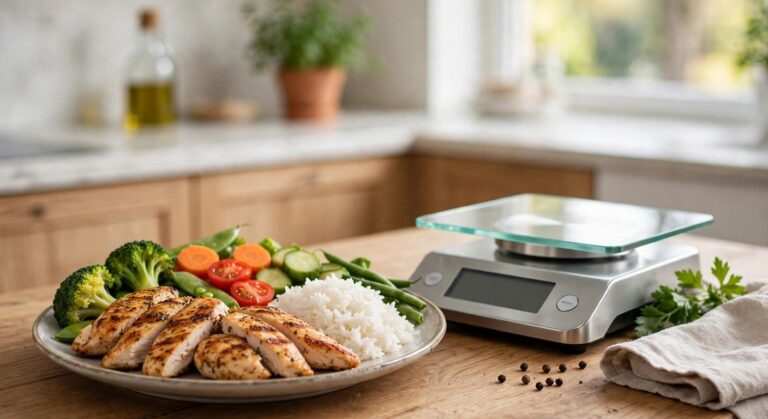
Weighing helps most for calorie-dense foods: meat, grains, oils, nuts, cheese, and butter. A kitchen scale removes the biggest source of tracking error, which is portion size. Vegetables, leafy greens, and broth-based foods can be estimated without much cost. You do not need to weigh everything forever. Weighing a food once calibrates your eye for every future portion of it.
What Are the Most Common Mistakes When Finding Calories in Food?
- Trusting the serving size without reading it. A bag that looks like one serving often lists two or three. Always multiply by the servings you actually eat.
- Logging dry weight as cooked, or cooked as dry. This is the biggest single error, and it can swing a meal by hundreds of calories. Match the database entry to the food as eaten.
- Forgetting cooking oil and butter. Oil used in the pan is part of the meal. One tablespoon adds about 119 calories, and most home cooking uses more than one.
- Trusting front-of-package claims. “Light”, “low fat”, and “only 100 calories” describe one serving under one definition. The Nutrition Facts panel is the number to use.
- Copying user-generated app entries. Many apps let users add foods, and those entries carry typos, wrong portions, and fantasy numbers. Prefer entries marked as USDA or verified, and cross-check anything that looks too good.
- Ignoring drinks, sauces, and tastes. A sauce, a sweet drink, and a few tastes while cooking can add 200 to 400 calories to a day that otherwise looks perfect on paper.
- Treating every number as exact. Labels carry a legal tolerance, databases describe representative samples, and restaurant numbers describe standard servings. Your total for calories in food is an estimate. Consistency matters more than false precision. If your weight trend disagrees with your log over two to four weeks, trust the trend and adjust.
Frequently Asked Questions
How do I find calories in food without a label?
Start with the USDA FoodData Central database, which lists calories in food per 100 g for whole foods and ingredients. Scale the value to your portion by multiplying by your portion weight divided by 100. If you cannot weigh the food, use the hand method: a palm of meat, a fist of grains or vegetables, and a thumb of oil or dressing. Round up when unsure.
How do you calculate calories in food from a label?
Read the calories line, then multiply by the number of servings you eat. If the label lists 260 calories per serving and 2 servings per container and you eat the whole container, the total is 260 x 2 = 520. You can also check the math from the macros: protein grams x 4, plus carb grams x 4, plus fat grams x 9, plus alcohol grams x 7.
Are calories in food on labels accurate?
Close, but not exact. FDA rules let actual calories run up to 20 percent above the declared value, so a 200 calorie bar could legally contain up to 240. Foods with fewer than 5 calories per serving may be labeled as 0. Treat label numbers as good estimates, stay consistent in how you log, and judge your plan by your weight trend over weeks, not by single-digit precision.
How many calories are in food at a restaurant?
Chain restaurants with 20 or more locations must post calories on menus in the US, and most large chains publish full nutrition pages online. Independent restaurants usually publish nothing. In that case, find a similar dish at a chain, then add a 20 percent buffer for generous portions and hidden oil, butter, and cheese. Ask for dressings and sauces on the side so you control the amount.
Do I count calories in drinks?
Yes. Drinks carry real calories that rarely feel like food. A 12 oz can of cola has about 140 calories. Juice, sweetened tea, smoothies, and alcohol all count. Water, plain tea, and black coffee carry effectively none. If you drink sweetened or alcoholic drinks regularly, logging them is one of the fastest accuracy wins in calorie tracking.