Fiber Intake: How Much You Need, Best Sources, and How to Increase It
Your fiber intake is one of the simplest numbers in nutrition, and one of the most commonly missed. Fiber intake means the total grams of dietary fiber you eat in a day, from food and, if you use them, supplements. It matters for digestion, fullness, blood sugar, cholesterol, and gut health, yet most adults eat only about half of what they need.
The gap is striking. According to the Dietary Guidelines for Americans, 90 percent of women and 97 percent of men do not meet the recommended fiber intake. The average American eats only about 15 to 16 grams of fiber a day, while most adults need 25 to 34 grams. Closing that gap does not require a special diet or expensive products. It requires knowing your target, knowing which foods actually deliver fiber, and increasing your fiber intake gradually so your gut can adjust.
This guide covers all three. You will learn your daily fiber intake target by age and sex, the difference between soluble and insoluble fiber, the best food sources with grams per serving, a gradual plan to raise your fiber intake without bloating, what fiber does for weight loss and blood sugar, what happens when intake is too low or too high, and a full sample day with every gram added up.
What Is Fiber Intake?
Fiber intake is the amount of dietary fiber you consume in a day, measured in grams. Dietary fiber is the part of plant foods your body cannot digest. Unlike protein, fat, and digestible carbohydrate, fiber passes through your digestive system largely intact, and that is exactly why it is useful.
Fiber comes only from plants. Fruits, vegetables, whole grains, legumes, nuts, and seeds contain it. Meat, fish, eggs, and dairy contain essentially none. So your fiber intake is really a measure of how much plant food you eat, and how much of it is whole rather than refined.
One point that confuses many people: fiber is a carbohydrate, but it does not behave like other carbohydrates. Your body cannot break it down into glucose, so it does not raise blood sugar the way starch and sugar do. That is also why fiber is subtracted when people calculate net carbs, which our guide to net carbs explains in full.
Fiber intake is usually discussed as a daily total, not a per-meal number. But it helps to think in meals too. If your target is 30 grams a day, that is roughly 10 grams per meal across three meals, or 7 to 8 grams per meal if you also eat a snack. Spreading fiber across the day is easier on digestion than loading it all into one giant salad.
Is Fiber Intake the Same as Net Carbs?
No. Fiber intake is the grams of fiber you eat. Net carbs are total carbohydrates minus fiber (and, in some counting methods, minus sugar alcohols). Fiber is already counted inside total carbohydrate grams on a label, so you do not add it on top. Subtracting it gives net carbs, which is the figure low-carb diets use to estimate the carbs that affect blood sugar. Our guide to net carbs explains the calculation with worked examples.
How Much Fiber Intake Do You Need Each Day?
Your fiber intake target depends on your age, sex, and how many calories you eat. The Dietary Guidelines for Americans, 2020 to 2025, set the official targets, and they follow a simple rule underneath: about 14 grams of fiber for every 1,000 calories you eat.
Here are the daily fiber intake targets by age and sex:
| Age group | Women | Men |
|---|---|---|
| 2 to 3 years | 14 g | 14 g |
| 4 to 8 years | 17 g | 20 g |
| 9 to 13 years | 22 g | 25 g |
| 14 to 18 years | 25 g | 31 g |
| 19 to 30 years | 28 g | 34 g |
| 31 to 50 years | 25 g | 31 g |
| 51 years and older | 22 g | 28 g |
You can read the full guidance in the Dietary Guidelines for Americans.
The 14 grams per 1,000 calories rule lets you personalize the table. Multiply your daily calories by 14 and divide by 1,000:
- 1,800 calories a day: 1,800 x 14 / 1,000 = 25.2, so about 25 grams.
- 2,000 calories a day: 2,000 x 14 / 1,000 = 28 grams.
- 2,500 calories a day: 2,500 x 14 / 1,000 = 35 grams.
That is why two people can have different targets even at the same age. A smaller, less active person eating 1,800 calories needs about 25 grams, while a larger, very active person eating 2,500 calories needs about 35 grams. If you do not know your calorie target yet, our guide on how to calculate TDEE walks through it.
Children need fiber too, but their targets are lower and scale with age, as the table shows. For children under 2, doctors use different guidance, so follow your pediatrician rather than this table.
A practical shortcut: if you do not want to count precisely, aim for at least 25 grams a day if you are a woman and at least 30 grams a day if you are a man. Those round numbers sit close to the official targets for most adults, and they are far above the 15 to 16 grams most people currently eat.
What Is the Difference Between Soluble and Insoluble Fiber?
Your total fiber intake is made of two types, and they do different jobs. Most plant foods contain both, in different proportions.
Soluble fiber dissolves in water and forms a gel in your gut. That gel slows digestion, which steadies blood sugar after meals and helps you feel full longer. It also binds to cholesterol-rich bile acids and carries them out of the body, which is how soluble fiber helps lower LDL cholesterol. Good sources include oats, barley, beans, lentils, apples, pears, carrots, chia seeds, and flaxseed. The soluble fiber in oats, called beta-glucan, is the most studied of all for cholesterol.
Insoluble fiber does not dissolve in water. It adds bulk to stool and speeds its movement through the colon, which prevents constipation and keeps bowel movements regular. Good sources include whole wheat, wheat bran, brown rice, nuts, seeds, skins of fruits and vegetables, and many vegetables such as green beans and cauliflower.
Most foods contain both types, but they lean one way or the other. Foods that lean soluble include oats, barley, beans, lentils, apples, pears, carrots, and chia seeds. Foods that lean insoluble include whole wheat, wheat bran, brown rice, nuts, seeds, and the skins of fruits and vegetables. A food such as broccoli contains a meaningful amount of both.
There is no official target for each type separately. A commonly cited balance is roughly 25 to 30 percent soluble and 70 to 75 percent insoluble. For a 30 gram day, that works out to about 8 to 10 grams of soluble fiber and 20 to 22 grams of insoluble fiber. Check: 30 x 0.25 = 7.5, rounded to about 8, and 30 x 0.75 = 22.5, rounded to about 22. You do not need to count the two types precisely. A varied diet with legumes, oats, fruit, vegetables, and whole grains hits the balance on its own.
One more type worth knowing: fermentable fiber. Some soluble fibers are fermented by gut bacteria into short-chain fatty acids, which feed the cells lining your colon and support gut health. Beans, oats, and many fruits are rich in fermentable fiber, which is one more reason a varied fiber intake beats a single supplement.
What Are the Best Sources of Fiber Intake?
Legumes win by a wide margin, then whole grains, fruits, vegetables, nuts, and seeds. The table below uses USDA-based values per serving. Brands and cooking methods shift individual numbers slightly, so treat these as anchors.
| Food | Serving | Fiber |
|---|---|---|
| Lentils, cooked | 1 cup | 16 g |
| Black beans, cooked | 1 cup | 15 g |
| Split peas, cooked | 1 cup | 16 g |
| Chickpeas, cooked | 1 cup | 12 g |
| Edamame | 1 cup | 8 g |
| Raspberries | 1 cup | 8 g |
| Avocado | 1 medium | 10 g |
| Chia seeds | 1 oz | 10 g |
| Pear | 1 medium | 6 g |
| Broccoli, cooked | 1 cup | 5 g |
| Quinoa, cooked | 1 cup | 5 g |
| Apple with skin | 1 medium | 4 g |
| Sweet potato | 1 medium | 4 g |
| Oatmeal, cooked | 1 cup | 4 g |
| Brown rice, cooked | 1 cup | 4 g |
| Banana | 1 medium | 3 g |
| Almonds | 1 oz | 4 g |
| Whole wheat bread | 1 slice | 2 g |
| Popcorn, air popped | 3 cups | 4 g |
| Carrots, raw | 1 cup | 4 g |
A few patterns in this table are worth noticing. First, one cup of lentils or beans delivers more than half of most adults’ daily fiber intake target. That is why a single legume-based meal is the fastest way to fix a low fiber intake. Second, fruit with skin beats fruit without it: an apple with skin has about 4 grams, while peeled apple has far less. Third, whole grains beat refined ones by a lot: brown rice has about 4 grams per cup while white rice has under 1 gram.
When you shop, use the label. A bread or cereal that lists at least 3 grams of fiber per serving is a genuinely high-fiber choice. Many products marketed as “wheat” or “multigrain” are made mostly from refined flour and carry only 1 gram per slice. Our guide on how to find calories in food explains how to read labels, and the same skill applies to the fiber line.
How Can You Increase Your Fiber Intake Without Bloating?
This is the question real people ask most often, and it is where most fiber advice fails. The advice “eat more fiber” is correct but incomplete, because jumping from 15 grams to 35 grams overnight almost guarantees gas, bloating, and cramps. Your gut bacteria need time to adjust to the extra fermentable fiber.
The fix is simple: increase gradually, and drink water alongside.
The 3-week gradual plan
Suppose you currently eat about 15 grams of fiber a day and your target is 30 grams. That is a gap of 15 grams. Spread it over three weeks, adding 5 grams per week:
Week 1: 15 + 5 = 20 grams a day. Add one high-fiber food, such as a cup of berries or a serving of oats.
Week 2: 20 + 5 = 25 grams a day. Add a second food, such as beans at lunch or an apple with skin.
Week 3: 25 + 5 = 30 grams a day. Add a third food, such as a serving of lentils or whole wheat bread swaps.
By week 3 you are at your target, and most people find the bloating has faded by then. Expect some gas in the first 1 to 2 weeks of any significant increase. That is normal and temporary, not a sign that fiber disagrees with you.
Water matters as much as fiber
Fiber absorbs water. If you raise your fiber intake without raising fluids, stool can become hard and bulky, and constipation can get worse instead of better. Aim for roughly 2 liters of fluids a day as a baseline, and more if you are active or in hot weather. Water, tea, and other unsweetened drinks all count. You do not need to force huge amounts, but a high-fiber diet with too little water is a common cause of the very constipation people are trying to fix.
Cooked beats raw at first
Raw cruciferous vegetables such as broccoli, cauliflower, and cabbage cause the most gas. Cooking softens their fiber and makes it easier to ferment gently. If beans bloat you, start with lentils and split peas, which are usually easier to tolerate, rinse canned beans well, and build up the portion slowly. Soaking dry beans overnight and cooking them thoroughly also helps.
Spread it across the day
A day with 5 grams at breakfast, 20 grams at lunch, and 5 grams at dinner will bloat you more than a day with 10 grams at each meal. Aim for roughly even fiber across meals, and keep snacks fiber-rich rather than fiber-free, so no single meal carries the whole load.
How Does Fiber Intake Help Weight Loss, Blood Sugar, and Gut Health?
Fiber intake helps weight loss through fullness, not through magic. High-fiber foods add bulk and volume to meals for very few calories, they slow stomach emptying, and soluble fiber triggers satiety signals in the gut. People who eat more fiber tend to eat less at the next meal without trying. That is why fiber is a core part of any sensible weight-loss plan, and why our guide on how to calculate macros treats fiber-rich carbs as the default carb source.
For blood sugar, soluble fiber is the key player. By forming a gel and slowing carbohydrate digestion, it blunts the blood sugar spike after a meal. Over weeks and months, a higher fiber intake is associated with better insulin sensitivity and a lower risk of type 2 diabetes. This effect is strongest from whole foods, because the fiber comes packaged with the meal it is slowing down.
For cholesterol and heart health, soluble fiber binds bile acids in the gut and removes them, which forces the liver to pull LDL cholesterol from the blood to make more bile. Oats and barley are the best studied for this effect, thanks to their beta-glucan content. A daily bowl of oatmeal is one of the cheapest cholesterol-lowering habits available.
For gut health, fiber feeds your microbiome. Gut bacteria ferment soluble and fermentable fibers into short-chain fatty acids, which nourish colon cells and support the gut barrier. Insoluble fiber keeps transit moving, which reduces the time waste spends in contact with the colon wall. Together, they are linked to lower rates of constipation, diverticular disease, and colorectal cancer in population studies.
One honest note: fiber is not a substitute for medical care. If you have high cholesterol, diabetes, or a digestive condition, fiber helps alongside treatment, not instead of it. And if you have a condition such as inflammatory bowel disease or a gut motility disorder, talk to your doctor before a big fiber increase, because the right type and amount differ by condition.
What Happens If Your Fiber Intake Is Too Low or Too High?
Too little fiber intake is the common problem. The short-term result is constipation, hard stools, and straining. Over years, a low fiber intake is associated with higher rates of heart disease, type 2 diabetes, diverticular disease, and colorectal cancer, and with weight gain, because low-fiber meals are less filling per calorie. Since 90 percent of women and 97 percent of men fall short, this is not a rare problem. It is the normal state of the modern diet, and it is fixable with food.
Too much fiber intake is rarer, and it usually comes from supplements or a sudden jump, not from food alone. Very high intakes, roughly above 50 to 70 grams a day, can cause gas, bloating, cramps, and diarrhea, and can interfere with the absorption of minerals such as iron, zinc, and calcium if sustained. Extremely high fiber with too little water can also cause constipation or, rarely, a blockage, especially in people with narrowed intestines.
The practical range is therefore wide and forgiving. Anywhere from your official target up to about 40 grams a day from food is comfortable for most adults. Above 50 grams, ask whether you need it and whether you are drinking enough water. There is no prize for the highest fiber intake, only for a consistent, comfortable one.
Can You Eat Too Much Fiber?
Yes, but it is uncommon from food alone. Very high fiber intake, roughly above 50 to 70 grams a day, can cause gas, bloating, cramps, and diarrhea, and over time can reduce absorption of minerals such as iron, zinc, and calcium. It usually happens with large supplement doses or a sudden jump from a low intake. The comfortable range for most adults is their official target up to about 40 grams a day from food, with enough water. If you take fiber supplements, start small and drink a full glass of water with each dose.
What Does a High-Fiber Day Look Like?
Here is a full day built for a fiber intake of about 33 grams, using only ordinary foods. Every gram is shown so you can check the math.
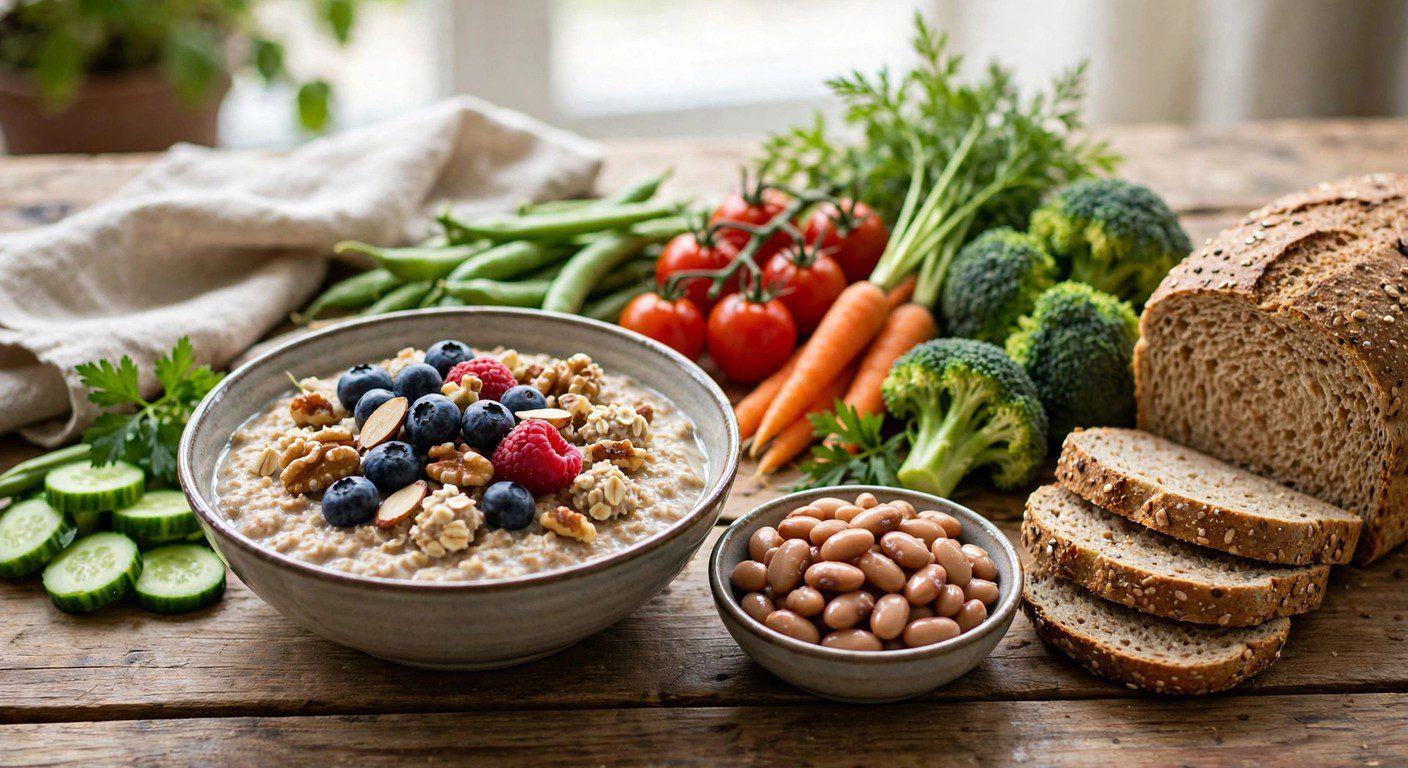
Breakfast: oatmeal with raspberries. 1 cup cooked oatmeal (4 g) + 1 cup raspberries (8 g) = 12 g.
Lunch: lentil soup with whole wheat bread. Half a cup of cooked lentils (8 g, since a full cup is 16 g, half is 16 / 2 = 8 g) + 2 slices whole wheat bread (2 x 2 g = 4 g) = 12 g.
Dinner: broccoli and sweet potato. 1 cup cooked broccoli (5 g) + 1 medium sweet potato (4 g) = 9 g.
Day total: 12 + 12 + 9 = 33 grams.
That is above the 25 gram target for a woman aged 31 to 50 and just above the 31 gram target for a man of the same age. Add a snack of one medium apple with skin (4 g) and the day reaches 33 + 4 = 37 grams, comfortably in the high-fiber range without any supplement.
Notice the structure. One legume serving does most of the work at lunch, fruit and oats carry breakfast, and vegetables carry dinner. No specialty products, no powders, no complicated recipes. If you eat a legume at one meal, fruit at another, and vegetables at dinner, you will land near your target almost automatically.
What Are the Most Common Fiber Intake Mistakes?
- Jumping too fast. Going from 15 grams to 35 grams overnight causes gas and bloating, and many people quit fiber entirely because of one bad week. Add 5 grams per week, as in the plan above.
- Raising fiber without water. Fiber needs fluid to do its job. A high-fiber diet with too little water can make constipation worse. Drink roughly 2 liters of fluids a day, more when active.
- Counting only supplements. A fiber powder adds grams, but it does not add the vitamins, minerals, and plant compounds that come with whole foods. Supplements are a top-up tool, not a replacement for food.
- Trusting “wheat” and “multigrain” labels. Many of these products are mostly refined flour with about 1 gram of fiber per slice. Check the fiber line on the label and look for at least 3 grams per serving, and for whole wheat or whole grain as the first ingredient.
- Peeling fruit and vegetables. Much of the fiber sits in or just under the skin. An apple with skin has about 4 grams, a peeled apple far less. Wash produce well and keep the skin when it is edible.
- Choosing juice over whole fruit. Juice removes almost all the fiber. An orange has about 3 grams of fiber, while a glass of orange juice has almost none, plus the sugar of several oranges. Eat the fruit.
- Forgetting that fiber is part of carbs. When you track macros, fiber grams are already inside your total carbohydrate grams. You do not add them on top. That is also why subtracting fiber gives net carbs, as explained in our guide to net carbs.
- Giving up after one gassy week. Gas in the first 1 to 2 weeks of a fiber increase is your gut bacteria adjusting, not a verdict on fiber. If you increase gradually and drink water, it usually settles by week 3 or 4.
Should You Take a Fiber Supplement?
Food first, supplement second. Whole foods deliver fiber plus vitamins, minerals, antioxidants, and the variety of fiber types your gut bacteria need. No powder replicates that package.
Supplements have a place as a top-up. Psyllium husk is the best studied: it is a soluble fiber that helps constipation and lowers LDL cholesterol, and it is the active ingredient in most well-known fiber powders. A typical dose adds about 3 to 7 grams of fiber, depending on the product, which can close a small gap.
Follow the same rules as with food. Start with a small dose, increase slowly, drink a full glass of water with each dose, and take it at a different time from medications, because fiber can slow their absorption. If you have a digestive condition, swallowing difficulties, or take regular medication, check with your doctor or pharmacist first.
If your fiber intake from food is already at target, you do not need a supplement. Spend the money on lentils, oats, and berries instead.
Should I Take a Fiber Supplement or Get Fiber from Food?
Food first. Whole foods give you fiber plus vitamins, minerals, antioxidants, and a mix of soluble and insoluble types that no single powder matches. A supplement such as psyllium husk is a reasonable top-up if your food intake falls short, adding about 3 to 7 grams per dose, but start small, drink water with it, and keep it away from medication times. If your food already meets your daily target, you do not need a supplement.
Frequently Asked Questions
How much fiber intake do I need per day?
Most adults need 25 to 34 grams of fiber intake per day, depending on age, sex, and calories. The Dietary Guidelines for Americans set 28 grams for women aged 19 to 30, 25 grams for women aged 31 to 50, and 22 grams for women aged 51 and older, and 34 grams, 31 grams, and 28 grams for men in the same age bands. The underlying rule is about 14 grams per 1,000 calories, so a 2,000 calorie diet points to 28 grams. A simple shortcut is at least 25 grams a day for women and at least 30 grams a day for men.
What is the difference between soluble and insoluble fiber intake?
Soluble fiber dissolves in water and forms a gel that slows digestion, steadies blood sugar, and helps lower LDL cholesterol. Good sources are oats, beans, lentils, apples, and chia seeds. Insoluble fiber does not dissolve in water. It adds bulk to stool and speeds movement through the colon, which prevents constipation. Good sources are whole wheat, bran, brown rice, nuts, and vegetable skins. Most foods contain both, and a varied diet with legumes, oats, fruit, vegetables, and whole grains covers both types without counting them separately.
How can I increase my fiber intake without bloating?
Increase gradually and drink water. Add about 5 grams per week until you reach your target, rather than jumping from 15 grams to 30 grams overnight. For example, go from 15 grams to 20 grams in week 1, 25 grams in week 2, and 30 grams in week 3. Drink roughly 2 liters of fluids a day, spread fiber across meals instead of loading it into one meal, and favor cooked vegetables and lentils at first, since raw cruciferous vegetables and large bean portions cause the most gas. Expect some gas in the first 1 to 2 weeks. It usually settles by week 3 or 4.
What foods have the most fiber intake per serving?
Legumes lead by far. One cup of cooked lentils has about 16 grams of fiber, black beans about 15 grams, split peas about 16 grams, and chickpeas about 12 grams. Other strong sources are raspberries at 8 grams per cup, avocado at 10 grams for a medium fruit, chia seeds at 10 grams per ounce, broccoli at 5 grams per cooked cup, and oatmeal at 4 grams per cooked cup. One legume-based meal alone can deliver more than half of most adults’ daily target.
Does fiber intake help with weight loss?
Yes, mainly through fullness. High-fiber foods add bulk and volume for few calories, slow stomach emptying, and trigger satiety signals, so people tend to eat less at the next meal without trying. Fiber does not burn fat directly, and it does not cancel out a calorie surplus. But as part of a calorie-controlled diet with enough protein, a higher fiber intake makes the diet easier to stick to, which is why it shows up in nearly every successful weight-loss eating pattern.