Weight Loss Percentage: How to Calculate It and What a Healthy Rate Looks Like
Weight loss percentage is the fairest single number for describing your progress, because it measures what you lost against where you started. Ten pounds sounds impressive on its own, but it means something different for a person who started at 180 pounds than for a person who started at 300 pounds. A percentage removes that guesswork and lets you compare your own progress over time, and even compare notes with someone of a completely different size, without the numbers misleading you.
The short answer: weight loss percentage equals your starting weight minus your current weight, divided by your starting weight, multiplied by 100. If you started at 200 pounds and now weigh 180 pounds, you lost 20 pounds, and 20 divided by 200 is 0.10, which is 10 percent. Public health guidance commonly frames 5 to 10 percent of starting weight over about six months as a sensible first goal. The rest of this article shows the steps, more examples, and how to track the number without letting it mislead you.
What Is Weight Loss Percentage?
Weight loss percentage is the share of your starting weight that is gone. It answers a different question than the scale does. The scale tells you how many pounds or kilos you lost. The percentage tells you how big that loss is relative to your body. Both numbers are useful, but only the percentage puts the loss in proportion.
Imagine two friends who each lose 10 pounds. One started at 180 pounds and the other started at 300 pounds. The first friend lost 5.6 percent of starting weight, because 10 divided by 180 is 0.0556, or 5.6 percent. The second friend lost 3.3 percent, because 10 divided by 300 is 0.0333, or 3.3 percent. The scale shows the same 10 pounds for both, yet the first friend made clearly faster relative progress. That is exactly why research studies and clinical guidelines usually report weight change as a percentage rather than as raw pounds.
Weight loss percentage also gives you a cleaner way to set milestones. Instead of picking a round number of pounds that may be easy for one person and very hard for another, you can aim for 5 percent, then 10 percent, and judge each milestone the same way no matter your size. You can also check how to calculate BMI to see where your current weight sits for your height, since BMI and weight loss percentage describe different things and work well side by side.
How Do You Calculate Weight Loss Percentage?
The calculation has three steps, and it takes less than a minute once you have two trustworthy weigh ins.
First, subtract your current weight from your starting weight. This gives the total amount lost. Second, divide that amount by your starting weight, not by your current weight. This is the step people most often get wrong, and it changes the answer. Third, multiply the result by 100 to turn the decimal into a percentage. Round your weight loss percentage to one decimal place for tracking, since more precision than that is just scale noise.
The formula looks like this: weight loss percentage equals starting weight minus current weight, divided by starting weight, multiplied by 100. Use the same unit for both weights, pounds with pounds or kilos with kilos. The unit cancels out in the division, so the percentage comes out the same either way, as long as you never mix units.
Worked example one, in pounds. A person starts at 200 pounds and now weighs 180 pounds. Weight lost is 200 minus 180, which is 20 pounds. Divide 20 by the starting weight of 200 to get 0.10. Multiply by 100 to get 10 percent. This person has reached a 10 percent weight loss percentage.
Worked example two, in kilos. A person starts at 84 kilos and now weighs 78 kilos. Weight lost is 84 minus 78, which is 6 kilos. Divide 6 by the starting weight of 84 to get 0.0714. Multiply by 100 to get 7.14 percent, which rounds to 7.1 percent. Notice that the method is identical in kilos and pounds. Only the unit label changes.
You can also work backwards from a target. Suppose you weigh 240 pounds and want to know what a 5 percent loss looks like as a scale weight. Multiply 240 by 0.95 to get 228 pounds. For a 10 percent loss, multiply 240 by 0.90 to get 216 pounds. In general, your target weight equals your starting weight multiplied by one minus your target percentage as a decimal. The table below shows the same milestones for a 200 pound starting weight.
| Milestone | Calculation | Target weight |
| 5 percent loss | 200 multiplied by 0.95 | 190 pounds |
| 10 percent loss | 200 multiplied by 0.90 | 180 pounds |
| 15 percent loss | 200 multiplied by 0.85 | 170 pounds |
| 20 percent loss | 200 multiplied by 0.80 | 160 pounds |
Can Weight Loss Percentage Be Negative?
Yes. If your current weight is above your starting weight, the formula gives a negative number, which simply describes a net gain from that starting point. For example, starting at 180 pounds and now weighing 185 pounds gives negative 5 divided by 180, which is negative 2.8 percent. It is a description of change, not a judgment about your health.
What Weight Loss Percentage Counts as Meaningful?
A small percentage can still matter a great deal, and this surprises many people. The 2013 American Heart Association, American College of Cardiology, and The Obesity Society guideline describes sustained weight loss of 3 to 5 percent as likely to produce clinically meaningful improvements in measures such as triglycerides, blood glucose, and hemoglobin A1c, along with a lower risk of developing type 2 diabetes. In plain terms, “clinically meaningful” means the change is big enough to show up in health markers, not just on the scale.
The commonly cited first goal goes one step further. Public health guidance from the National Institute of Diabetes and Digestive and Kidney Diseases frames an initial goal of 5 to 10 percent of starting weight within about six months. For a 200 pound person, that means 10 to 20 pounds. For a 150 pound person, it means 7.5 to 15 pounds. The range exists because a percentage goal adapts to body size in a way that a fixed pound goal never can.
It helps to read these numbers as a first milestone rather than a finish line. Reaching a 5 percent weight loss percentage is a real achievement with real health relevance, and it also sets up the next milestone cleanly. If your starting weight is already in a healthy range, these bands are best treated as descriptions of a loss rather than targets to chase. Anyone with a medical condition, anyone taking medication that affects weight, and anyone who has lost weight without trying should talk with a clinician about what range, if any, makes sense for them.
How Fast Should Your Weight Loss Percentage Rise Each Week?
Pace matters as much as the total, because a pace you can repeat beats a pace that burns you out. The Centers for Disease Control and Prevention describes gradual, steady loss of about 1 to 2 pounds a week as more likely to be kept off than faster loss, and warns that unrealistic goals such as losing 20 pounds in 2 weeks can leave you feeling defeated and frustrated. You can read that guidance in full on the CDC page about steps for losing weight.
Translated into weight loss percentage terms, the same weekly pound range means different things at different sizes. One percent of body weight per week is 2.5 pounds for a 250 pound person but only 1.5 pounds for a 150 pound person. That is one reason a fixed weekly pound target can feel moderate for one person and aggressive for another. Judging your weekly pace as a percentage of your own starting weight keeps the comparison honest.
Early weeks often look faster than later weeks, and that is normal. The first drop usually includes water weight as stored carbohydrate is used up, so the scale can move several pounds before fat loss settles into its steadier rhythm. Do not mistake that early drop for your long term pace, and do not panic when the pace slows. A steady average across four weeks tells you far more than any single week does.
As a rough planning frame, losing 5 percent over about three to six months works out to roughly 0.2 to 0.4 percent per week on average, which for a 200 pound person is about 0.4 to 0.8 pounds a week. That is slower than the headline 1 to 2 pounds a week, and the difference is deliberate. The six month window leaves room for holidays, illness, plateaus, and ordinary life. A plan with slack in it is a plan you can actually finish.
Why Is Weight Loss Percentage Better Than Kilos Alone?
Raw kilos or pounds hide the context that makes a loss meaningful. Weight loss percentage restores that context in one number, and it does so in three practical ways.
First, it makes progress comparable between people. A support group, a coach, or a research study can talk about a 10 percent loss and everyone understands the scale of the achievement, regardless of whether members started at 160 pounds or 260 pounds. A 10 pound loss cannot do that, because it means 6.3 percent at 160 pounds and only 3.8 percent at 260 pounds. Check the arithmetic: 10 divided by 160 is 0.0625, or 6.3 percent rounded, and 10 divided by 260 is 0.0385, or 3.8 percent rounded.
Second, it makes your own milestones fair across your journey. Early losses usually come faster, and later losses usually come slower as your body gets smaller. A percentage milestone such as 5 percent, then 10 percent, stays proportional the whole way. A fixed pound milestone gets harder in relative terms as you go, which can feel like failure even when you are still progressing well.
Third, it keeps goal setting honest. Saying “I want to lose 30 pounds” sounds specific, but without a starting weight it is impossible to judge whether that is modest or extreme. Saying “I want to lose 10 percent” states the ambition relative to your body from the start. That clarity helps you pick a timeline that fits, rather than a timeline borrowed from someone else.
None of this means the percentage tells the whole story. It counts every pound lost together, whether that pound was fat, muscle, water, or gut content. It cannot tell you what changed inside your body. That limitation leads directly to the most common confusion about this number, which the next section clears up.
Is Weight Loss Percentage the Same as Body Fat Percentage?
No, and mixing these two up is probably the most common misunderstanding in weight tracking. Weight loss percentage measures how much of your total starting weight is gone. Body fat percentage measures how much of your current body is fat. They sound similar, and both use the percent sign, but they describe different things.
Here is a concrete example. Suppose you start at 200 pounds with 30 percent body fat, which means about 60 pounds of fat. You lose 20 pounds and reach 180 pounds, a 10 percent weight loss percentage. If all 20 pounds lost were fat, your fat would fall to 40 pounds out of 180, which is 22.2 percent body fat. If instead half the loss were fat and half were muscle and water, your fat would be 50 pounds out of 180, which is 27.8 percent body fat. Same 10 percent weight loss percentage, very different body fat outcomes. The weight loss percentage alone cannot tell you which version happened.
This confusion shows up in real questions people ask online. One person loses 3 pounds in 9 days but finds only a small part of it was fat, and worries the rest came from muscle. Another watches body fat percentage rise on a smart scale even as weight falls. Both cases usually come down to the same facts: the scale measures total weight, not composition, and single readings swing with water, food, and timing. Weighing at the same time of day, and judging trends across weeks rather than single days, removes most of that noise.
If you want the fat share itself, you need a body composition method, not just a scale. Our guide on how to calculate body fat walks through the common methods, from Navy tape measurements to skinfold estimates, and explains what each one can and cannot show. Use weight loss percentage to track how far you have come overall, and use a body fat estimate to check what kind of progress it was. Together they give a fuller picture than either one alone.
Does Weight Loss Percentage Show Fat Loss?
Not directly. It shows total weight change, which combines fat, muscle, water, and gut content. Two people with the same weight loss percentage can have very different fat loss, depending on their eating, protein intake, and activity. Pair the percentage with waist measurements or a body fat estimate if you want to know what kind of loss it was.
What Mistakes Give You the Wrong Weight Loss Percentage?
Four mistakes account for almost every wrong weight loss percentage, and all four are easy to fix once you see them.
The first mistake is dividing by the wrong weight. Some people divide the amount lost by their current weight instead of their starting weight. Take the 200 to 180 example again. Dividing 20 by the current weight of 180 gives 0.1111, or 11.1 percent, which overstates the loss. Dividing 20 by the starting weight of 200 gives the correct 10 percent. Always divide by where you started.
The second mistake is mixing units. A starting weight in pounds and a current weight in kilos, or a starting weight in kilos and a current weight in pounds, produces nonsense. Convert one reading so both use the same unit before you subtract. If you switched scales and one reads in different units, convert first and calculate second.
The third mistake is using a shaky starting weight. A single weigh in after a big meal, a salty weekend, or a change of scale can be several pounds off your true baseline. If your starting weight is wrong, every percentage you calculate from it is wrong too. Take two or three morning readings across a week, average them, and use that average as your starting weight.
The fourth mistake is reading too much into daily movement. Body weight can swing a few pounds within a day from food, drink, bathroom use, and water retention. A daily percentage that jumps up and down is mostly measuring those swings. Weigh daily if you like the habit, but judge the trend from weekly averages, and recalculate your weight loss percentage monthly rather than daily.
One more trap is worth naming: chasing the percentage at any cost. Crash diets and extreme restriction can push the number up fast while costing muscle, energy, and long term maintenance. A percentage that rises steadily on a plan you can live with is worth far more than a percentage that spikes on a plan you abandon.
How Do You Track Your Weight Loss Percentage Week by Week?
A simple tracking plan beats a complicated one, because the plan you follow is the plan that works. Set it up once, then let routine do the rest.
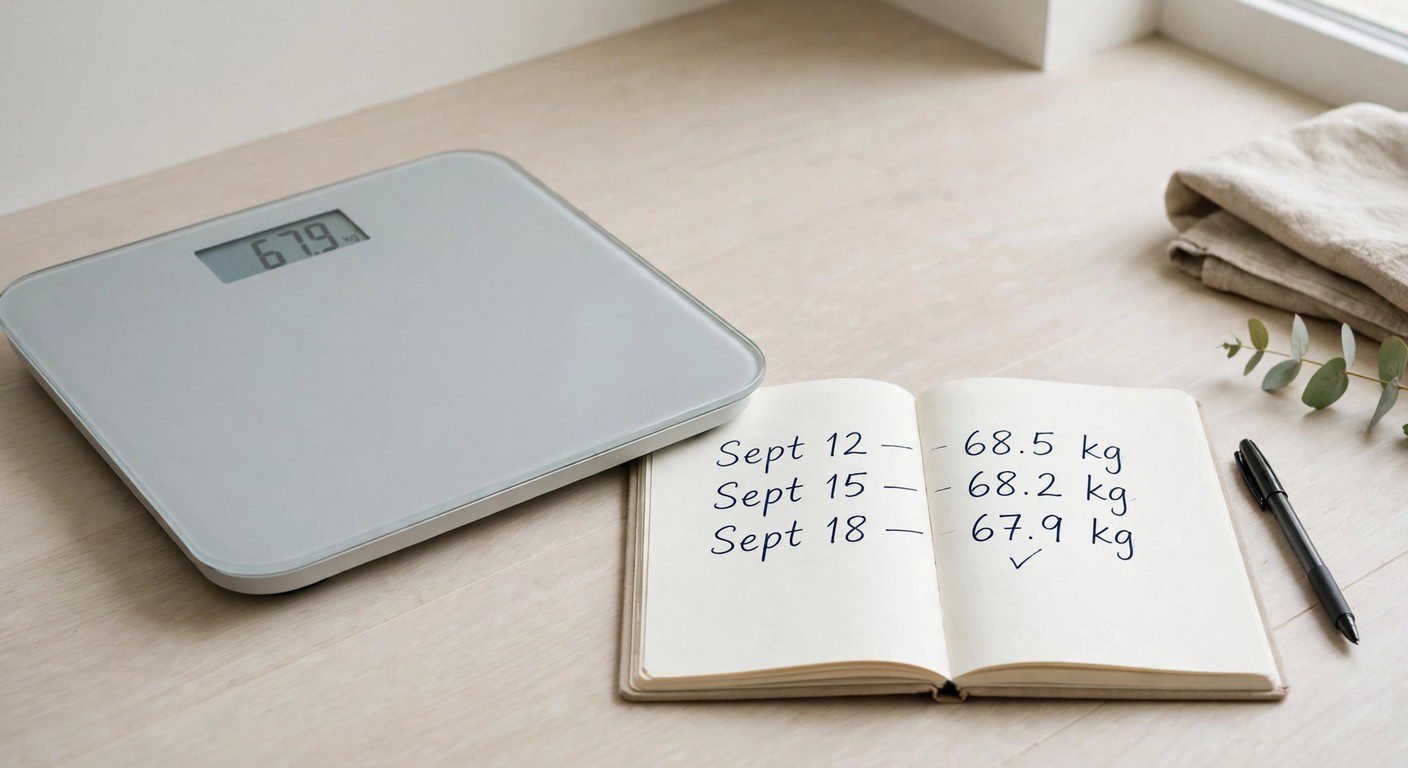
Weigh yourself at the same time, on the same scale, in similar clothing. First thing in the morning, after using the bathroom and before eating, is the most consistent slot for most people. Record the number daily if that motivates you, but calculate your weekly average every Sunday and use that average as the week’s official weight. A weekly average smooths out water swings that would otherwise dominate the story.
Recalculate your weight loss percentage once a month from the monthly average, not from a single day. The table below shows what that looks like for a 200 pound starter losing about a pound a week on average.
| Check in | Average weight | Total lost | Weight loss percentage |
| Start | 200 pounds | 0 pounds | 0 percent |
| Week 4 | 196 pounds | 4 pounds | 2.0 percent |
| Week 8 | 192 pounds | 8 pounds | 4.0 percent |
| Week 12 | 188 pounds | 12 pounds | 6.0 percent |
Check the arithmetic: 4 divided by 200 is 0.02, or 2.0 percent; 8 divided by 200 is 0.04, or 4.0 percent; 12 divided by 200 is 0.06, or 6.0 percent. Notice how the monthly rhythm makes progress visible even in weeks when the daily scale barely moves.
Pair the percentage with two supporting habits. First, set your eating plan around a realistic target, and our guide on how to calculate macros shows how to turn a calorie target into daily protein, carbohydrate, and fat grams. Second, plan the phase after the loss, because keeping weight off is its own skill, and our maintenance calories guide explains how to find the intake that holds your new weight steady. Add a waist measurement once a month and a short note about energy and sleep, and you have a tracking system that captures health, not just weight.
Review the plan every four weeks. If your weight loss percentage is rising steadily and you feel well, keep going. If it has stalled for a full month, look first at consistency, sleep, and portion sizes before changing anything drastic. If the number is falling because of illness, appetite loss, or medication changes, talk with a clinician rather than celebrating the drop. Context always beats a single number.
How Often Should I Recalculate My Weight Loss Percentage?
Weigh at a consistent time, average each week, and recalculate the percentage once a month from the monthly average. Daily recalculation mostly shows water and food swings rather than real progress. A monthly rhythm makes trends visible and keeps a single odd reading from distorting the picture.
What Should You Do After You Hit Your First Percentage Goal?
Hitting 5 percent, or 10 percent, deserves a pause, not just a new target. Take a week to consolidate. Keep weighing, keep the habits that got you there, and notice what actually worked. Many people find that the habits matter more than the milestone, because the habits are what keep the result.
Then choose the next step deliberately. Some people set a second percentage milestone, such as moving from 5 percent to 10 percent. Others switch focus to strength, fitness, or maintenance for a few months before deciding. Both are reasonable. What matters is that the next goal is chosen, not drifted into, and that it still fits your health and your life.
If you have reached a weight you are happy with, the job changes from losing to maintaining. That phase has its own percentage logic: a small regain of 1 to 2 percent is normal fluctuation, while a sustained climb back toward your starting weight is a signal to revisit the plan early, while the correction is still small. Catching a 3 percent regain is far easier than catching a 15 percent regain, which is one more reason monthly tracking is worth keeping after the loss phase ends.
Finally, keep perspective on what the number can and cannot say. A weight loss percentage records how much of your starting weight is gone. It does not record your strength, your fitness, your sleep, or your health markers. Celebrate the weight loss percentage, by all means, and also celebrate the habits and the health changes behind it. Those are the parts that last.
How do I calculate weight loss percentage?
Subtract your current weight from your starting weight, divide the result by your starting weight, and multiply by 100. For example, starting at 200 pounds and now weighing 180 pounds gives 20 pounds lost, and 20 divided by 200 is 0.10, or 10 percent. Always divide by your starting weight and use the same unit for both weights.
What is a good weight loss percentage?
A good first goal for many adults is 5 to 10 percent of starting weight over about six months, following public health guidance. For a 200 pound person that means 10 to 20 pounds. Smaller losses still matter: sustained loss of 3 to 5 percent is linked with meaningful improvements in blood sugar and cholesterol measures. Your own right target depends on your health, so discuss it with a clinician if you have any medical condition.
Is 10 percent weight loss a lot?
Yes, 10 percent is a substantial achievement. For a 200 pound person it means 20 pounds, and for a 150 pound person it means 15 pounds. It sits at the top of the commonly cited 5 to 10 percent first goal range, and it is associated with meaningful health improvements. It is also a milestone worth consolidating before setting the next goal.
Is weight loss percentage the same as body fat percentage?
No. Weight loss percentage is the share of your starting total weight that is gone. Body fat percentage is the share of your current body that is fat. Losing 10 percent of your weight does not mean your body fat percentage fell by 10 points, because weight loss includes water and sometimes muscle as well as fat. You need a body composition method to measure body fat percentage itself.
Why is my weight loss percentage so small even though I lost several pounds?
Because the percentage divides by your starting weight, so a larger starting weight makes the same pound loss a smaller percentage. Ten pounds is 5.6 percent at 180 pounds but only 3.3 percent at 300 pounds. Judge your progress against your own starting weight and your own timeline, not against someone else’s numbers.