How to Calculate Body Fat Percentage: Your Complete Guide
If you want to learn how to calculate body fat percentage, you probably want one number: how much of your weight is fat. The scale cannot answer that. Two people can weigh exactly the same, and one can be lean and muscular while the other carries far more fat.
You do not need a lab for a useful estimate. A tape measure, calipers, or a smart scale can give you a number you can track. This guide shows you how to calculate body fat percentage with every common method, compares accuracy and cost, and works through the math step by step.
Quick Answer: How to Calculate Body Fat Percentage?
The fastest way to learn how to calculate body fat percentage at home is the US Navy tape method. You need a tape measure, your height, and two minutes.
For men: Body Fat % = 86.010 x log10(waist minus neck) minus 70.041 x log10(height) plus 36.76. For women: Body Fat % = 163.205 x log10(waist plus hip minus neck) minus 97.684 x log10(height) minus 78.387. All measurements go in inches, and log10 means logarithm base 10.
If you do not want to do the math by hand, our body fat percentage calculator runs the same formula for you. Below: how to measure correctly, how calipers compare, and what your number means. The rest of this guide shows how to calculate body fat percentage with calipers, scales, and lab methods too.
What Is Body Fat Percentage, and Why Does It Beat Scale Weight?
Before you learn how to calculate body fat percentage, it helps to know what the number means. It is the share of your total body weight that is fat mass. Everything else is lean mass: muscle, bone, organs, and water. The formula is simple: body fat percentage equals fat mass divided by total body weight, times 100.
Take an 85 kg man at 17.5 percent body fat. His fat mass is 85 times 0.175, which is 14.9 kg. His lean mass is the rest, 70.1 kg. If he loses 5 kg of fat and gains 2 kg of muscle, the scale only shows a 3 kg drop, but his body fat percentage falls from 17.5 to about 12.0 percent. That is the change that matters, and the scale hides it. That is why learning how to calculate body fat percentage matters more than watching the scale.
This is also why body fat percentage beats BMI alone. BMI only uses height and weight, so it cannot tell muscle from fat. If you want the fat mass and lean mass split in kilograms, our lean body mass calculator works it out from your body fat percentage.
Which Method Should You Use to Measure Body Fat?
There is no single best method, only the best one for your budget and patience. The table compares the six most common ways to learn how to calculate body fat percentage.
| Method | What you need | Typical accuracy vs DEXA | Typical cost | Best for |
|---|---|---|---|---|
| Navy tape method | Tape measure | Plus or minus 3 to 4 percent | Free | Beginners at home |
| Skinfold calipers | Calipers | Plus or minus 3 to 4 percent with a trained tester | 10 to 50 dollars | Fitness testing |
| BIA scale | Smart scale | Plus or minus 3 to 8 percent, worse when dehydrated | 20 to 200 dollars | Daily tracking |
| DEXA scan | Clinic visit | Plus or minus 1 to 2 percent | 50 to 150 dollars per scan | Precise baseline |
| Bod Pod | Specialist facility | Plus or minus 2 to 3 percent | 40 to 80 dollars per test | Athletes |
| Hydrostatic weighing | Underwater tank | Plus or minus 1 to 2 percent | 25 to 150 dollars per test | Research |
Two lessons run through the table. Every method is an estimate, even the lab ones. And consistency beats precision: the same method, done the same way, shows your trend even if its absolute number is a few points off. That is why repeating one method is the key to how to calculate body fat percentage for tracking.
How Do You Calculate Body Fat Percentage With the Navy Method?
The Navy method is the classic answer to how to calculate body fat percentage with a tape measure. Developed at the Naval Health Research Center in 1984, it is still used for military body composition checks.
For men: Body Fat % = 86.010 x log10(waist minus neck) minus 70.041 x log10(height) plus 36.76. For women: Body Fat % = 163.205 x log10(waist plus hip minus neck) minus 97.684 x log10(height) minus 78.387. Use inches for every measurement. If you measured in centimeters, divide by 2.54 first.
How to measure for the Navy method
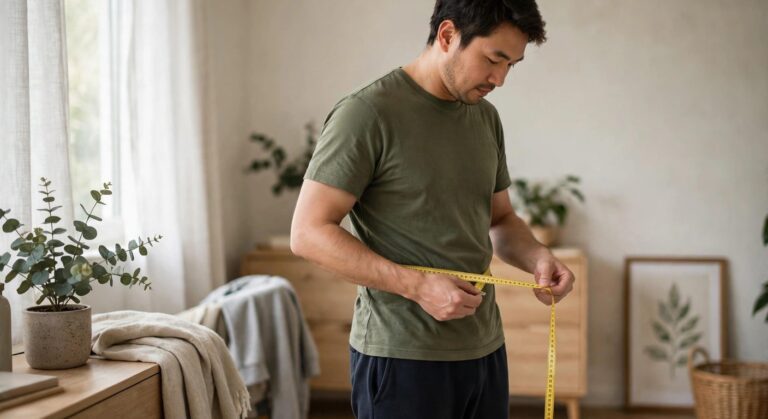
Measure in the morning, standing relaxed, in light clothing. Take each measurement twice, and average a third reading if the first two differ. These steps stay the same whether you are learning how to calculate body fat percentage for the first time or retesting.
- Neck: tape just below the Adam’s apple, sloping slightly downward toward the front, neck relaxed.
- Waist for men: abdomen horizontally at the navel, stomach relaxed. Do not suck in.
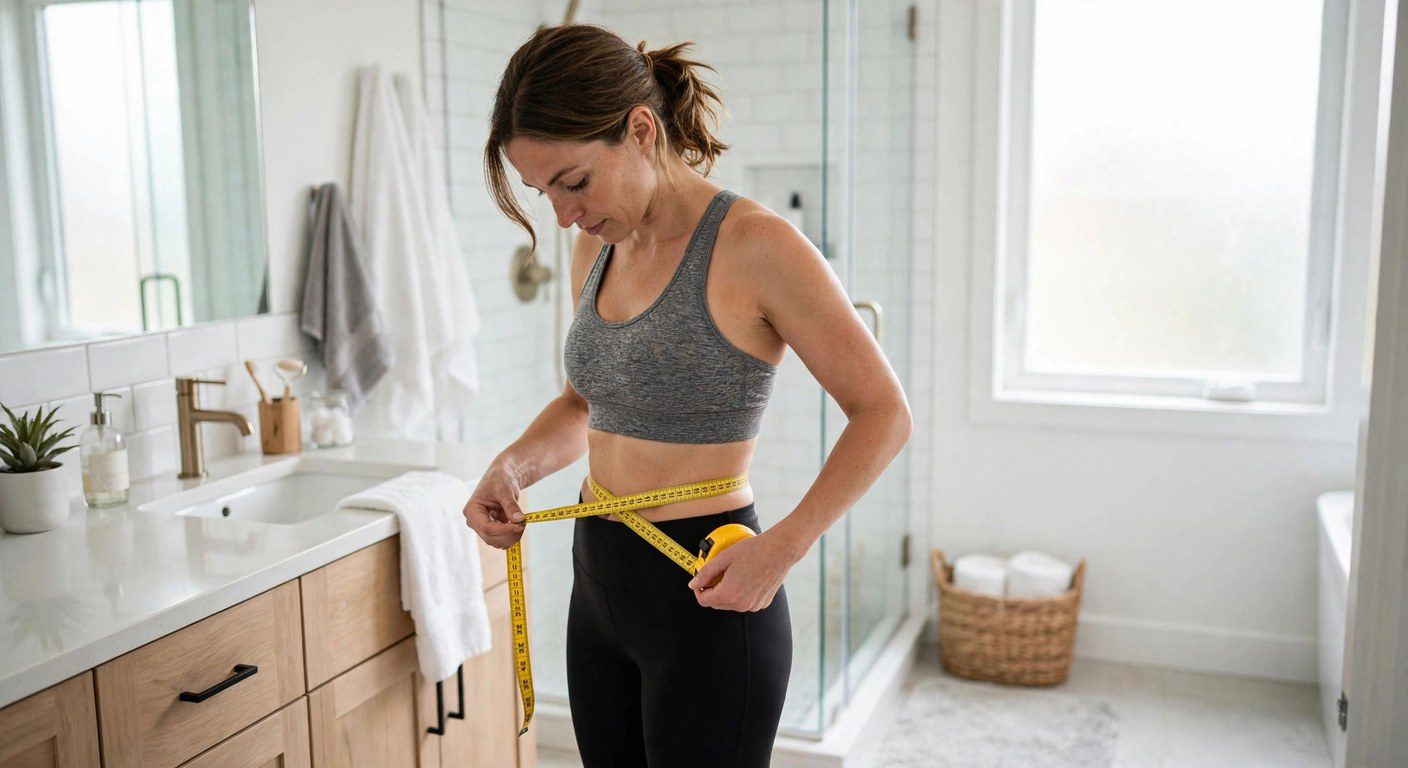
- Waist for women: narrowest point of the torso, usually just above the navel.
- Hips for women: widest point around the buttocks, tape level.
- Height: without shoes, back against a wall, looking straight ahead.
The most common error is measuring the waist in the wrong place. A tape two inches too high or low can shift the result by several points.
Worked example: a man
Here is how to calculate body fat percentage with the Navy formula for a man. Dan is 5 feet 10 inches (70 inches), with a 34 inch waist and a 15 inch neck. Waist minus neck = 19. log10(19) = 1.27875, so 86.010 x 1.27875 = 109.986. log10(70) = 1.84510, so 70.041 x 1.84510 = 129.233. Body Fat % = 109.986 minus 129.233 plus 36.76 = 17.51, about 17.5 percent. At 85 kg, his fat mass is 14.9 kg and his lean mass is 70.1 kg, at the top of the fitness range for men.
Worked example: a woman
Now a woman’s example of how to calculate body fat percentage with the Navy formula. Sara is 5 feet 5 inches (65 inches), with a 29 inch waist, 39 inch hips, and a 13 inch neck. Waist plus hip minus neck = 55. log10(55) = 1.74036, so 163.205 x 1.74036 = 284.036. log10(65) = 1.81291, so 97.684 x 1.81291 = 177.093. Body Fat % = 284.036 minus 177.093 minus 78.387 = 28.56, about 28.6 percent. At 65 kg, her fat mass is 18.6 kg and her lean mass is 46.4 kg, in the average range for women near the fitness boundary.
Navy method strengths and limits
The Navy method is free, fast, and consistent when your technique is consistent. Its weakness is lean people: it tends to overestimate body fat for men under about 15 percent and women under about 25 percent. A competitive bodybuilder once reported a tape result near 19 percent while calipers put him near 7 percent. For most recreational exercisers, it is a solid starting point for how to calculate body fat percentage at home.
How to Calculate Body Fat Percentage for Women?
To learn how to calculate body fat percentage for women, use the women’s Navy formula, which adds a hip measurement: Body Fat % = 163.205 x log10(waist plus hip minus neck) minus 97.684 x log10(height) minus 78.387, all in inches. Measure the waist at the narrowest point, the hips at the widest point, and the neck just below the Adam’s apple. For calipers, women measure triceps, suprailiac, and thigh, then use the women’s Jackson-Pollock density formula and the Siri equation. Women carry more essential fat, so the healthy bands sit higher: fitness is 21 to 24 percent and average is 25 to 31 percent.
How Do You Calculate Body Fat Percentage With Calipers?
The caliper method is the hands-on answer to how to calculate body fat percentage from skinfolds. It measures the thickness of the fat under your skin at specific sites, then converts that into body density and body fat percentage.
The standard protocol is the Jackson-Pollock 3-site method. The formulas use the sum of three skinfold measurements in millimeters, plus your age.
For men: Body Density = 1.10938 minus (0.0008267 x sum) plus (0.0000016 x sum squared) minus (0.0002574 x age). For women: Body Density = 1.0994921 minus (0.0009929 x sum) plus (0.0000023 x sum squared) minus (0.0001392 x age). Then convert density to body fat with the Siri equation: Body Fat % = (495 divided by Body Density) minus 450.
Where to pinch: the 3 sites
Measure on the right side of the body, on bare skin. Use calibrated calipers, not your fingers.
| Site | Men | Women | Fold direction |
|---|---|---|---|
| Chest or triceps | Chest: diagonal fold, halfway between nipple and front of armpit | Triceps: vertical fold, back of upper arm, halfway between shoulder and elbow | Men diagonal, women vertical |
| Abdomen or suprailiac | Abdomen: vertical fold, 2 cm right of navel | Suprailiac: diagonal fold, just above front of hip bone | Men vertical, women diagonal |
| Thigh | Vertical fold, front of thigh, halfway between hip crease and kneecap | Same as men | Vertical |
How to take a skinfold reading
Pinch a double fold of skin and the fat beneath it, pulling it away from the muscle. Place the caliper jaws about 1 cm below your fingers, at a right angle to the fold. Release the lever, wait 1 to 2 seconds, then read the number.
Take three readings per site and use the middle value. If two readings differ by more than 2 mm, take another. The most common beginner error is grabbing muscle with the fold, which inflates the reading. If the fold feels hard and will not lift cleanly away from the muscle, let go and try again.
A trained tester with good calipers lands within about 3 to 4 percent of hydrostatic weighing. A 2023 validation study that cross-checked skinfold equations against a three-compartment lab model found the Jackson-Pollock 3-site equation among the best-performing skinfold formulas (Frontiers in Sports and Active Living, validation of skinfold equations). Self-testing is harder, so a partner or a trainer helps you learn how to calculate body fat percentage with calipers.
Worked example: calipers
Here is a full example of how to calculate body fat percentage with calipers. A 30-year-old man measures chest 12 mm, abdomen 20 mm, thigh 15 mm, for a sum of 47 mm. Density = 1.10938 minus (0.0008267 x 47) plus (0.0000016 x 47 squared) minus (0.0002574 x 30) = 1.10938 minus 0.038855 plus 0.003534 minus 0.007722 = 1.06634. Body Fat % = (495 divided by 1.06634) minus 450 = 464.21 minus 450 = 14.2 percent. At 80 kg, fat mass is 11.4 kg and lean mass is 68.6 kg, which puts him in the fitness range for men.
How Accurate Are Body Fat Scales?
Body fat scales offer another way to learn how to calculate body fat percentage, with no tape and no pinching. They use bioelectrical impedance (BIA): a small electrical current passes through your body, and the scale measures resistance. Water and muscle conduct current well, while fat resists it. The scale combines that resistance with your height, weight, age, and sex to estimate body fat.
The physics is real, but the reading swings with anything that changes your body water. A big glass of water, a salty meal, a hard workout, or a hot day can move the number by several points. That is why scales often disagree with the Navy method or calipers.
For consistent BIA readings, test under the same conditions every time: first thing in the morning, after the bathroom, before food or exercise, with bare damp feet on the electrodes. Track the trend across weeks, not the single reading. For people with very low body fat, BIA is the least reliable home method, so a tape or caliper reading is a better check when you want to know how to calculate body fat percentage precisely.
What About DEXA, Bod Pod, and Hydrostatic Weighing?
These three are lab methods for how to calculate body fat percentage. They cost more and need a facility, but they give the most precise numbers.
DEXA is a low-dose X-ray scan that separates bone, lean tissue, and fat, and reports fat by body region. It is the most useful lab option for most people, since it also gives bone density. Expect 50 to 150 dollars per scan and 10 to 20 minutes on the table.
The Bod Pod measures body volume by air displacement. You sit in a sealed chamber in tight clothing and a swim cap for a few minutes while the machine works out density from volume and weight. Accuracy is about plus or minus 2 to 3 percent, and a test costs 40 to 80 dollars.
Hydrostatic weighing is the classic gold standard. You are weighed on land and then fully submerged while exhaling, and body density comes from the difference. It is accurate to about plus or minus 1 to 2 percent, but it costs 25 to 150 dollars, needs a tank and a trained operator, and many people dislike the dunking.
You do not need a lab test to make progress. For most people learning how to calculate body fat percentage, one DEXA scan for a baseline, then month-to-month tracking with the Navy method or calipers, is a sensible plan. Recheck in the lab once or twice a year.
Can You Estimate Body Fat Percentage Without Any Equipment?
Yes, but treat the result as a rough range, not a measurement. The two no-equipment options for how to calculate body fat percentage are visual comparison and a BMI-based estimate.
Visual comparison means matching your body to photo charts of people at known body fat percentages. It is free and places you within a broad band. The problem is that fat distribution, lighting, posture, and a recent pump all change how you look. Two people at 20 percent can look quite different, and most people guess themselves leaner than they are. Use photos to set a goal, not to measure progress.
The BMI-based option is the Deurenberg formula, which answers how to calculate body fat percentage from height, weight, and age. For men: Body Fat % = 1.20 x BMI plus 0.23 x Age minus 16.2. For women: Body Fat % = 1.20 x BMI plus 0.23 x Age minus 5.4.
Take a 30-year-old man with a BMI of 25. His estimate is 1.20 times 25 plus 0.23 times 30 minus 16.2, which is 30 plus 6.9 minus 16.2, or 20.7 percent. That is a reasonable ballpark for an average build, but the formula fails for muscular people, since BMI counts muscle as fat. It is a last resort, not a replacement for a tape or caliper measurement.
What Is a Healthy Body Fat Percentage?
Once you know how to calculate body fat percentage, the next question is what the number means. Healthy ranges come from the American Council on Exercise (ACE) norms, which sort adults into five bands. Your band depends on sex, and older adults typically sit a little higher within their band.
| Category | Men | Women |
|---|---|---|
| Essential fat | 2 to 5 percent | 10 to 13 percent |
| Athletes | 6 to 13 percent | 14 to 20 percent |
| Fitness | 14 to 17 percent | 21 to 24 percent |
| Average | 18 to 24 percent | 25 to 31 percent |
| Obese | 25 percent and above | 32 percent and above |
Essential fat is the minimum your body needs for hormones, organ protection, and cell function. Dropping below it is risky, especially for women, where it can disrupt menstrual cycles and bone health. Most recreational exercisers do best in the fitness or low average band.
The table above is the short version. For the full discussion of what each band means and when a number deserves a doctor’s attention, see our guide to what is a healthy body fat percentage.
Body Fat Percentage vs BMI: Which One Should You Trust?
Trust both, for different jobs. BMI is a fast screen that only needs height and weight. Body fat percentage is the better personal measure because it separates fat from muscle.
Take a lifter who is 1.78 m tall and weighs 95 kg. His BMI is 95 divided by 1.78 squared, which is 95 divided by 3.1684, or about 30.0, the start of the obesity range. But if his body fat is 12 percent, he carries 11.4 kg of fat and 83.6 kg of lean mass, and he is not overfat at all. BMI called him obese because it counted his muscle as fat.
The opposite error is skinny fat: a normal BMI with high body fat and low muscle. A sedentary person can sit at a BMI of 22 while carrying 28 percent body fat, with the health risk that BMI misses. If you know how to calculate body fat percentage, you already have the better personal measure. For the full comparison, see our guide to how to calculate BMI.
Can I Calculate Body Fat Percentage From BMI?
You can estimate it, but the estimate is rough. The Deurenberg formula uses BMI and age: for men, Body Fat % = 1.20 x BMI plus 0.23 x Age minus 16.2; for women, Body Fat % = 1.20 x BMI plus 0.23 x Age minus 5.4. For a 30-year-old man with a BMI of 25, that gives 20.7 percent. The problem is that BMI cannot tell muscle from fat, so the formula overestimates body fat for muscular people and underestimates it for people with low muscle, so you can learn how to calculate body fat percentage from BMI but should treat the result as a ballpark.
What Are the Most Common Measurement Mistakes?
Most wrong answers to how to calculate body fat percentage come from technique, not from the formula. These five mistakes cover almost all of them.
- Measuring over clothes. Even a T-shirt adds millimeters to a tape reading and changes a skinfold. Measure on bare skin.
- Sucking in or flexing. A flexed abdomen or a sucked-in waist shrinks the tape number and flatters the result. Stand relaxed and breathe normally.
- Measuring in the wrong spot. The Navy waist for men is at the navel, and the caliper abdomen site is 2 cm to its right. Move the tape by a couple of inches and the result shifts by points.
- Testing at the wrong time. A BIA scale after a workout, a big meal, or a salty dinner reads differently than the same scale in the morning. Test under the same conditions every time.
- Switching methods and comparing numbers. A Navy result, a caliper result, and a scale result will disagree by a few points. That is normal. Pick one method and track its trend.
One more habit matters: measure more than once. Two tape readings or three caliper readings per site, averaged, cut random error roughly in half.
What Should You Do With Your Number?
Once you know how to calculate body fat percentage, match your band from the table above to the plan below.
If your number is below the healthy range, meaning under about 6 percent for men or under about 14 percent for women, do not chase it lower. Eat at maintenance or a small surplus, keep protein high, and talk to your doctor or dietitian, especially if you have fatigue, missed periods, or frequent illness.
If your number is in the fitness or average band, your job is maintenance. Keep strength training two to four times a week, keep protein near 1.6 to 2.2 grams per kilogram of body weight, and recheck every two to four weeks. A steady upward drift across two months is the signal to tighten up.
If your number is in the obese band, focus on fat loss with muscle protection: a modest calorie deficit, high protein, and strength training. Your body fat number also sharpens your calorie target, since lean mass drives your basal metabolic rate. Our guide to how to calculate BMR turns lean mass into a calorie target with the Katch-McArdle formula. For the full daily plan, see our guide to how many calories a day.
Recheck every two to four weeks, under the same conditions, with the same method. Body fat changes slowly, and weekly readings mostly show water and food noise. Judge the trend across two months, not the jump between two Sundays.
How Often Should I Measure Body Fat Percentage?
Measure every two to four weeks. Body fat changes slowly, and weekly readings mostly reflect water, food, and glycogen rather than real fat change. Always test under the same conditions: same time of day, same method, same tape spots or caliper sites, and for BIA scales, same hydration state. Judge the trend across two months of learning how to calculate body fat percentage consistently. If it stalls for two months, adjust one variable, such as calories or training volume.
Frequently Asked Questions
How to calculate body fat percentage at home without calipers?
Use the Navy tape method. You only need a flexible tape measure and your height. Men measure neck and waist at the navel. Women measure neck, waist at the narrowest point, and hips at the widest point. Plug the numbers into the Navy formulas: for men, Body Fat % = 86.010 x log10(waist minus neck) minus 70.041 x log10(height) plus 36.76; for women, Body Fat % = 163.205 x log10(waist plus hip minus neck) minus 97.684 x log10(height) minus 78.387, with all measurements in inches. Take each measurement twice and average the readings, the simplest way to learn how to calculate body fat percentage without buying anything.
How accurate is the Navy body fat calculator?
The Navy method is typically accurate to about plus or minus 3 to 4 percent compared with DEXA when measurements are taken carefully. It works best for people in the average and fitness ranges. It tends to overestimate body fat for very lean people, meaning men under about 15 percent and women under about 25 percent. The biggest error source is tape placement, especially the waist. Measure in the same spots, under the same conditions, and track the trend rather than treating one reading as exact, which is good enough for most people learning how to calculate body fat percentage at home.
How to calculate body fat percentage with calipers?
Use the Jackson-Pollock 3-site method. Men measure chest, abdomen, and thigh. Women measure triceps, suprailiac, and thigh. Pinch a double fold of skin and fat away from the muscle, place the caliper 1 cm below your fingers, wait 1 to 2 seconds, and read the thickness in millimeters. Take three readings per site and use the middle value. Add the three sites, use the Jackson-Pollock formula for your sex to get body density, then the Siri equation, Body Fat % = (495 divided by Body Density) minus 450, to get your percentage. A trained tester lands within about 3 to 4 percent of hydrostatic weighing.
Why does my scale say a different body fat percentage than the Navy method?
Different methods answer how to calculate body fat percentage in different ways. Your scale uses bioelectrical impedance, which estimates body fat from how easily a small current passes through your body. That current is affected by hydration, food, salt, exercise, and skin temperature, so the reading moves through the day. The Navy method uses tape measurements, which do not change with a glass of water. A gap of 3 to 8 points between methods is normal. Pick one method, test under the same conditions every time, and follow the trend.
What is a good body fat percentage for a man or a woman?
Using the ACE norms, a good target for most active adults is the fitness band: 14 to 17 percent for men and 21 to 24 percent for women. The average band, 18 to 24 percent for men and 25 to 31 percent for women, is also healthy. Athletes typically sit at 6 to 13 percent for men and 14 to 20 percent for women. Essential fat is 2 to 5 percent for men and 10 to 13 percent for women. The best target also depends on age, training, and health, so treat the bands as guides rather than verdicts. If you want to compare your number with these bands, use the Navy method or calipers above to learn how to calculate body fat percentage first.