How Much Protein Do I Need to Build Muscle?
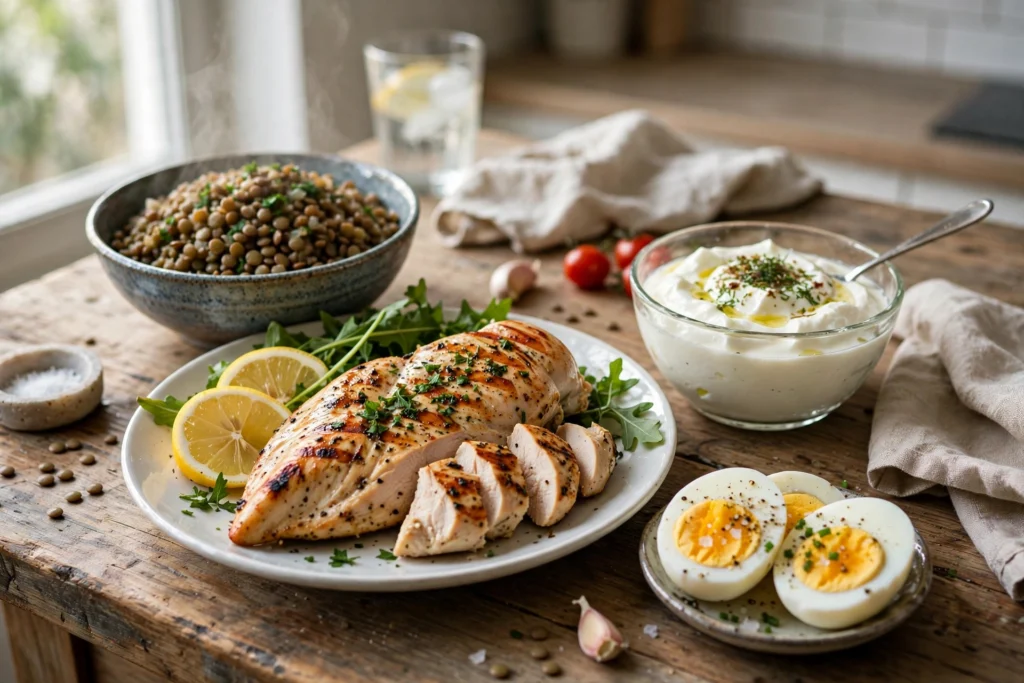
If you lift weights and want to see real muscle growth, protein is the nutrient that matters most after training itself. Yet the advice online is confusing. Some people say you need a gram of protein per pound of body weight. Others say you need far more. Still others warn that a high protein diet is dangerous. The truth is simpler, and it is backed by a large body of research.
The short answer is that most lifters need about 1.6 to 2.2 grams of protein per kilogram of body weight per day. That is about 0.73 to 1.0 grams per pound. For most people, 1.6 grams per kilogram covers nearly all of the benefit. Eating more than that rarely builds extra muscle, and it can crowd out the other foods that support hard training.
In this guide, you will learn exactly how much protein to aim for based on your body weight, how your target changes when you are bulking or cutting, how much protein to eat at each meal, whether timing matters, and which foods make hitting your target easy. You will also get a simple table you can use today, plus answers to the most common questions about protein and muscle growth.
Key Takeaways
- Most lifters need 1.6 to 2.2 grams of protein per kilogram of body weight per day.
- About 1.6 grams per kilogram covers nearly all of the muscle building benefit for most lifters.
- Spread protein across 3 to 5 meals, at roughly 25 to 40 grams per meal.
- Total daily protein matters far more than exact timing around workouts.
- Women use the same per kilogram range as men, scaled to body weight.
- Eating more than the range rarely builds extra muscle and can crowd out carbs.
How Protein Actually Builds Muscle
Muscle is built by a daily balance between breakdown and repair, and training plus protein tip that balance toward repair. Hard training creates tiny damage in muscle fibers. Your body answers by breaking down old muscle protein and building new muscle protein, a process called muscle protein synthesis. When synthesis beats breakdown over weeks and months, you gain muscle. When breakdown wins, you lose it.
Protein supplies the raw material for that repair, and one amino acid acts as the trigger. Leucine, found in high amounts in dairy, meat, eggs, and soy, signals the muscle to start building. The International Society of Sports Nutrition recommends that protein doses contain 700 to 3000 mg of leucine, alongside a balanced set of the other essential amino acids. That is why per-meal protein matters: each protein-rich meal is another chance to trigger synthesis during the day, and a day of protein bunched into one meal gives you fewer chances than the same total spread across three to five meals.
The Short Answer: 1.6 g/kg Covers Nearly All of It
For years, gym advice pushed protein intakes higher and higher. The research points in a different direction. A 2018 analysis of 49 trials found that protein intakes above about 1.6 grams per kilogram per day gave no additional lean mass gain for people who lift weights. In plain words, once you reach about 1.6 grams per kilogram, extra protein stops adding extra muscle for most lifters.
High dose trials tell the same story. In studies that compared very high intakes, around 3.2 grams per kilogram, with moderate intakes around 1.6 grams per kilogram, the high dose group did no better for strength or muscle size. That does not mean protein is unimportant. It means there is a ceiling, and most lifters reach it sooner than supplement marketing suggests.
So why does this guide give a range of 1.6 to 2.2 grams per kilogram instead of one single number? Because your best target depends on your goal, your body, and your diet. People who are cutting fat, older lifters, and people who eat mostly plant foods may benefit from the upper end of the range. People who are bulking or maintaining may do very well near 1.6 grams per kilogram. The range gives you room to adjust without guessing.
- General muscle building target: 1.6 to 2.2 grams per kilogram per day.
- In pounds: about 0.73 to 1.0 grams per pound per day.
- Near maximal benefit: about 1.6 grams per kilogram per day.
- Below 1.6 grams per kilogram: muscle growth may be slower, especially if training is hard.
The range in this guide rests on two named sources, not on gym lore. The first is a 2018 meta-analysis by Morton and colleagues, published in the British Journal of Sports Medicine, which pooled 49 resistance training trials with 1,863 participants. It found that protein supplementation added an average of 0.30 kg of fat-free mass and 2.49 kg on one-rep-max strength, and that intakes above about 1.62 grams per kilogram per day added no further lean mass gain. Read the study on PubMed.
The second is the International Society of Sports Nutrition position stand on protein and exercise from 2017. It concludes that 1.4 to 2.0 grams per kilogram per day is sufficient for most exercising people to build and maintain muscle, and that resistance-trained people in a calorie deficit may need 2.3 to 3.1 grams per kilogram per day to hold on to lean mass. That is why this guide keeps 1.6 to 2.2 grams as the general range and pushes toward the top end during a cut. Read the position stand on PubMed.
How Much Protein to Build Muscle by Body Weight
The easiest way to set your target is to start with your body weight. Use your total body weight in kilograms. If you are very overweight, you can use your lean body mass instead, since fat tissue does not need the same amount of protein as muscle tissue. For most lifters, total body weight works fine.
| Body weight | Daily protein target |
|---|---|
| 50 kg (110 lb) | 80 to 110 g |
| 60 kg (132 lb) | 95 to 132 g |
| 70 kg (154 lb) | 110 to 154 g |
| 80 kg (176 lb) | 125 to 176 g |
| 90 kg (198 lb) | 140 to 198 g |
| Note | Use total body weight, or lean mass if very overweight. |
To use the table, find the row closest to your body weight. If you weigh 70 kilograms, aim for 110 to 154 grams of protein per day. Start near the middle if you are new to tracking protein. If you are cutting, older, or eating mostly plants, start near the top. If you are bulking and eating plenty of calories, the lower to middle part of the range is often enough.
It helps to compare this range with the standard recommended dietary allowance, or RDA. The RDA is 0.8 grams per kilogram per day. That number is a floor to prevent deficiency in the general population. It is not a muscle building target. If you train hard and want to build muscle, 0.8 grams per kilogram is usually too low. You need more raw material to repair and grow muscle after training, and the RDA was never designed for that goal.
If you want a fast, personalized number, use a protein intake calculator to get a daily target based on your weight and goal. Then use a macro calculator to see how protein fits with carbs and fat for your total calories. You will find links to both calculators in the final section of this guide.
How Much Protein Do Women Need to Build Muscle?
Women use the same per kilogram range as men: 1.6 to 2.2 grams per kilogram of body weight per day. The range scales to body weight, not to sex. A 60 kg woman therefore aims for about 96 to 132 grams per day, the same way a 60 kg man would.
The fear that protein will make you bulky is the most common reason women under-eat protein, and it does not match how muscle growth works. Protein alone does not build bulk. Noticeable bulk takes years of dedicated training plus a sustained calorie surplus, which is a very different program from lifting two or three times a week and eating enough protein.
Research also shows that women gain muscle at a similar relative rate to men, even though the absolute amount is smaller because women typically start with less muscle mass. Men also carry roughly 10 to 20 times more testosterone than women, which explains most of the difference in starting muscle mass. If your goal is a firmer, more defined look rather than size, that is still muscle growth plus lower body fat, and it runs on the same protein range. If you want targets matched to your goal, age, and activity level, our protein needs guide walks through the same range by goal.
How Much Protein Should a Woman Eat to Build Muscle?
The same range as men, scaled to body weight: 1.6 to 2.2 grams per kilogram per day. A 60 kg woman therefore aims for about 96 to 132 grams per day.
Protein will not make you bulky on its own. Visible bulk takes years of dedicated training plus a sustained calorie surplus.
If You Are New to Lifting, Start Here
If you are new to lifting, start in the lower half of the range and build up as your training volume rises. A practical starting point used by coaches is around 1.2 to 1.6 grams per kilogram per day for a beginner, moving toward 1.6 grams and beyond as sessions get harder and more frequent. Note that this is coaching guidance, not a study cutoff. The research breakpoint near 1.6 grams describes where added benefit levels off, not where benefit begins.
Beginners also gain fastest, which is good news and a trap at the same time. Early strength gains come largely from your nervous system learning the movements, so the scale and the mirror move slower than your numbers in the gym. Do not chase that gap with extreme protein. Learn the big compound lifts, train consistently two to four times per week, hit your protein target most days, and let the range grow with you.
A Worked Example: Using Goal Weight or Lean Mass
The body weight table in this guide uses total body weight, and that works for most lifters. It overstates the target if you carry a lot of body fat, because fat tissue does not need the same amount of protein as muscle tissue. In that case, base the math on lean mass or goal weight instead.
Here is the difference it makes. Take a lifter who weighs 100 kg with about 30 percent body fat. That means about 70 kg of lean mass. On total body weight, the 1.6 to 2.2 gram range gives 160 to 220 grams per day. On lean mass, the same range gives 112 to 154 grams per day. The second number is cheaper, easier to eat, and closer to what the muscles can actually use.
You can estimate lean mass with a lean body mass calculator, then multiply that number by 1.6 to 2.2 grams as usual. If you do not know your body fat percentage, use your goal weight as a rough stand-in and adjust after two weeks of tracking. Once you have your lean-mass number, our protein intake guide shows how to track it day to day so the target survives contact with real meals.
Where Should a Beginner Start With Protein?
Start in the lower half of the range, around 1.2 to 1.6 grams per kilogram per day as a practical coaching starting point, and move up as your training volume rises. Focus first on learning the big compound lifts and training consistently.
The range grows with you, and early strength gains come largely from your nervous system learning the movements.
Bulking vs Cutting: Different Targets
Your calorie intake changes how much protein you need. When you eat more calories than you burn, your body has plenty of energy, and protein can be used mainly for building and repair. When you eat fewer calories than you burn, your body needs extra protein to protect the muscle you already have. That is why bulking and cutting call for different targets.
Bulking: 1.6 to 2.0 g/kg
When you are bulking, you are in a calorie surplus. That surplus is protein sparing, which means your body is less likely to break down protein for energy. As a result, 1.6 to 2.0 grams per kilogram is enough for most lifters. Eating more protein than that during a bulk rarely adds muscle. It can also displace carbs, and carbs fuel hard training. If your workouts feel flat, you may be eating too much protein and too few carbs, not too little protein.
A practical bulking approach is to set protein near 1.6 to 1.8 grams per kilogram, then fill the rest of your calories with carbs and fat in amounts that support performance and recovery. Use a calorie calculator and a TDEE calculator to set your surplus, so you gain mostly muscle instead of excess fat. Links to both calculators are in the final section.
Cutting: 2.0 to 2.4 g/kg
When you are cutting, you are in a calorie deficit. Your body is more likely to break down muscle along with fat. Higher protein helps preserve muscle while you lose fat. During a cut, aim for 2.0 to 2.4 grams per kilogram, which is about 0.9 to 1 gram per pound. Protein also helps you feel full, which makes a diet easier to stick with.
Cutting is the one phase where the top of the protein range often makes sense. You are asking your body to do two hard things at once: lose fat and keep muscle. Extra protein gives your body the building blocks it needs while calories are low. Keep training hard, and keep protein high, even when total calories drop.
Maintenance: About 0.7 to 0.8 g/lb
If you are eating at maintenance, neither bulking nor cutting, aim for about 0.7 to 0.8 grams per pound, which is about 1.6 to 1.8 grams per kilogram. That range supports muscle maintenance and slow growth without forcing you to eat very large amounts of protein. If your training volume is high, or you are an older lifter, stay near the top of that maintenance range.
Protein as a Percentage of Calories
If you track macros by percentage rather than by body weight, use 20 to 30 percent of calories from protein as your muscle building zone. That range sits comfortably inside the official Acceptable Macronutrient Distribution Range for protein, which is 10 to 35 percent of calories for adults.
The math is simple. Take your daily calories, multiply by the percentage, then divide by 4, because protein provides 4 calories per gram. At 2,500 calories per day and 25 percent protein, that is 625 calories from protein, which equals about 156 grams. That number lands in the same place as the body weight method for most lifters, so use whichever method you will actually stick with.
What Percentage of My Calories Should Be Protein to Build Muscle?
A practical muscle building zone is 20 to 30 percent of calories from protein, inside the official Acceptable Macronutrient Distribution Range of 10 to 35 percent.
To convert, multiply your daily calories by the percentage, then divide by 4. At 2,500 calories and 25 percent protein, that is about 156 grams.
How Big Should Your Surplus Be, and How Fast Will You Gain?
For a lean bulk, aim for a modest surplus of roughly 10 to 20 percent above your maintenance calories. Practical reviews of gaining phases use this range because a bigger surplus mostly adds fat, not muscle. Protein can only build muscle as fast as training stimulates growth, and extra calories beyond that need have nowhere else to go.
Set your expectations by training experience, using the widely used coaching model from Alan Aragon. These are scale weight targets during a gaining phase, not pure muscle, and they assume consistent training, enough protein, and enough sleep.
| Training experience | Realistic gain per month |
|---|---|
| Beginner (first year of proper training) | 1 to 1.5 percent of body weight |
| Intermediate (second year and beyond) | 0.5 to 1 percent of body weight |
| Advanced (several years of proper training) | 0.25 to 0.5 percent of body weight |
For an 80 kg intermediate lifter, that means roughly 0.4 to 0.8 kg of scale weight per month. Women typically gain about half the absolute amounts of men at each stage, because they start with less muscle mass, even though the relative rate of gain is similar. If the scale is climbing much faster than your row in this table, you are most likely gaining fat, and trimming the surplus is the fix.
Can You Build Muscle Without Gaining Fat?
Yes, in the right circumstances, and the approach is called body recomposition. It works best for beginners, for people returning after a long break, and for people carrying higher body fat, because all three groups have more room to gain muscle while losing fat at the same time. It is much harder for an advanced lifter who is already lean, and a dedicated bulk or cut usually serves that lifter better.
For recomposition, aim near the upper end of the range, around 2.0 grams per kilogram per day, eat at roughly maintenance calories or in a small deficit, and train hard with progressive overload. The evidence that this combination can work comes from a 2016 trial by Longland and colleagues. Young men in a marked calorie deficit who trained intensely for 4 weeks gained an average of 1.2 kg of lean mass on 2.4 grams per kilogram per day, while the group on 1.2 grams gained only 0.1 kg, and the higher protein group also lost more fat.
Treat that trial honestly. It was short, it used young men, and the deficit and training volume were both extreme. It proves recomposition is possible under the right conditions, not that it is easy or fast. If you try it, judge success over 8 to 12 weeks by strength, measurements, and photos, not by daily scale weight.
Yes, in the right circumstances, and it is called body recomposition. It works best for beginners, people returning after a break, and people carrying higher body fat.
Aim near the upper end of the range, around 2.0 grams per kilogram per day, eat at roughly maintenance calories or in a small deficit, and train hard with progressive overload.
How Much Protein Per Meal?
Daily total matters most, but how you split that total across the day also helps. Aim for about 25 to 40 grams of protein per meal, or about 0.3 to 0.5 grams per kilogram per meal, spread across 3 to 5 meals. That pattern keeps muscle protein synthesis active through the day. Muscle protein synthesis is the process your body uses to repair and build muscle tissue after training.
Research suggests that about 20 to 40 grams of protein maximally stimulates muscle protein synthesis in one sitting for most adults. Eating much more in one meal does not keep switching that process on harder. It still counts toward your daily total, so a large meal is not wasted. But spreading protein across several meals gives you more chances to stimulate muscle growth during the day.
For a target of 120 to 150 grams per day, 3 meals means about 40 to 50 grams at each meal, 4 meals means about 30 to 40 grams at each meal, and 5 meals means about 25 to 35 grams at each meal. Include a protein source at breakfast, not just at lunch and dinner, so you start the day with muscle protein synthesis active.
Now let us clear up a common myth. You may have heard that your body can only absorb 30 grams of protein per meal, and that anything above that is wasted. That is false. Your body absorbs all the protein you eat. Digestion may take longer after a large meal, but the amino acids still enter your bloodstream and become available to your tissues. There is no hard per meal cap.
Does Protein Timing Matter?
For years, lifters were told they had to drink a protein shake within 30 minutes of training or lose their gains. That idea, often called the anabolic window, has been overstated. Total daily protein matters far more than exact timing. If you hit your daily target and train hard, you will build muscle even if your shake is not perfectly timed.
That does not mean timing is fully irrelevant. The window after training lasts hours, not minutes. A normal meal before or after training works fine. If you train first thing in the morning on an empty stomach, eating protein soon after training is a good idea. If you ate a protein rich meal two or three hours before training, you are already covered.
A practical approach is simple. Eat protein at each meal, include protein in the meals around your workout, and do not stress about the clock. If you train in the evening, a protein rich dinner after training is a natural way to meet both goals. If you train at lunch, a protein rich lunch or afternoon snack does the same job. Consistency beats perfect timing.
Not specifically. Total daily protein matters far more. A normal meal within a few hours of training works fine.
Supplements: Whey, Casein, and Creatine
Supplements are optional, and whole foods can cover your whole target, but three of them answer questions readers keep asking. Here is what each one actually does, so you can decide whether any of them earns a place in your routine.
Whey vs casein
Whey digests quickly and is rich in leucine, which makes it convenient around training or whenever a meal is impractical. Casein digests slowly, because it forms a gel in the stomach and releases amino acids over several hours. Neither is better in absolute terms. Whey suits fast delivery, casein suits slow delivery, and both count toward your daily total the same way.
Protein before bed
Your longest fast of the day is overnight sleep, and a slow protein before bed covers part of it. In a trial in healthy older men, 40 grams of casein before sleep raised overnight muscle protein synthesis compared with a placebo, while 20 grams did not. An earlier trial in young men found that 40 grams of casein before bed improved overnight protein balance after evening exercise.
You do not need a casein powder to use this idea. Cottage cheese and Greek yogurt are casein-rich dairy foods, so a bowl of either before bed is a whole-food version of the same strategy. Keep the portion inside your daily total rather than adding it on top, or the extra calories will quietly become a larger surplus than you planned.
What Should I Eat Before Bed for Muscle Growth?
A slow-digesting protein is the practical choice, because it covers part of the overnight fast. Casein protein is the standard option, and research has used 40 grams of casein before sleep.
Cottage cheese and Greek yogurt are whole-food alternatives, since both are casein-rich dairy foods. Keep the portion inside your daily total.
Creatine
Creatine monohydrate is the most studied sports supplement, and the International Society of Sports Nutrition calls it the most effective ergogenic supplement for increasing high-intensity exercise capacity and lean body mass during training. The standard protocol is a loading phase of about 0.3 grams per kilogram per day for 5 to 7 days, followed by 3 to 5 grams per day to maintain elevated stores. Taking 3 to 5 grams per day without loading also raises muscle creatine stores, over 3 to 4 weeks instead of days.
Creatine is not protein, and it does not replace protein or training. It helps you train slightly harder, which is where the extra muscle comes from. It is also not required. If your budget is tight, spend it on food first, and treat creatine as an optional extra once your protein and training are already consistent.
Why More Protein Stops Helping
Muscle growth follows a pattern of diminishing returns. The first increase in protein, from a low intake to an adequate intake, makes a big difference. The next increase makes a smaller difference. Once you pass about 1.6 grams per kilogram, extra protein adds little or nothing for most lifters. Your muscles can only use so much protein for repair and growth at one time.
This is where the protein maxing trend goes wrong. Social media often treats more protein as always better, with very high intakes presented as the key to faster gains. The research does not support that view. In fact, very high protein can work against you, because every calorie of extra protein is a calorie you are not eating from another food group.
Extra protein can displace carbs that fuel hard training and recovery. Very high protein meals can reduce food variety, so you may miss out on fiber, vitamins, and minerals. Chasing an extreme protein target can make eating feel stressful and hard to sustain. More protein does not fix weak training. Progressive overload, sleep, and consistency matter more.
The smarter goal is to hit your target, train with progressive overload, and eat enough total calories and carbs to perform well. If you already hit 1.6 to 2.2 grams per kilogram, adding another 50 grams is unlikely to change your results. Improving your training, sleep, and consistency is far more likely to help. You can also track strength progress with a one rep max calculator.
No. Above about 1.6 g/kg, extra protein gives little or no extra muscle. It can crowd out carbs and other foods.
Training: The Other Half of the Equation
Protein without progressive overload builds very little muscle, no matter how exact your gram target is. Progressive overload means gradually asking your muscles to do more over time: a little more weight, a few more reps, or an extra set, tracked week to week. That rising demand is the signal that tells your body to use the protein you eat for growth.
Volume matters too. A 2017 meta-analysis by Schoenfeld and colleagues found that 10 or more hard sets per muscle group per week produced better hypertrophy than very low volume, and the practical range most lifters land in is 10 to 20 hard sets per muscle per week. A hard set means a working set taken close to failure, not a warm-up. Splitting that volume across two or more sessions per muscle per week usually works better than doing it all in one day, because training quality stays higher.
For rep ranges, the same body of research supports roughly 6 to 12 reps per set at 65 to 85 percent of your one-rep max as a solid hypertrophy zone, with heavier and lighter work both useful as long as sets finish near failure. Sleep closes the loop. Consistent, good quality sleep supports recovery and the muscle building process, so a perfect protein plan paired with broken sleep still underperforms. Protein, progressive training, and recovery are three legs of one stool.
Protein After 50: Fighting Sarcopenia
After about age 50, muscles respond less strongly to protein, a change called anabolic resistance, and that is why older lifters need more attention to protein, not less. The gradual loss of muscle mass, strength, and physical function with age is called sarcopenia, and it raises the risk of falls, frailty, and loss of independence. Protein and resistance training are the two strongest tools against it.
The PROT-AGE Study Group recommends 1.0 to 1.2 grams of protein per kilogram per day for older adults, rising to 1.2 to 1.5 grams for those with sarcopenia or chronic conditions. A review of nutrition for sarcopenia recommends 25 to 30 grams of high-quality protein per meal, spread across the day, because a small, protein-light meal may not trigger muscle protein synthesis strongly enough in an older adult. That is why the per-meal target matters even more with age than it does for younger lifters.
Practically, this means an older lifter should anchor every meal with a clear protein source, aim for the upper end of this guide’s range when training, and pair the eating plan with regular resistance training. Protein without training slows the loss, but protein plus training is what rebuilds strength. Anyone with kidney disease or another condition that affects protein metabolism should talk to a doctor before raising intake, as the safety note in this guide already says.
How Much Protein Do I Need to Build Muscle After 50?
Aim for the upper end of the range with 25 to 40 grams per meal, since muscles become less responsive to protein with age.
Is High Protein Safe for Your Kidneys?
In healthy adults, reviews of the research find no adverse effect of higher protein intake on kidney function markers. A 2018 systematic review and meta-analysis of 28 trials by Devries and colleagues found that higher protein intake had minimal or no effect on glomerular filtration rate, the standard measure of kidney filtering, in people with normal kidney function. A separate 2018 systematic review of 26 studies reached the same conclusion: protein above the US recommended allowance showed no adverse effect on blood markers of kidney function in healthy adults.
Two honest limits apply. First, most of the trials were short term, so the evidence speaks most confidently about months, not decades. Second, this safety finding is about healthy kidneys. People with kidney disease, or with a condition that affects protein metabolism, should talk to a doctor before raising protein intake, because the rules are different once kidney function is already reduced.
There is also no single official upper limit for healthy lifters, and you do not need one for muscle building. The International Society of Sports Nutrition notes novel evidence that intakes above 3.0 grams per kilogram per day may improve body composition in resistance-trained people, but that is about fat loss, not about building more muscle. Since the muscle building benefit levels off near 1.6 grams, very high intakes add cost and digestive load without adding muscle.
Is a High Protein Intake Safe for My Kidneys?
In healthy adults, systematic reviews find no adverse effect of higher protein intake on kidney function markers, although most trials were short term. There is no single official upper limit for healthy lifters.
If you have kidney disease or a condition that affects protein metabolism, talk to a doctor before raising your protein intake.
Common Mistakes to Avoid
Most lifters who stall do not have a protein problem, they have one of five fixable habits. Check yourself against this list before raising your target again.
- Eating too little total food. Protein cannot build muscle in a large calorie deficit unless you are a beginner or returning lifter. If your weight is falling and your lifts are stalling, total calories are the first suspect, not protein grams.
- Bunching protein into one meal. A huge dinner and two protein-free meals gives your muscles one strong trigger instead of three or four. Spread protein across the day, including breakfast.
- Pushing protein so high that carbs collapse. Very high protein can displace the carbs that fuel hard training. If workouts feel flat, you may be eating too much protein and too few carbs, not too little protein.
- Expecting visible change in weeks. Muscle growth is measured in months. Judge a plan over 8 to 12 weeks by strength, measurements, and photos, not by the mirror after two weeks.
- Training without a progression plan. Doing the same weights for the same reps every session gives your body no reason to grow, whatever you eat. Add weight, reps, or sets over time, and write it down so progression is real instead of guessed.
Best Protein Sources
The best protein source is the one you will eat regularly, enjoy, and digest well. Animal proteins are complete proteins, which means they provide all essential amino acids in useful amounts. Many plant proteins are also valuable, but plant eaters often need larger portions or a mix of foods to get the same amount of protein and leucine. Leucine is an amino acid that plays a key role in switching on muscle protein synthesis.
Animal Protein Sources
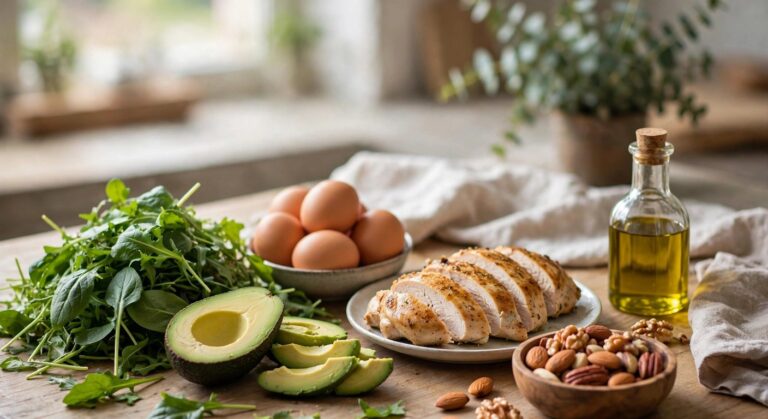
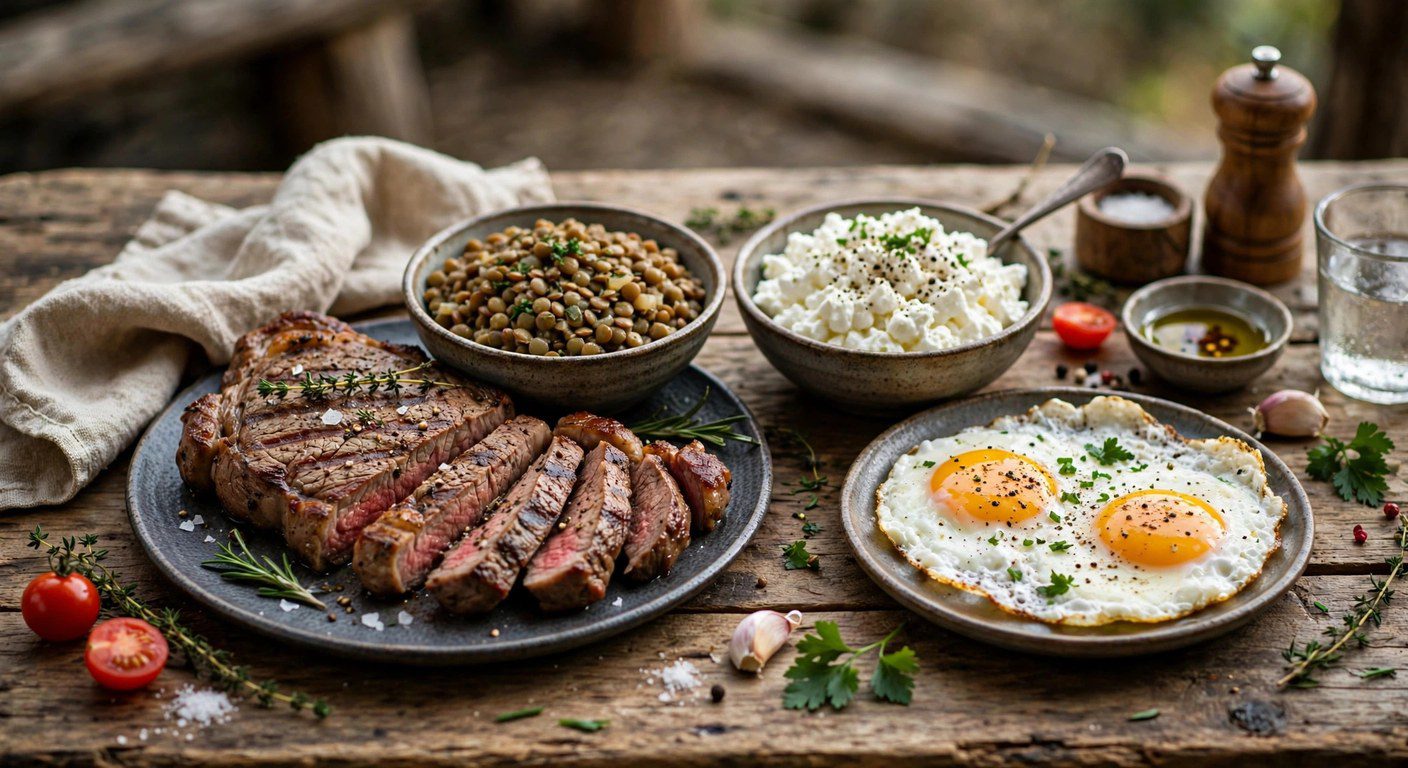
Good animal options include chicken breast, which is lean and high in protein per calorie; eggs, which are affordable and complete; salmon, which adds healthy fats and vitamin D; Greek yogurt, which is thick and high in protein; lean beef, which provides iron and creatine; and whey protein, which is convenient when a meal is impractical.
Plant Protein Sources
Good plant options include lentils, which are high in protein and fiber; chickpeas, which work in salads and stews; tofu, which takes on the flavor of the dish; quinoa, a grain with more protein than most other grains; and beans such as black beans, kidney beans, and pinto beans, which add protein and fiber.
If you eat mostly plants, plan for larger portions and combine foods across the day. For example, beans with rice, or tofu with quinoa, can help you cover a wider range of amino acids. You may also want to aim for the upper end of the protein range, since plant proteins are often lower in leucine and slightly less digestible than animal proteins. Plant based muscle building takes a little more planning, but it is fully possible.
Vegan Protein Blends
If you eat only plant foods, blends are the practical answer to the complete protein question. Soy on its own is a complete protein, containing all nine essential amino acids. Pea protein is high in lysine but low in methionine, while rice protein is high in methionine but low in lysine. Combine pea and rice, or use soy as your base, and the gaps fill each other.
In practice, that means choosing a pea plus rice blend powder, or building meals from complementary foods across the day, such as beans with rice or tofu with quinoa. Because plant proteins are often lower in leucine and slightly less digestible than animal proteins, aim for the upper end of this guide’s range and make sure each meal carries a clear protein source. A varied plant-based diet can fully support muscle growth, but it takes a little more planning than an animal-based one.
What Is the Best Protein Source for Building Muscle, Including Vegan Options?
There is no single best source, because the best source is the one you will eat regularly and digest well. If you want a default answer, eggs and whey are strong choices: both are complete proteins, rich in leucine, and easy to portion.
What matters most is hitting your daily total from foods you enjoy, not finding one perfect food.
The same question comes up for plant-based lifters.
A blend is the best default. Soy on its own is complete, while a pea plus rice blend combines complementary amino acids into a complete profile. Because plant proteins are often lower in leucine and slightly less digestible, aim for the upper end of the protein range and make sure each meal carries a clear protein source.
Protein in Common Foods: A Quick Reference Table
Use this table to turn your daily gram target into actual meals. Values are approximate and come from USDA FoodData Central records. Brands and cooking methods vary, so check the label on packaged foods when exact intake matters.
| Food | Serving | Protein |
|---|---|---|
| Chicken breast, cooked | 100 g | 31 g |
| Greek yogurt, plain nonfat | 170 g (about 3/4 cup) | 17 g |
| Eggs | 2 large | 13 g |
| Cottage cheese, 2% fat | 1/2 cup | 12 g |
| Atlantic salmon, cooked | 3 oz | 19 g |
| Light tuna, canned in water, drained | 3 oz | 17 g |
| Firm tofu | 1/2 cup | 11 g |
| Tempeh, cooked | 1/2 cup | 17 g |
| Lentils, cooked | 1 cup | 18 g |
| Whey protein | 1 scoop | 20 to 25 g (check the label) |
Notice how the table solves the most common planning problem. If your target is 150 grams, you can see at a glance that you need roughly five 30 gram servings across the day, not one giant meal. Keep this table open while you build your meals, and hitting the target becomes simple arithmetic instead of guesswork.
Sample 150 g Protein Day
Here is what a day near 150 grams of protein can look like with ordinary foods. Amounts are approximate, and you can swap foods to fit your taste, budget, and calorie needs.
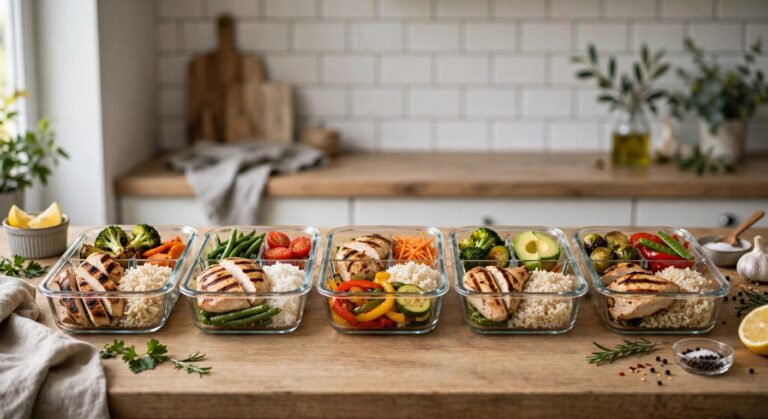
Breakfast: Greek yogurt with oats and berries, about 30 grams of protein. Lunch: chicken breast, rice, and vegetables, about 40 grams. Snack: two eggs and cottage cheese, about 30 grams. Dinner: salmon or lean beef with potatoes and salad, about 40 grams. Total: about 140 to 150 grams across four meals.
Notice that no single meal is extreme. Each meal has a clear protein source, and the total adds up without forcing you to eat huge portions. That is the goal. Build each meal around protein, add carbs for energy, add vegetables for fiber and micronutrients, and repeat that pattern most days.
Sample 100 g Protein Day (Smaller Lifter)
Here is what a day near 100 grams of protein can look like for a smaller lifter, or for anyone whose target sits below the 150 gram day above. Amounts are approximate, and you can swap foods to fit your taste, budget, and calorie needs.
Breakfast: 2 eggs with Greek yogurt and berries, about 30 grams of protein. Lunch: tuna and cottage cheese salad with bread, about 29 grams. Snack: one scoop of whey with milk or water, about 20 to 25 grams. Dinner: lentils with rice and vegetables, about 18 grams. Total: about 95 to 100 grams across four meals.
The pattern is the same as the 150 gram day, just scaled down. Each meal still carries a clear protein source, and no single meal is extreme. If you want to track a day like this against your own target, our protein intake guide shows how to log meals and check your daily total.
How to Find Your Exact Number
You do not need to guess your target. Start with the range in this guide, then use calculators on this site to make it personal. A protein intake calculator gives you a daily target based on your weight and goal. Then a macro calculator splits your calories into protein, carbs, and fat. That combination gives you a complete plan, not just a protein number.
Here is a simple three step process. First, weigh yourself and decide whether you are bulking, cutting, or maintaining. Second, multiply your weight in kilograms by the target for your phase, such as 1.8 for bulking or 2.2 for cutting. Third, divide that total across 3 to 5 meals, aiming for 25 to 40 grams of protein per meal. Track for two weeks, then adjust based on how you feel, how you train, and how your weight changes.
A quick note on safety. High protein is safe for healthy people, according to the current research. If you have kidney disease or a condition that affects protein metabolism, talk to a doctor first before raising your protein intake. People over 50 should also pay attention to per meal protein. With age, muscles become less responsive to protein, a process called anabolic resistance. Aim for 25 to 40 grams of protein per meal with 2.5 to 3 grams of leucine.
The bottom line is simple. Train hard, eat 1.6 to 2.2 grams of protein per kilogram per day, spread it across 3 to 5 meals, and be patient. Muscle growth takes months, not days. If you stay consistent with training, protein, calories, and sleep, you will give your body everything it needs to grow.
Helpful Calculators on This Site
Sources and References
- Morton RW, Murphy KT, McKellar SR, et al. A systematic review, meta-analysis and meta-regression of the effect of protein supplementation on resistance training-induced gains in muscle mass and strength in healthy adults. British Journal of Sports Medicine, 2018. PubMed
- Jager R, Kerksick CM, Campbell BI, et al. International Society of Sports Nutrition position stand: protein and exercise. Journal of the International Society of Sports Nutrition, 2017. PubMed
- Kreider RB, Kalman DS, Antonio J, et al. International Society of Sports Nutrition position stand: safety and efficacy of creatine supplementation in exercise, sport, and medicine. Journal of the International Society of Sports Nutrition, 2017. PDF
- Longland TM, Oikawa SY, Mitchell CJ, Devries MC, Phillips SM. Higher compared with lower dietary protein during an energy deficit combined with intense exercise promotes greater lean mass gain and fat mass loss: a randomized trial. American Journal of Clinical Nutrition, 2016. PubMed
- Kouw IWK, Holwerda AM, Trommelen J, et al. Protein ingestion before sleep increases overnight muscle protein synthesis rates in healthy older men: a randomized controlled trial. Journal of Nutrition. PDF
- Devries MC, Sithamparapillai A, Brimble KS, et al. Changes in kidney function do not differ between healthy adults consuming higher- compared with lower- or normal-protein diets: a systematic review and meta-analysis. Journal of Nutrition, 2018. See also the systematic review of protein intake above the US RDA and kidney function in healthy adults. PubMed
- Deutz NE, Bauer JM, Barazzoni R, et al. Protein intake and exercise for optimal muscle function with aging: recommendations from the ESPEN Expert Group. Clinical Nutrition, 2014. See also the review of nutrition for sarcopenia, which recommends 1.0 to 1.2 g/kg per day with 25 to 30 g of high-quality protein per meal. PMC
- PROT-AGE Study Group recommendations for older adults: 1.0 to 1.2 g/kg per day, rising to 1.2 to 1.5 g/kg per day with sarcopenia or chronic conditions. PMC
- Institute of Medicine. Acceptable Macronutrient Distribution Range for protein: 10 to 35 percent of calories. Summarized in Advances in Nutrition. PMC
- US Department of Agriculture, FoodData Central, SR Legacy records, for the per-food protein values in the table above. USDA FoodData Central
- Alan Aragon’s widely used coaching model for realistic muscle gain rates by training experience. Model summary
- Schoenfeld BJ, Ogborn D, Krieger JW. Dose-response relationship between weekly resistance training volume and increases in muscle mass: a systematic review and meta-analysis. Journal of Sports Sciences, 2017. Explainer
Frequently Asked Questions
How much protein do I need to build muscle?
1.6 to 2.2 grams per kilogram of body weight per day (0.73 to 1 gram per pound). For most lifters, 1.6 grams per kilogram covers nearly all the benefit.
Is 200 g of protein too much?
Not if you are large or highly active. For a 90 kg lifter, 200 g is about 2.2 g/kg, the top of the range. For a 60 kg lifter, it is far more than needed.
Can I build muscle with low protein?
Slowly and less efficiently. Without enough protein, training stimulus alone cannot maximize muscle repair and growth.
Do I need protein powder to build muscle?
No. Whole foods are enough. Powder is just convenient when a meal is impractical.
How much protein per meal to build muscle?
About 25 to 40 grams per meal across 3 to 5 meals. That keeps muscle protein synthesis active through the day.
This guide is general educational information, not medical advice. Protein needs vary with age, health, pregnancy, and medical conditions, and the ranges here are written for healthy adults who train regularly. If you have kidney disease, a condition that affects protein metabolism, or you are pregnant, under 18, or managing a medical diet, talk to a doctor or registered dietitian before changing your protein intake.