
Protein Intake: How to Track It and Hit Your Daily Target
Your protein intake is the total grams of protein you eat in a day. Most people who fail to hit their protein intake target do not fail because they lack discipline. They fail because they never actually measured it. They eat what feels like a lot of protein, guess at the total, and land 40 or 50 grams short without knowing where the gap came from.
Tracking changes that. Once you log your protein intake for even one week, you stop guessing. You learn which meals carry your day and which ones are empty. You learn that your breakfast was the problem all along, or that your snacks were doing more work than your dinners. And once you can see the number, hitting it becomes a planning task, not a daily struggle.
This guide is the practical companion to our target-setting guide. It does not re-teach the target ranges. It teaches you how to track your protein intake day to day and actually reach the number: how to log it with an app, a notebook, or hand portions, how to read labels for protein grams, how much protein common foods contain, how to build each meal around protein, how to handle restaurants and travel, how to do it cheaply, and how to fix the most common shortfalls.
What Is Protein Intake, and Why Does Tracking It Work?
Protein intake is simply the grams of protein you eat in a day, added up across every meal and snack. It is not a percentage, not a ratio, and not a feeling. It is a number, and like any number, you can only manage it if you measure it.
Tracking works for the same reason tracking spending works. Most people underestimate some things and overestimate others. Protein is a perfect example. A chicken salad feels high in protein, but if the chicken portion is small and the bowl is mostly leaves and dressing, it might hold only 20 grams. Meanwhile a plain bowl of Greek yogurt that feels like a light snack can hold 20 grams on its own. Without logging, you cannot tell which is which.
There is a second reason tracking works: it turns a vague goal into a visible gap. “Eat more protein” is hard to act on. “You are 45 grams short, and your breakfast holds only 12 grams” tells you exactly what to fix. That is the whole method in this guide: find your protein intake target, log your day, find the gap, and fix the smallest meal first.
One important note before the methods. Your protein intake target itself is a separate question from tracking, and it is covered in full in our guide to protein needs, which lays out the gram targets by goal, age, and activity. If you want the arithmetic done for you, our protein intake calculator computes your target from your weight and goal. Get that number first, write it down, and then use this guide to hit it.
How Do You Find Your Daily Protein Intake Target Before You Track?
You cannot track toward a number you do not have, so this step comes first and takes about two minutes. Your protein intake target is a daily gram figure based on your body weight and your goal, and the full reasoning behind it lives in our guide to protein needs.
The fast route is our protein intake calculator. Enter your weight, pick your goal, and it returns your daily range plus a per-meal split. Write both numbers down: the daily total and the per-meal figure. The per-meal figure is what makes tracking easy, because it turns one big number into a small check at each meal.
Here is the arithmetic the calculator does, so you can sanity-check it. Take a daily target of 150 grams across 4 meals: 150 divided by 4 equals 37.5 grams per meal, so roughly 38 grams at each meal. Across 3 meals, the same target is 150 divided by 3, which equals 50 grams per meal. Across 5 meals, it is 150 divided by 5, which equals 30 grams per meal. None of these splits is magic. The daily total matters most. The split just tells you what a normal meal should look like for you.
A final point on targets: treat your protein intake target as a range with a floor, not a pass-or-fail line. If your target is 150 grams, then landing between 140 and 160 grams is a hit. Chasing exactly 150 every day is how tracking becomes stressful. Weekly consistency beats daily perfection, and the section near the end of this guide shows the weekly math that proves it.
What Are the Best Ways to Track Your Protein Intake?
There is no single best tracking method. There is only the method you will actually use for more than a week. Here are the four that work, with their honest trade-offs.
| Method | Effort per day | Accuracy | Best for |
|---|---|---|---|
| Food logging app | 5 to 10 minutes | High, once foods are saved | Beginners and anyone who wants exact numbers |
| Notebook or notes app | 3 to 5 minutes | Good, if you know food grams | People who dislike apps or eat repeat meals |
| Photo log | 1 to 2 minutes | Rough, but catches forgotten snacks | People who hate typing and mostly eat at home |
| Tally method | Under 1 minute | Good enough, after a learning week | People who eat similar meals every day |
Food logging apps are the most accurate starting point. Apps like MyFitnessPal and Cronometer hold huge food databases, remember your frequent meals, and add up protein automatically. The first week is slow because every food is new. By week two, most of your meals are saved, and logging a repeat day takes minutes. The main trap is database errors: user-entered foods with wrong protein values. When a value looks surprising, check it against the label or a second entry.
A notebook or notes app works well if you eat repeat meals. Write your protein intake target at the top of the page, then log each meal as a line: food, portion, grams. A typical day fits in five lines. The advantage is speed and zero dependence on a database. The disadvantage is that you must know the grams yourself, which is why the food table later in this guide exists. Keep a running total in the margin so you always know how far you have left to go.
A photo log means photographing every meal and snack before you eat it, then reviewing the photos in the evening and estimating the protein. It is the lowest-effort method and it catches the snacks people forget to log, which are the biggest source of tracking error. Its weakness is estimation: photos do not weigh portions. Use it for a week to find your blind spots, then switch to a more precise method if your protein intake is still short.
The tally method is the long-term winner for most people. After two or three weeks of logging, you know your regular meals by heart: your breakfast is 25 grams, your lunch is 40, your usual snack is 20. From then on, you track by tallying familiar meals and only logging the unfamiliar ones. This is how people hit their protein intake for years without becoming people who weigh everything forever.
Whichever method you pick, follow two rules. First, log before you eat when you can, not after. Pre-logging turns tracking into planning: you see the gap before dinner, while you can still fix it. Second, log everything, including the small stuff. A splash of milk in coffee is 1 gram and barely matters, but a handful of nuts is 6 grams and a cheese stick is 7, and those add up across a day.
How Do You Estimate Portions Without a Scale?
A kitchen scale is the most accurate tool, and it costs little, but you will not always have one. Hand portions solve that problem, because your hand travels with you and scales roughly with your body size.
The palm rule is the workhorse. A palm-sized piece of cooked meat or fish, about 100 grams for most adults, holds roughly 21 to 31 grams of protein depending on the meat. A palm of cooked chicken breast is about 31 grams. A palm of cooked salmon is about 21 grams. A palm of lean beef is about 27 grams. Two palms of chicken at dinner is therefore roughly 62 grams, which is why a generous dinner portion can carry a large share of a day.
Other hand measures help with the rest of the plate. A fist is about 1 cup, which is the serving for cooked lentils (about 18 grams of protein), cooked quinoa (about 8 grams), or cottage cheese (about 24 grams per cup, since 150 grams holds 18 grams and a cup is roughly 200 grams). A cupped handful is about half a cup, useful for nuts and seeds. A thumb tip is about 1 tablespoon, useful for peanut butter (about 4 grams per tablespoon, since 2 tablespoons hold about 8 grams).
Hand portions have real error, roughly 20 percent either way, so treat them as estimates, not measurements. That error is acceptable for tracking, because your protein intake target is a range, not an exact line. If your hand estimate says 145 grams and your target is 150, you are close enough. The method fails only when portions are wildly misjudged, which usually means restaurant portions: a restaurant chicken breast can easily be two palms, not one, which is good news for protein and worth remembering when a restaurant meal seems to overshoot your target.
The calibration trick is to weigh your hand portions at home for one week. Weigh a palm of chicken once, note that it was 110 grams, and from then on your palm has a number attached to it. One week of calibration turns a rough method into a reliable one, and it is the fastest route to tracking without a scale.
How Do You Read a Label for Protein Grams?
Labels are the most reliable protein data you will ever get, because they describe the exact product in your hand. But three label traps catch almost everyone.
Trap 1: the serving size is not the amount you ate. A yogurt tub lists protein per 100 grams, but you ate 200 grams. A cereal box lists protein per 40 gram serving, but your bowl held 80 grams. The fix is one multiplication: grams eaten divided by serving size, times protein per serving. Worked example: a yogurt lists 10 grams of protein per 100 gram serving, and you eat 200 grams. Divide 200 by 100, which equals 2, and multiply 2 by 10, which equals 20 grams. Your snack held 20 grams, not 10.
Trap 2: per 100 grams versus per serving. Some labels show both columns, and they disagree by design. Per 100 grams lets you compare products fairly. Per serving tells you what one portion holds. When you compare two products, use the per 100 gram column. When you log what you ate, use the per serving column and adjust for how many servings you actually ate. Worked example: a cheese lists 25 grams of protein per 100 grams, and you eat a 40 gram slice. Multiply 25 by 0.4, which equals 10 grams. That slice held 10 grams.
Trap 3: protein added by marketing. Bars, cereals, and drinks labeled high protein sometimes hold only 8 to 12 grams per serving, with the rest of the calories coming from sugar and fat. The label settles it in seconds: if the protein line is under 15 grams and the sugar line is over 15 grams, it is a candy bar with a gym name, not a protein food. A genuinely useful protein product holds at least 15 grams per serving with modest sugar.
One more label skill: scan the whole day from labels alone. Most packaged foods you eat in a day carry labels, so a day of label reading often reveals the gap faster than any app. People who do this exercise usually find the same two surprises: breakfast products are weaker than they look, and condiments and sides add almost nothing. Both surprises point to the same fix, which the next sections cover.
How Much Protein Is in Common Foods?
You cannot track protein intake without knowing food values, so here is the working table. Values are cooked weights unless stated, rounded to whole grams, and based on USDA-style data. Brands vary by a gram or two, so treat these as anchors, not lab results.
| Food | Serving | Protein |
|---|---|---|
| Chicken breast, cooked | 100 g | 31 g |
| Turkey breast, cooked | 100 g | 29 g |
| Lean beef (sirloin), cooked | 100 g | 27 g |
| Salmon, cooked | 100 g | 21 g |
| Canned tuna, drained | 100 g | 24 g |
| Egg, large | 1 egg | 6 g |
| Greek yogurt, nonfat | 200 g | 20 g |
| Cottage cheese, low fat | 150 g | 18 g |
| Milk, whole or skim | 1 cup (240 ml) | 8 g |
| Cheddar cheese | 30 g | 7 g |
| Lentils, cooked | 1 cup | 18 g |
| Black beans, cooked | 1 cup | 15 g |
| Chickpeas, cooked | 1 cup | 15 g |
| Edamame, shelled | 1 cup | 17 g |
| Firm tofu | 100 g | 10 g |
| Tempeh | 100 g | 19 g |
| Quinoa, cooked | 1 cup | 8 g |
| Oats, dry | 40 g | 5 g |
| Whole wheat bread | 2 slices | 8 g |
| Peanut butter | 2 tablespoons | 8 g |
| Almonds | 28 g (small handful) | 6 g |
| Pumpkin seeds | 28 g | 7 g |
| Whey protein powder | 1 scoop | 25 g |
| Rotisserie chicken, meat only | 100 g | 28 g |
Three patterns in this table do most of the work. First, animal proteins are dense: 100 grams of chicken beats a whole cup of most plant foods. Second, dairy punches above its weight: Greek yogurt and cottage cheese deliver 18 to 20 grams in an ordinary serving with no cooking. Third, plant proteins add up when portions are real: a cup of lentils at 18 grams plus a cup of quinoa at 8 grams is 26 grams, which is a full meal anchor without any meat.
Keep this table on your phone for the first month of tracking your protein intake. After that you will know your twenty regular foods by heart, and the table becomes a reference for new foods only. That is the normal path from tracking beginner to tracking expert, and it takes weeks, not years.
How Do You Build Each Meal Around Protein?
The single most effective tracking habit is also the simplest: pick the protein first, then build the rest of the meal around it. Most people do the opposite. They pick a pasta, a salad, or a sandwich, then wonder why the protein total is low. When protein is an afterthought, it stays small. When it is the anchor, the meal almost plans itself.
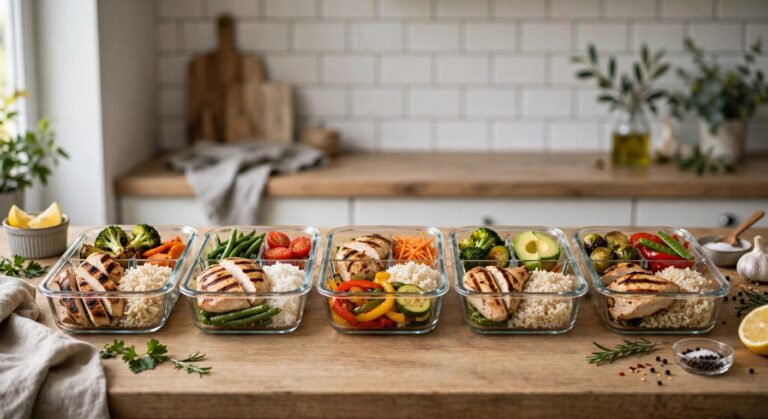
The method works in three steps. First, choose your protein anchor and its grams from the table above. Second, add vegetables and a carb source around it for volume and energy. Third, check the meal against your per-meal figure from the target section. If the anchor alone clears that figure, the meal is done. If it falls short, add a side protein, such as a yogurt, an egg, or a scoop of cottage cheese, rather than a bigger portion of the main dish.
Worked example for a 150 gram day across 4 meals, where each meal should hold about 38 grams. Lunch anchor: 120 grams of cooked chicken breast. Multiply 31 grams per 100 grams by 1.2, which equals 37.2 grams, so about 37 grams. That single anchor nearly hits the meal figure, and a small side, such as a handful of almonds at 6 grams, takes the meal to 43 grams. Compare that with a lunch built the other way: a large salad with a small sprinkle of chicken, perhaps 50 grams of chicken, which is 31 times 0.5, or about 16 grams, plus dressing and vegetables at nearly zero. Same lunch hour, very different protein intake, and only the anchor method makes the difference visible before you eat.
The anchor method also fixes the classic weak meal, which for most people is breakfast. Breakfast anchors that work: 3 eggs at 18 grams plus 200 grams of Greek yogurt at 20 grams, which totals 38 grams before you add toast or fruit. Or cottage cheese at 18 grams plus 2 slices of whole wheat bread at 8 grams, which totals 26 grams, with an egg taking it to 32. Or, for a plant-based morning, oats at 5 grams plus soy milk at 7 grams plus a scoop of nut butter at 8 grams, which totals 20 grams, with a tofu scramble taking it past 30. The pattern is the same in every case: anchor first, sides second.
How Do You Fix a Breakfast That Holds Almost No Protein?
Breakfast is where most protein intake days are lost, because the default breakfast foods are almost protein-free. Toast with jam holds about 8 grams from the bread alone. A bowl of cereal with milk holds about 10 to 12 grams. A pastry and coffee holds about 4 to 6 grams. If your per-meal figure is 38 grams and breakfast delivers 10, you start the day 28 grams behind, and lunch and dinner must carry an extra load they were not built for.
The fix is to rebuild breakfast around one anchor, not to overhaul your whole morning. Add eggs to toast: 2 eggs add 12 grams, taking toast breakfast from 8 to 20 grams. Swap regular yogurt for Greek yogurt: 200 grams of Greek yogurt holds 20 grams, roughly double regular yogurt. Add cottage cheese to fruit: 150 grams adds 18 grams to a breakfast that previously had almost none. Or front-load with leftovers: last night’s chicken, about 100 grams at 31 grams, on toast is a 39 gram breakfast that takes two minutes.
A useful rule: breakfast should hold at least as much protein as your other meals, not less. People who fix breakfast alone often find their daily protein intake rises by 20 to 30 grams with no other change, because the gap was concentrated in a single meal. That is the highest-leverage fix in this entire guide, and it costs nothing but a different first food of the day.
How Do You Hit Your Protein Intake When Eating Out or Traveling?
Restaurant meals are the hardest protein intake days to track, because portions are bigger, labels are absent, and sauces hide the details. The method still works, but it shifts from exact logging to smart estimation.
First, anchor the meal the same way you do at home: identify the protein and estimate its weight. A restaurant grilled chicken breast is usually 150 to 200 grams cooked, which at 31 grams per 100 grams is roughly 46 to 62 grams of protein. A salmon fillet is usually 150 to 180 grams, which at 21 grams per 100 grams is roughly 32 to 38 grams. A burger patty is usually 150 grams, which at about 27 grams per 100 grams for lean beef is roughly 40 grams. These are estimates, and they run high, which is fine: restaurant portions usually overshoot, not undershoot, your protein intake.
Second, use the menu as a label substitute. Many chains publish nutrition data online, and a 30-second search before ordering turns a guess into a number. When no data exists, pick the plainly cooked protein: grilled chicken, grilled fish, or a bean dish, rather than breaded, battered, or sauce-heavy versions, which add calories without adding protein.
Third, plan the sides. A restaurant meal of chicken with fries holds the chicken’s protein but little else. Swapping fries for a side of beans adds about 15 grams. Adding a side salad with cheese adds about 7 grams. These small swaps are how a restaurant day reaches your protein intake target without a second main course.
For travel days, pack the anchors. A bag with roasted chickpeas, a few cheese sticks, single-serve yogurt cups, and a protein bar covers the gaps that airports and road trips create. The bar is the weakest option on protein per calorie, but a 20 gram bar beats a 0 gram pastry when the alternative is skipping the meal entirely. Travel protein intake is about damage control, not perfection: land within 20 grams of your target and the day counts as a win.
How Do You Hit Your Protein Intake on a Budget?
Protein has a reputation for being expensive, and some sources are. But the cheapest proteins per gram are ordinary foods, and tracking protein intake on a budget is mostly about leaning on them.
The cheapest complete proteins are eggs, milk, yogurt, cottage cheese, lentils, beans, canned tuna, and chicken thighs. The math shows why they matter. A single egg holds 6 grams, so hitting 150 grams from eggs alone would take 150 divided by 6, which equals 25 eggs. Nobody eats that way, but the calculation proves the point: cheap proteins work when combined. Lentils at 18 grams per cup mean that 150 grams from lentils alone would take 150 divided by 18, which is about 8.3 cups. Again, nobody eats that way. But a day built from eggs at breakfast, lentils at lunch, and chicken thighs at dinner hits 150 grams easily, because each cheap source carries one meal.
Whey protein deserves an honest budget note. A scoop holds about 25 grams, and per gram of protein it is often cheaper than meat, even though the tub looks expensive. That makes it a budget tool, not a luxury, when it replaces a meat portion rather than adding to one. The mistake is buying powder while still eating meat at every meal: then it is an extra cost, not a saving.
The budget tracking rule is simple: anchor two meals a day with cheap proteins (eggs, lentils, beans, yogurt, cottage cheese) and spend your protein budget on one meat or fish meal. That pattern hits most targets for a fraction of the cost of meat at every meal, and it is the pattern most successful budget trackers actually use.
What If You Are Always 30 to 50 Grams Short?
This is the most common protein intake tracking complaint, and it almost always has the same cause: one weak meal, not a weak day. The fix is a gap audit, done once, with real numbers.
Worked example. Your protein intake target is 150 grams. Yesterday you logged: breakfast, 2 eggs at 12 grams plus 2 slices of toast at 8 grams, which totals 20 grams. Lunch, a grilled chicken salad with 120 grams of chicken at 37 grams. Snack, an apple at 0 grams plus a handful of almonds at 6 grams, which totals 6 grams. Dinner, 150 grams of salmon at 32 grams plus rice at 4 grams, which totals 36 grams. Day total: 20 plus 37 plus 6 plus 36 equals 99 grams. Gap: 150 minus 99 equals 51 grams short.
Now fix the gap meal by meal, smallest change first. Add 200 grams of Greek yogurt at breakfast, which adds 20 grams: 99 plus 20 equals 119 grams. Swap the snack for 150 grams of cottage cheese at 18 grams instead of the almonds and apple at 6 grams, which adds 12 grams: 119 plus 12 equals 131 grams. Swap the dinner rice at 4 grams for a cup of lentils at 18 grams, which adds 14 grams: 131 plus 14 equals 145 grams. Add a glass of milk at 8 grams in the evening: 145 plus 8 equals 153 grams. You are now inside the 140 to 160 gram band for a 150 gram target, and no meal was rebuilt from scratch. Three swaps and one addition closed a 51 gram gap.
If your gap survives that audit, check three usual suspects. First, drinks: juice, soda, and sweetened coffee add calories with zero protein and crowd out real food. Second, condiment meals: salads, soups, and grain bowls that look substantial but hold only 10 to 15 grams of protein because the protein portion is small. Third, skipped snacks: people who eat only three meals must average 50 grams per meal for a 150 gram target, which is a lot per meal, while one 20 gram snack drops every meal to about 43 grams. The snack is often the easiest fix of all.
Why Am I Always 30 to 50 Grams Short on Protein?
Almost always because one meal is weak, usually breakfast. Audit one day meal by meal: add up each meal’s grams and find the smallest one. A breakfast of toast and coffee at 8 to 10 grams starts you nearly 30 grams behind a 38 gram per-meal figure.
Fix that one meal with an anchor such as eggs, Greek yogurt, or cottage cheese, add a protein snack, and the gap usually closes without rebuilding any other meal.
How Do Vegetarians Track Protein Intake?
Vegetarian protein intake tracking works the same way, but portions must be bigger, because most plant proteins are less dense than meat. The table above shows the gap: 100 grams of chicken holds 31 grams, while 100 grams of firm tofu holds only 10 grams. That does not make vegetarian tracking harder. It makes portion awareness more important.
The key calculation is the cup problem. To get 30 grams of protein from lentils alone, divide 30 by 18 grams per cup, which equals about 1.7 cups. That is a large but normal serving. To get 30 grams from tofu alone, divide 30 by 10 grams per 100 grams, which equals 300 grams of tofu. That is also doable, but it shows why vegetarians do better combining sources: a cup of lentils at 18 grams plus 100 grams of tempeh at 19 grams totals 37 grams in an ordinary meal, with no giant portions.
Two tracking traps are specific to vegetarian diets. First, grain-heavy meals that look protein-rich but are not: a big bowl of rice and vegetables might hold only 10 to 12 grams, because rice holds about 4 grams per cup and vegetables hold 2 to 3 grams per cup. Second, meat substitutes with weak labels: some plant burgers hold only 10 to 12 grams per patty, while others hold 20 grams or more, and only the label tells you which. Read it before you count it.
Dairy and eggs, for vegetarians who eat them, are the easiest anchors in the plant world: Greek yogurt at 20 grams per 200 grams and eggs at 6 grams each behave exactly like meat anchors in the meal-building method. For fully plant-based eaters, soy foods, tempeh, lentils, beans, and edamame are the anchors, and combining two of them per meal is the reliable route to a full day.
How Do Vegetarians Track Protein Intake Accurately?
Use the same methods to track your protein intake, but bigger portions, because plant proteins are less dense: tofu holds about 10 grams per 100 grams versus 31 grams for chicken. Combine two plant anchors per meal, such as a cup of lentils at 18 grams plus 100 grams of tempeh at 19 grams, which totals 37 grams.
Read labels on meat substitutes, because some hold only 10 to 12 grams per patty while others hold 20 grams or more.
Do You Need a Protein Shake to Hit Your Target?
No, but shakes are useful, and the honest answer depends on where your gap sits. Whole foods cover every protein intake target in this guide. A shake is convenient food, not required food. It earns its place in exactly three situations: when you are short on protein intake by 20 to 30 grams at the end of the day and cooking is done, when you travel or train and real food is unavailable, and when appetite is low and liquid calories are easier than solid food.
The evidence supports that framing. The International Society of Sports Nutrition position stand, which you can read in full in the International Society of Sports Nutrition position stand, recommends about 20 to 40 grams of high-quality protein per serving for athletes, and notes that whole foods can meet requirements while supplementation is a practical way to ensure quantity and quality. That matches this guide exactly: food first, shake as a tool.
Two shake rules keep it honest. First, count the shake in your log like any food, because an unlogged shake is how people overshoot calories while thinking they are on target. Second, cap shakes at about one serving a day for most people. More than that usually means the meals themselves need rebuilding, and liquid protein is less filling than the same grams from food, which matters if your goal includes fat loss.
If you dislike shakes entirely, skip them without worry. A yogurt, a cottage cheese cup, or a few eggs close the same gap with the same grams, and they keep you fuller for longer.
How Does Protein Intake Fit Into Your Full Diet?
Protein intake is one number in a full day of eating, and it sits alongside carbs and fat. Once your protein tracking is steady, the next step is fitting it into a complete macro split, which our guide on how to calculate macros walks through step by step. The order matters: set protein first, because it is the hardest number to hit by accident, then fill the remaining calories with carbs and fat around it.
That order is also why protein tracking deserves to come before calorie perfectionism. People who track only calories often hit their calorie target while missing their protein intake target by 50 grams, which is the worst combination for body composition: enough energy to maintain weight, but too little protein to maintain muscle. People who track protein first usually land near their calorie target anyway, because protein-rich meals are filling and self-limiting.
One practical consequence: when your protein intake is on target but your calories run high, look at fat and carbs first, not protein. Sauces, oils, and sugary drinks are the usual culprits, and they add calories without touching your protein total. Fixing them preserves the protein number you worked to build.
How Long Should You Track Your Protein Intake Before You Stop?
Track daily for at least two to four weeks. That is long enough to learn your regular meals, find your weak meal, and calibrate your hand portions. Most people who quit tracking quit in week one, before the learning pays off, and they conclude that tracking does not work. It works, but the first week is data collection, not results.
After the learning period, switch to spot checks. Log two or three days a week, including one weekend day, because weekends are where most protein intake days drift. If your spot checks land within your target band, you are maintaining the skill. If they drift short for two weeks running, return to daily logging until the gap is fixed.
Weekly math is the reason spot checks work. A weekly protein intake target of 150 grams a day is 150 times 7, which equals 1,050 grams per week. A week of six days at 150 grams plus one day at 90 grams totals 900 plus 90, which equals 990 grams, and 990 divided by 7 equals about 141 grams per day on average. That average sits inside the 140 to 160 gram band, which is fine: one low day did not ruin the week. But three low days would, and that is exactly what spot checks catch before the month is lost.
The end goal is not lifelong logging. It is a calibrated eye: you look at a plate and know, within about 10 grams, how much protein it holds. That skill, built in a month of tracking your protein intake, pays off for years, and it is the real product of this guide.
How Long Do I Need to Track Protein Intake?
Track your protein intake daily for two to four weeks to learn your regular meals, find your weak meal, and calibrate your hand portions. Then switch to spot checks two or three days a week, including one weekend day.
If spot checks stay inside your target band, you are maintaining the skill. If they drift short for two weeks, return to daily logging until the gap is fixed. The goal is a calibrated eye that estimates a plate within about 10 grams, not lifelong logging.
Frequently Asked Questions
How do I track my protein intake without an app?
Use a notebook or the tally method to track your protein intake. Write your daily protein intake target at the top, log each meal as food, portion, and grams from a food table, and keep a running total. After two or three weeks you will know your regular meals by heart: breakfast 25 grams, lunch 40 grams, snack 20 grams. From then on you tally familiar meals and only look up unfamiliar ones. Pre-log meals when you can, so you see the gap before dinner while you can still fix it.
What is the easiest way to hit 150 grams of protein a day?
Anchor every meal with protein and add one protein snack to hit your protein intake target. For a 150 gram target across 4 meals, each meal needs about 38 grams. Build breakfast around eggs and Greek yogurt, lunch around chicken or tofu, dinner around fish or lentils, and add a cottage cheese or yogurt snack. Fix breakfast first if it holds under 15 grams, because a weak breakfast forces lunch and dinner to carry an extra load they were not built for.
How much protein is in an egg, chicken breast, and Greek yogurt?
One large egg holds about 6 grams of protein, so 3 eggs hold 18 grams. Cooked chicken breast holds about 31 grams per 100 grams, so a 150 gram portion holds about 46 grams. Nonfat Greek yogurt holds about 20 grams per 200 grams. These three foods alone cover most tracking needs: eggs for breakfast, chicken for lunch or dinner, and yogurt as the snack that closes a gap.
Can I hit my protein intake target without protein powder?
Yes. Whole foods cover every target in this guide. Meat, fish, eggs, dairy, lentils, beans, tofu, and tempeh all work, and the food table in this guide gives their grams per serving. A shake is convenient when you are short by 20 to 30 grams at the end of the day or traveling, but it is not required, and liquid protein is less filling than the same grams from food.
How do I track protein intake at restaurants?
Estimate the protein portion by weight and multiply by the per-100-gram value. A restaurant chicken breast is usually 150 to 200 grams cooked, which is roughly 46 to 62 grams of protein. A salmon fillet is usually 150 to 180 grams, roughly 32 to 38 grams. Check chain nutrition data online before ordering when it exists, pick plainly cooked proteins over breaded versions, and add a bean or cheese side to lift a light meal into your target range.