
What Is TDEE?
If you are asking what is TDEE, here is the short answer. TDEE is the total number of calories you burn in a day. Eat below it to lose weight, eat at it to maintain your weight, and eat above it to gain weight. Everything else in calorie planning starts here, because your TDEE is the baseline that turns a vague goal like eat less into a specific daily target.
If you have ever wondered why two people can eat the same meals and get different results, TDEE is usually the answer. They burn different amounts, so the same intake can mean a deficit for one person and a surplus for the other. Age, size, sex, muscle mass, and daily movement all change the number, which is why a calorie target copied from a friend or an influencer rarely works as well as a target built from your own numbers.
This guide explains what TDEE means, how to calculate it with a simple formula, how accurate that number is, and how to turn it into a plan you can actually follow. You do not need a lab test to get started. You need your weight, your height, your age, and an honest estimate of how active you are. In short, what is TDEE? It is your daily calorie burn, and this guide shows how to use it. The result is an estimate, not a perfect measurement, but it is a far better starting point than guessing, and you can refine it with a few weeks of tracking.
- TDEE is all the calories you burn in a day: rest, digestion, movement, and exercise combined. Your deficit comes off TDEE, never off BMR alone, because BMR is a survival floor, not a diet target.
- Your activity multiplier choice moves your TDEE more than your formula choice does. Most desk workers who train a few times a week are lightly to moderately active, not very active. Pick honestly, start there, and adjust from results.
- Formulas estimate, they do not measure. Expect any calculator result to be off by a real margin, and confirm it against two to four weeks of weight trend. If your weight is not moving the way your target predicts, the trend wins and the calculator loses.
- TDEE falls as you get lighter, so recalculate every few weeks during weight loss. A plateau is usually the equation updating its inputs, not a broken metabolism.
What Is TDEE?
Definition: Total daily energy expenditure (TDEE) is all the calories you burn in a day, from rest, digestion, movement, and exercise. TDEE is often called your maintenance calories, because eating at your TDEE holds your weight steady.
TDEE stands for Total Daily Energy Expenditure. It is all the calories your body burns in 24 hours, including the energy used to keep you alive at rest, to digest food, to move through your day, and to exercise. Think of it as your total daily calorie budget. When you eat fewer calories than your TDEE, your body makes up the difference from stored energy, mostly body fat, and you lose weight. When you eat more than your TDEE, the extra energy gets stored, and you gain weight. That is what is TDEE in one sentence: your total daily burn.
TDEE is made up of four parts. The largest part is your basal metabolic rate. The other three are the thermic effect of food, exercise activity, and non-exercise movement. Together they explain why total burn varies so much from person to person, even among people who look similar on paper.
Basal Metabolic Rate (BMR)
BMR is the number of calories your body burns at complete rest to keep you alive. It covers breathing, circulation, keeping your organs running, maintaining body temperature, and repairing cells. BMR is roughly 60 to 75 percent of TDEE for most people, which makes it the biggest single piece of the puzzle. Bigger bodies, more muscle mass, and younger ages tend to raise BMR, while smaller bodies and older ages tend to lower it. Because BMR is so large, even a small change in it matters. A person with a BMR of 1,400 burns 1,400 calories before taking a single step. When people ask what is TDEE, BMR is the first part to explain.
Thermic Effect of Food (TEF)
TEF is the cost of digesting, absorbing, and processing the food you eat. It accounts for about 10 percent of TDEE, though the exact share depends on what you eat. Protein has the highest thermic effect, followed by carbohydrates, with fat the lowest. That is one reason high protein diets can feel easier for fat loss: a little more of the energy you eat is used up in digestion. TEF is real, but it is not large enough to build a diet around. You cannot eat your way to a fast metabolism by chasing foods with a high thermic effect. It is a small part of what is TDEE, but it still counts.
Exercise Activity Thermogenesis (EAT)
EAT is the energy you burn during planned exercise: lifting weights, running, cycling, swimming, classes, and sports. It is the part most people think of first, but for many people it is smaller than they expect. A hard one hour workout might burn 300 to 600 calories depending on body size and intensity, and it only lasts an hour. Exercise still matters a great deal, especially resistance training, because it protects muscle while you lose fat and improves health in ways calorie burn alone does not capture. It just does not dominate total daily burn the way people often assume. Exercise is the most visible part of what is TDEE, but not always the largest.
Non-Exercise Activity Thermogenesis (NEAT)
NEAT is the energy you burn through all the movement that is not formal exercise: walking to work, standing, taking the stairs, doing chores, carrying groceries, typing, and even fidgeting. For many people, NEAT can exceed workout calories. Two people with the same job and the same workout routine can differ by several hundred calories a day in NEAT alone, simply because one walks more, stands more, and moves more between tasks. That is also why NEAT is a powerful lever for weight loss. Adding a daily walk, using a standing desk, or taking the stairs is often easier to sustain than adding a second workout, and it adds up day after day. NEAT is often the most underrated part of what is TDEE.
Does TDEE Account for NEAT?
Yes. The activity multiplier covers NEAT together with planned exercise and digestion, which is why TDEE is higher than BMR.
But NEAT is also the most variable part of TDEE between people: two people with the same job and workout routine can differ by several hundred calories a day in everyday movement alone. That is why the multiplier is an estimate, and why a step-count check and a few weeks of weight tracking are the best way to confirm whether your multiplier is right.
How to Raise Your TDEE
You cannot change your age or your height, but you can move every lever that makes up TDEE. The levers, in order of practical impact, are daily movement, muscle mass, food choice, and planned exercise.
Daily movement is the biggest lever most people ignore. NEAT covers walking, standing, stairs, chores, and fidgeting, and it can differ by several hundred calories a day between two people of the same size. Adding a daily walk, using a standing desk, or taking the stairs is often easier to sustain than adding a second workout, and it adds up day after day. If you diet, protect this lever deliberately, since NEAT is the first thing that quietly drops when intake falls.
Muscle mass raises BMR, but only modestly: muscle at rest burns far fewer calories per kilogram than organs do, so adding muscle helps without transforming the number. Food choice helps a little too, because protein has a higher thermic effect than carbohydrate or fat: roughly 20 to 30 percent of protein calories are used in digestion, against 5 to 10 percent for carbohydrate and 0 to 3 percent for fat. Planned exercise matters most for health and for protecting muscle during fat loss, even when its calorie burn is smaller than people expect. No lever here is a shortcut. Together, they are the whole plan.
Put the four parts together and the formula is simple: TDEE equals BMR plus TEF plus EAT plus NEAT. In practice, calculators do not measure each part separately. They estimate BMR from your weight, height, age, and sex, then multiply it by an activity factor that is meant to cover TEF, EAT, and NEAT together. That shortcut is convenient, and it is also where most of the error comes from, as you will see below. So what is TDEE? It is BMR plus TEF plus EAT plus NEAT.
What Share of TDEE Is Each Part?
Readers often ask how much of their burn is exercise, and the answer surprises most people. The table below gives typical shares for each component:
| Component | Typical share of TDEE |
|---|---|
| BMR | 60 to 75 percent |
| Thermic effect of food (TEF) | About 10 percent |
| Non-exercise activity (NEAT) | 15 to 30 percent |
| Planned exercise (EAT) | 5 to 15 percent |
These are ranges, not a sum that must equal 100, because they vary by person and by day. Two patterns matter. First, BMR dominates for everyone, and its share is highest when you are sedentary. Second, NEAT is usually larger than planned exercise, which is why two people with the same workout routine can differ by several hundred calories a day. If you want a bigger TDEE, daily movement usually beats another gym session.
TDEE vs BMR: What Is the Difference?
BMR is what you burn at rest. TDEE is what you burn in total, rest plus everything else. The gap between them is the energy cost of your whole day, and it is typically 400 to 1,200 calories. A sedentary person has a small gap, while a very active person has a large one. That is why BMR and TDEE answer different questions. BMR tells you what your body needs to stay alive if you did nothing. TDEE tells you what you actually need to eat to hold your weight given the life you live. If you are still asking what is TDEE versus BMR, remember this: BMR is rest, TDEE is total.
- BMR is your resting burn. It is a survival floor, never a diet target.
- TDEE is your total burn. It is the number you use to set calorie targets for weight loss, maintenance, or muscle gain.
- Your deficit comes off TDEE, not BMR. Eating at BMR long term starves the energy needed for movement, workouts, hormones, and recovery.
- If your TDEE is 2,100 and your BMR is 1,400, a sensible weight loss target might be around 1,600 to 1,800, not 1,400.
You may also see the term RMR, or resting metabolic rate. RMR is close to BMR, about 5 to 10 percent higher, and it is measured under looser conditions than BMR. For everyday calorie planning the difference does not matter much. What matters is the core idea: BMR is the floor, TDEE is the working number. For a deeper comparison, see this BMR vs TDEE guide.
How to Calculate TDEE
Calculating TDEE takes two steps. First, estimate BMR with the Mifflin-St Jeor formula. Then multiply BMR by an activity factor that reflects how much you move. You can do this with a pen and paper in a few minutes, and the worked examples below show every step. Once you see what is TDEE made of, the math is simple.
Step 1: Calculate BMR With the Mifflin-St Jeor Formula
The Mifflin-St Jeor formula, published in 1990, is the most validated formula for estimating BMR in most adults. It uses weight in kilograms, height in centimeters, and age in years. The formulas for men and women differ by a single constant at the end.
- Men: BMR equals (10 x weight in kg) + (6.25 x height in cm) minus (5 x age in years) + 5
- Women: BMR equals (10 x weight in kg) + (6.25 x height in cm) minus (5 x age in years) minus 161
To convert pounds to kilograms, divide pounds by 2.205. To convert inches to centimeters, multiply inches by 2.54. Use your current weight and height, and be honest about age. Small errors in the inputs produce small errors in the result, so round only at the end.
Harris-Benedict vs Mifflin-St Jeor: Which Formula Is Most Accurate?
Mifflin-St Jeor is the default in this guide, but Harris-Benedict is the older formula you will meet in many calculators, so here is how they compare. The original Harris-Benedict equations, published in 1919, are: for men, BMR = 66.5 + (13.75 x weight in kg) + (5.003 x height in cm) – (6.755 x age); for women, BMR = 655.1 + (9.563 x weight in kg) + (1.850 x height in cm) – (4.676 x age). The revised 1984 version by Roza and Shizgal is: for men, BMR = 88.362 + (13.397 x weight in kg) + (4.799 x height in cm) – (5.677 x age); for women, BMR = 447.593 + (9.247 x weight in kg) + (3.098 x height in cm) – (4.330 x age).
Run the article’s own worked examples through the revised Harris-Benedict equations and the pattern is clear. The 25-year-old man at 70 kg and 175 cm gets about 1,724 calories by revised Harris-Benedict, against 1,674 by Mifflin-St Jeor. The 30-year-old woman at 65 kg and 165 cm gets about 1,430 calories by revised Harris-Benedict, against 1,370 by Mifflin-St Jeor. Harris-Benedict runs higher in both cases, by roughly 50 to 60 calories.
For accuracy, the evidence favors Mifflin-St Jeor. A 2005 systematic review by Frankenfield and colleagues found it the most reliable of the common equations, predicting resting metabolic rate within 10 percent of measured values in more nonobese and obese people than any other equation tested, with the narrowest error range (Frankenfield and colleagues, 2005). The same review notes a caveat: older adults and US ethnic minorities were underrepresented in the validation studies, so accuracy is weakest exactly where readers most need a reliable number. The practical rule is simple. Use Mifflin-St Jeor as your default, use Harris-Benedict only as a second opinion, and use Katch-McArdle if you know your body fat percentage well.
Which BMR Formula Is Most Accurate, Harris-Benedict or Mifflin-St Jeor?
Mifflin-St Jeor. A 2005 systematic review found it predicted resting metabolic rate within 10 percent of measured values in more nonobese and obese people than any other common equation, with the narrowest error range.
Harris-Benedict, from 1919, tends to run higher, by roughly 50 to 60 calories on the examples in this guide. Use Mifflin-St Jeor as your default and Harris-Benedict only as a second opinion. If you know your body fat percentage well, Katch-McArdle is a better option, since it works from lean mass.
Step 2: Multiply by Your Activity Factor
Once you have BMR, multiply it by the activity factor that best describes your typical week. The factors run from 1.2 for a sedentary life to 1.9 for an extra active life. The next section lists each level in detail. The key point is that the multiplier does a lot of work: the difference between 1.2 and 1.55 on a BMR of 1,400 is almost 500 calories a day. That is why picking the activity level honestly matters more than getting the BMR arithmetic perfect.
Worked Example 1: 30-Year-Old Woman, Moderately Active
Take a 30-year-old woman who weighs 65 kg, is 165 cm tall, and is moderately active. First, calculate her BMR with the formula for women.
- 10 x 65 equals 650
- 6.25 x 165 equals 1,031.25
- 5 x 30 equals 150
- BMR equals 650 + 1,031.25 minus 150 minus 161, which equals 1,370 calories per day
- TDEE equals 1,370 x 1.55, which equals 2,124 calories per day
So her estimated maintenance intake is about 2,124 calories per day. A weight loss target of 300 to 500 calories below that would be roughly 1,624 to 1,824 calories per day. That range is a starting point, not a verdict. Tracking will show whether it is right for her.
Worked Example 2: 25-Year-Old Man, Moderately Active
Take a 25-year-old man who weighs 70 kg, is 175 cm tall, and is moderately active. His BMR uses the formula for men.
- 10 x 70 equals 700
- 6.25 x 175 equals 1,093.75
- 5 x 25 equals 125
- BMR equals 700 + 1,093.75 minus 125 + 5, which equals 1,674 calories per day
- TDEE equals 1,674 x 1.55, which equals 2,594 calories per day
His estimated maintenance intake is about 2,594 calories per day. A weight loss target of 300 to 500 below that would be roughly 2,094 to 2,294 calories per day. Want to skip the math? Use our TDEE calculator to get the same estimate in seconds, then use the rest of this guide to check it and put it to work.
Worked Example 3: 35-Year-Old Man, 5 ft 10 in, 180 lb
The first two examples use metric inputs. This one uses imperial inputs, since most US readers think in pounds and inches. Take a 35-year-old man who weighs 180 lb, is 5 ft 10 in tall, and is moderately active.
First, convert. To get kilograms, divide pounds by 2.205: 180 divided by 2.205 equals about 81.6 kg. To get centimeters, multiply inches by 2.54: 70 inches times 2.54 equals 177.8 cm. Next, run the Mifflin-St Jeor formula for men: 10 times 81.6 equals 816, plus 6.25 times 177.8 equals 1,111.25, minus 5 times 35 equals 175, plus 5. That gives 816 plus 1,111.25 minus 175 plus 5, which equals about 1,757 calories per day for BMR.
Then multiply by the activity factor for moderately active, 1.55. TDEE equals 1,757 times 1.55, which equals about 2,724 calories per day. His estimated maintenance intake is about 2,724 calories per day. A weight loss target of 500 calories below that would be roughly 2,224 calories per day. Same method as the first two examples, just imperial inputs.
Activity Multipliers: Pick Honestly
Activity multipliers are where most TDEE estimates go wrong, not because the numbers are mysterious, but because people overestimate how active they really are. A workout is one hour of your day. The other 15 or 16 waking hours matter too. A person who trains hard for an hour and then sits for the rest of the day is not as active overall as a person who never goes to the gym but walks all day at work. The multiplier is where what is TDEE gets personal, because it reflects your life.
| Activity level | Multiplier | What it looks like |
|---|---|---|
| Sedentary | 1.2 | Desk job, little exercise, mostly sitting |
| Lightly active | 1.375 | Light exercise 1 to 3 days per week |
| Moderately active | 1.55 | Moderate exercise 3 to 5 days per week |
| Very active | 1.725 | Hard exercise 6 to 7 days per week |
| Extra active | 1.9 | Very hard exercise, physical job, or training twice a day |
This multiplier is also called your physical activity level, or PAL. Researchers write the same calculation as TDEE equals BMR times PAL, and the term comes from the FAO, WHO, and UNU energy consultation framework that underpins modern activity categories. Same number, scientific name: when a study says PAL 1.55, it means the moderately active multiplier in the table above.
One Person, Five TDEE Numbers
The multiplier you pick matters more than the formula you pick. Take the same man from Worked Example 2, with a BMR of 1,674 calories, and run him through every activity level:
| Activity level | Multiplier | TDEE (calories per day) |
|---|---|---|
| Sedentary | 1.2 | 2,009 |
| Lightly active | 1.375 | 2,301 |
| Moderately active | 1.55 | 2,594 |
| Very active | 1.725 | 2,887 |
| Extra active | 1.9 | 3,180 |
Values are rounded to the nearest calorie, and the moderately active row matches Worked Example 2. The spread from the lowest to the highest is 1,171 calories, which is larger than most people eat in an entire meal. That is why honest self-placement matters more than decimal-point precision in your BMR. If you are unsure between two levels, pick the lower one for a weight loss target, since overestimating activity is the most common reason a deficit fails.
The biggest mistake is overestimating activity. Most desk workers who lift 3 to 5 times a week are lightly to moderately active, around 1.375 to 1.55, not 1.725. Very active is for people who train hard almost every day and stay on their feet otherwise. Extra active is for athletes, people with physical jobs, and people training twice a day. If you are unsure, pick the level below what you think you are. It is far better to start a little low and adjust upward than to start high, eat too much, and conclude that calorie counting does not work.
A quick honesty check helps. Count your real workouts over the last month, not your best week. Count your daily steps. If your workouts are real but your step count is low and your job is seated, you are probably one level lower than you first guessed. That is not a judgment. It is how the multiplier is defined: it describes your whole week, not your hardest session.
Typical TDEE Ranges: A Quick Ballpark
Many readers want a ballpark before doing any math. The table below gives estimated maintenance calories from the Dietary Guidelines for Americans, 2020-2025, for adults. These are rough averages for reference-sized adults, rounded in the source, and your own number will differ with your exact size and activity:
| Age group | Women, sedentary | Women, moderately active | Women, active | Men, sedentary | Men, moderately active | Men, active |
|---|---|---|---|---|---|---|
| 19 to 30 | 1,800 to 2,000 | 2,000 to 2,200 | 2,400 | 2,400 to 2,600 | 2,600 to 2,800 | 3,000 |
| 31 to 50 | 1,800 | 2,000 | 2,200 | 2,200 to 2,400 | 2,400 to 2,600 | 2,800 to 3,000 |
Two patterns are worth noticing. First, a moderately active man in his twenties sits around 2,600 to 2,800 calories, while a moderately active woman of the same age sits around 2,000 to 2,200, which is why copying someone else’s target rarely works. Second, the jump from sedentary to active is roughly 600 calories in both sexes, which shows again why the activity level you pick matters more than small formula differences. Use this table to sanity-check your own result, then calculate your personal number with the formula above or our TDEE calculator.
What Is a Normal or Average TDEE?
There is no single normal number, because TDEE depends on size, sex, age, and activity. As a ballpark from the Dietary Guidelines for Americans, a moderately active woman aged 19 to 30 sits around 2,000 to 2,200 calories a day, and a moderately active man of the same age around 2,600 to 2,800.
Your own number can sit well outside those ranges if you are much larger, smaller, older, or more active, so calculate it from your own weight, height, age, and activity level rather than adopting an average.
How Accurate Is a TDEE Calculator?
A formula-based TDEE is an estimate, typically within about 10 to 15 percent of measured values for most people. That sounds close, but in calories it is a wide range. A 15 percent miss on a 2,000 calorie TDEE is 300 calories, which is enough to stall progress or to turn a planned deficit into maintenance. This is why you should treat your first TDEE as a hypothesis to test, not a number carved in stone. Knowing what is TDEE also means knowing how rough the estimate is.
How Accurate Is Mifflin-St Jeor, Exactly?
The intro above says a formula-based TDEE is typically within about 10 to 15 percent of measured values. Here is the study evidence behind that range, so you can judge it properly.
A 2005 systematic review by Frankenfield and colleagues compared the common resting metabolic rate equations and found Mifflin-St Jeor the most reliable: it predicted resting metabolic rate within 10 percent of measured values in more nonobese and obese people than any other equation tested, and it had the narrowest error range (Frankenfield and colleagues, 2005). An earlier validation study by the same group put numbers on the gap: Mifflin-St Jeor was off by more than 10 percent in 22 percent of people, against 33 percent for Harris-Benedict. In plain terms, roughly four out of five people get a resting estimate within 10 percent from Mifflin-St Jeor, and roughly one in five does not.
The same review carries an important caveat: older adults and US ethnic minorities were underrepresented both in developing the equations and in validating them. Accuracy also drops at the extremes of body composition, which is why the Katch-McArdle section above exists. Treat any formula result as a strong starting point, then calibrate against your weight trend, as the sections below explain.
Three sources of error explain most misses. The first is activity overestimation, covered above. The second is body composition. The third is everyday variation in appetite, sleep, stress, and movement that no formula can see. None of these make TDEE useless. They make calibration essential.
High Body Fat and the Katch-McArdle Alternative
The Mifflin-St Jeor formula uses total body weight, so it can overestimate BMR for very overweight people. The reason is simple: fat tissue burns far fewer calories than muscle tissue. As a rough guide, fat burns about 2 to 4 calories per pound per day, while muscle burns about 6 to 10 calories per pound per day. A formula that treats every pound the same will overshoot when a large share of weight is fat.
If you are significantly overweight, a practical fix is to start 10 to 15 percent below the calculated TDEE and then calibrate from real weight data. If you know your body fat percentage, the Katch-McArdle formula is a better option because it uses lean mass instead of total weight. Its formula is BMR equals 370 + (21.6 x lean mass in kg). You still multiply the result by an activity factor to get TDEE. If you do not know your body fat percentage, the 10 to 15 percent adjustment plus calibration is the simpler path.
Calibrate With 2 to 4 Weeks of Tracking
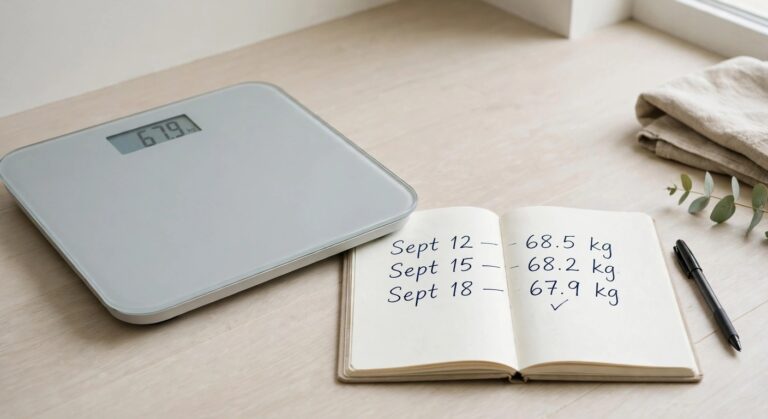
Calibration beats any formula alone. Track your calories and your weight for 2 to 4 weeks, then adjust by 100 to 200 calories based on what actually happened. This method works because it measures your real life, including the NEAT and appetite patterns no calculator can see.
- Eat a consistent calorie target based on your estimated TDEE and goal, and log food as honestly as you can.
- Weigh yourself daily under the same conditions, then compare weekly averages, not single days. Daily weight swings from water, salt, and food volume are normal.
- If weight is not moving in the direction you want after 2 to 4 weeks, adjust by 100 to 200 calories and track for another 2 weeks.
- Change one thing at a time. If you change calories, activity, and sleep all at once, you will not know which change mattered.
Small, patient adjustments win. A 100 calorie change is easy to live with and easy to measure over a few weeks. A 600 calorie swing is hard to sustain and hard to interpret. Think of your TDEE as a starting line, and your weekly average weight as the feedback that moves it.
How Often Should I Recalculate TDEE?
Every four to six weeks during active weight change, or every 3 to 5 kg lost or gained, whichever comes first.
Recalculate immediately after a big activity change, such as a new desk job, an injury, or a new training block, since a multiplier change moves TDEE by hundreds of calories. A number calculated months ago describes a different body living a different week.
Work Out Your Real TDEE From Your Own Data
Calibration gets much more useful when you turn it into a calculation instead of a guess. If you have eaten a steady number of calories and tracked your weight honestly for at least three weeks, your real TDEE is hiding in that data. Here is the method, step by step.
First, eat a consistent daily intake and log it as honestly as you can. Second, weigh yourself daily under the same conditions and compare weekly averages, not single days, since water, salt, and food volume swing daily weight by a lot. Third, convert the weekly change into a daily deficit or surplus with the 3,500 calorie per pound rule: multiply pounds lost per week by 3,500, then divide by 7 to get the daily deficit. Fourth, add that daily deficit back to your intake. The result is your estimated real TDEE.
A worked example makes it concrete. Suppose you ate 2,000 calories a day for three weeks and lost 1.5 pounds in total. That is 1.5 times 3,500, which equals 5,250 calories over 21 days, or 250 calories per day. Add that deficit back to intake: 2,000 plus 250 gives an estimated real TDEE of about 2,250 calories. That number beats any calculator for you personally, because it comes from your own body rather than a population average. Use it as your new baseline, set your next target from it, and repeat the check every few weeks.
This is also how you check any calculator result, including our own TDEE calculator, which uses the same Mifflin-St Jeor formula and activity multipliers as this guide. If your tracked result and the calculator disagree, trust the tracked result and adjust from there.
The 3,500 Calorie Rule Works Short Term, Not Forever
The back-calculation above uses the classic rule that one pound of body fat stores about 3,500 calories, so a 500 calorie daily deficit should mean one pound lost per week. That rule is fine for the first few weeks, but it overstates long-term loss, and knowing why prevents a lot of frustration.
As you get lighter, your body costs less energy to run, so the same intake produces a smaller and smaller deficit over time. A dynamic model published by Hall and colleagues in The Lancet in 2011 replaced the straight-line rule with a curve: a permanent change of 100 calories per day in intake leads to about 10 pounds of eventual weight change, with about half of that change arriving in the first year and nearly all of it by about three years (Hall and colleagues, 2011). Under that model, a 500 calorie daily deficit does not produce a pound a week forever. It produces a slowing curve that levels off at a new stable weight.
The practical lesson is simple. Use the 3,500 calorie rule for short-term planning and for the back-calculation above, since it is accurate enough over a few weeks. For goals longer than a few months, expect the curve: fast early, slower later, and a plateau that means your maintenance number has fallen, not that your body is broken. Recalculate and adjust, rather than assuming the rule failed you.
How TDEE Is Measured in a Lab
Formulas are convenient guesses. Real measurement works differently, and knowing the methods explains why lab numbers and calculator numbers sometimes disagree.
First, a terminology note. Resting energy expenditure, or REE, is the measured value: what you actually burn at rest. BMR is the same idea measured under the strictest conditions, after an overnight fast and complete rest. RMR, resting metabolic rate, is measured under looser conditions and comes out about 5 to 10 percent higher than BMR, as noted above. For everyday planning the difference does not matter much, but when you read studies, check which term they use.
Indirect calorimetry is the standard lab method for resting expenditure. You lie still under a ventilated hood or in a metabolic chamber while the device measures the oxygen you breathe in and the carbon dioxide you breathe out. From that gas exchange it calculates how much energy you are producing. It is accurate, but it needs a clinic visit, an overnight fast, and complete rest, which is why almost nobody gets it done casually.
Doubly labeled water is the gold standard for free-living TDEE. You drink water containing harmless heavy isotopes of hydrogen and oxygen, then researchers track how fast those isotopes leave your body in urine over one to three weeks. The difference in elimination rates reveals total carbon dioxide production, and therefore total energy expenditure, while you live normally. It is the most accurate way to measure TDEE, and also the most expensive and least available, which is why researchers use it to validate calculators and wearables rather than for personal use.
For everyone else, the practical path is a formula estimate plus a weight-trend check, as described above. That combination gets most people close enough to plan around.
How to Use Your TDEE
Once you know your TDEE, the rest of the plan is straightforward. Your goal decides whether you eat below, at, or above that number. The size of the gap decides how fast you move, and protein and resistance training decide what kind of weight you gain or lose. Once you know what is TDEE for your body, you can set a target.
- Lose weight: eat TDEE minus 300 to 500 calories per day. This is a moderate deficit that most people can sustain, and it usually produces about 0.5 to 1 pound of fat loss per week.
- Maintain weight: eat at TDEE. This is also the right target for a diet break or for learning what maintenance feels like before another fat loss phase.
- Gain muscle: eat TDEE plus 200 to 300 calories per day, with enough protein and consistent resistance training. A small surplus plus training builds muscle with less fat gain than a large surplus.
Percentages Scale Better Than Fixed Deficits
The goal bullets above use fixed deficits of 300 to 500 calories for fat loss and a surplus of 200 to 300 for muscle gain. Those are fine starting points, but percentages scale better across body sizes. A 500 calorie deficit is a large cut for someone whose TDEE is 1,800 and a modest one for someone whose TDEE is 3,200. A common framing is a deficit of 10 to 20 percent below TDEE for fat loss and a surplus of 10 to 20 percent above TDEE for muscle gain.
To convert, take your TDEE and multiply by the percentage. For the man in Worked Example 2 at 2,594 calories, a 20 percent deficit is about 519 calories, giving a target near 2,075. A 15 percent deficit is about 389 calories, giving a target near 2,205. For context, the 2013 AHA, ACC, and TOS obesity guideline recommends a deficit of 500 or 750 calories per day as one standard option, which lands near 20 to 25 percent for most adults. Percentages also make adjustments cleaner: if progress stalls, move by 5 percentage points rather than guessing a new fixed number. You can size either version with our calorie deficit calculator.
What Is a Good TDEE for Weight Loss?
There is no single number. Calculate your own TDEE, then eat 300 to 500 calories below it. A 500 calorie daily deficit is roughly 1 pound per week.
Protein Target for Muscle Gain
The gain-muscle bullet above says to eat above TDEE “with enough protein.” Here is the number behind “enough.” The International Society of Sports Nutrition position stand recommends 1.4 to 2.0 grams of protein per kilogram of body weight per day for exercising individuals. For an 80 kg person, that is 112 to 160 grams a day.
A widely cited 2018 meta-analysis of 49 resistance training trials with 1,863 participants found that extra protein stopped adding lean-mass gains beyond roughly 1.6 grams per kilogram per day (Morton and colleagues, 2018). For that same 80 kg person, that is about 128 grams a day, comfortably inside the ISSN range. More protein beyond that point did not build more muscle in the trials. Spread the target across meals, keep resistance training consistent, and let the small surplus plus training do the work. Our protein intake calculator and macro calculator can split your TDEE into daily targets.
Respect the floors. Do not eat below BMR long term, and as a general guide, do not go below about 1,200 calories per day for women or 1,500 calories per day for men without medical supervision. Very low intakes make it hard to get enough nutrients, hurt training and recovery, and are hard to sustain. If your calculated target falls below those floors, talk to a clinician or dietitian, and consider raising activity or choosing a smaller deficit instead. This is why what is TDEE matters more than BMR alone for dieting.
Recompute as your weight changes. If you lose 10 kg, your BMR drops, because a smaller body costs less energy to run. That is why plateaus happen. It is not a broken metabolism. It is the equation updating its inputs. Recalculate TDEE every few weeks during weight loss, and expect your maintenance number to fall as you get lighter. The same logic works in reverse during muscle gain. As weight falls, what is TDEE changes too, so recompute it.
Metabolic Adaptation: Why Your TDEE Drops When You Diet
If you diet for a long time and your weight loss stalls even though you changed nothing, you are probably meeting metabolic adaptation, also called adaptive thermogenesis. Your body defends its weight by burning less: resting expenditure falls as you get smaller, and the calories you burn through everyday movement quietly shrink as you fidget less, sit more, and move less without noticing. Hunger rises at the same time, so you are fighting both a smaller budget and a bigger appetite.
The numbers behind this are real. In a classic study, people maintaining a weight loss of 10 percent or more showed energy expenditure about 300 to 400 calories per day below what their smaller bodies alone would predict (Leibel and colleagues, 1995). Lower everyday movement accounts for much of that gap, which is why NEAT is not a footnote in this story. You will not see the extreme end of this effect from an ordinary diet, but the direction is the same: the longer and harder the deficit, the more your expenditure adapts downward.
Two responses help. First, recalculate your TDEE at your new weight instead of dieting on your old number, since part of the stall is just the equation updating its inputs. Second, consider a short diet break: one to two weeks at maintenance calories before resuming the deficit. A diet break will not undo adaptation overnight, but it gives you a psychological break, restores some training performance, and lets you check whether your maintenance calories are what you thought. If your weight stays stable during the break at a given intake, that intake is a good estimate of your current TDEE.
Why Your TDEE Changes Over Time
Weight change is the driver most readers know, but three others move TDEE just as surely. Together they explain nearly every “why did my number change” question.
First, weight change itself: a smaller body costs less energy to run, so TDEE falls as you lose weight and rises as you gain. Second, activity change: a new desk job, an injury, a training block, or a move from walking to driving can shift your multiplier by a full level, which moves TDEE by hundreds of calories overnight. Third, age: resting expenditure drifts down gradually as muscle is lost with age, even if weight stays the same. Fourth, dieting itself: as the adaptation section above explains, sustained deficits shrink everyday movement and resting burn beyond what the smaller body alone predicts.
The practical rhythm follows from these four drivers. Recalculate your TDEE every four to six weeks during active weight change, or every 3 to 5 kg lost or gained, and recalculate immediately after any big activity change, such as an injury or a new physical job. A number you calculated six months ago describes a different body living a different week.
Does TDEE Change as I Lose Weight?
Yes. A smaller body burns fewer calories, so TDEE falls. Recompute every few weeks, or plateaus will surprise you.
Should You Eat Back Exercise Calories?
The FAQ below answers this in one line. Here is the full reasoning, because it is one of the most asked practical questions on this topic.
If your TDEE already includes an activity multiplier, then no, do not add exercise calories on top. The multiplier already accounts for your workouts, so adding the 400 calories your watch claims you burned double counts them and quietly erases your deficit. This is the second most common mistake after picking too high a multiplier.
The second problem is that the watch number itself is unreliable. In a Stanford study of seven wrist devices, even the most accurate device was off by an average of 27.4 percent for energy expenditure, and the least accurate by 92.6 percent (Shcherbina and colleagues, 2017). None of the devices came close to the accuracy needed for calorie targets. Use the watch for trends, such as whether you moved more this month than last month, not for targets.
The exception is a genuinely unusual day: a long hike, a tournament, or a double training session far beyond your normal routine. On those days, eating back roughly half the extra estimated burn is a reasonable middle path, since exercise estimates tend to run high. On a normal training day, eat your planned TDEE target and let the weight trend judge it.
Should I Eat Back Exercise Calories?
Usually no, if your activity multiplier already includes your workouts. Eating them back often double-counts and erases the deficit.
When to Talk to a Clinician First
TDEE estimates are built for healthy adults, and some situations need professional guidance instead of a calculator. Talk to a clinician or registered dietitian before setting a calorie target if any of these apply to you: you are pregnant or breastfeeding; you have a current or past eating disorder; you have diabetes, a thyroid condition, a heart condition, or any condition that affects weight or metabolism; you take medication that affects appetite, weight, or metabolism; or you are setting targets for a child or teenager.
Very low targets deserve the same caution. If your calculated target falls below about 1,200 calories per day for women or 1,500 for men, or below your BMR for more than a short period, get professional input before proceeding, since very low intakes make it hard to get enough nutrients and can hurt training, recovery, and hormones. This guide is general information, not a prescription, and a clinician can adjust it to your situation.
Finally, put TDEE to work with the right tools. Use our BMR calculator to check your resting burn, our calorie calculator for a quick daily target, and our calorie deficit calculator to size your deficit. Then split that target with our macro calculator and check protein with our protein intake calculator. For background, read what a calorie deficit is and how many calories are in a pound of fat. The TDEE calculator page is the tool. This article is the guide. That is what is TDEE in practice: a number to calculate, test, and adjust.
Sources
- Mifflin MD, St Jeor ST, Hill LA, Scott BJ, Daugherty SA, Koh YO. A new predictive equation for resting energy expenditure in healthy individuals. Am J Clin Nutr. 1990.
- Frankenfield D, Roth-Yousey L, Compher C. Comparison of predictive equations for resting metabolic rate in healthy nonobese and obese adults: a systematic review. J Am Diet Assoc. 2005. PubMed
- Frankenfield D, et al. Validation of several established equations for resting metabolic rate in obese and nonobese people. J Am Diet Assoc. 2003. ScienceDirect
- Harris JA, Benedict FG. A biometric study of basal metabolism in man. Carnegie Institution of Washington. 1919.
- Roza AM, Shizgal HM. The Harris Benedict equation reevaluated: resting energy requirements and the body cell mass. Am J Clin Nutr. 1984.
- Jensen MD, Ryan DH, Apovian CM, et al. 2013 AHA/ACC/TOS guideline for the management of overweight and obesity in adults. Circulation. 2013. DOI
- Hall KD, Sacks G, Chandramohan D, et al. Quantification of the effect of energy imbalance on bodyweight. Lancet. 2011. DOI
- Leibel RL, Rosenbaum M, Hirsch J. Changes in energy expenditure resulting from altered body weight. N Engl J Med. 1995. DOI
- Jager R, et al. International Society of Sports Nutrition position stand: protein and exercise. J Int Soc Sports Nutr. 2017.
- Morton RW, et al. A systematic review, meta-analysis and meta-regression of the effect of protein supplementation on resistance training-induced gains in muscle mass and strength in healthy adults. Br J Sports Med. 2018. PMC
- Shcherbina A, et al. Accuracy in wrist-worn, sensor-based measurements of heart rate and energy expenditure in a diverse cohort. J Pers Med. 2017. DOI
- Westerterp KR. Doubly labelled water assessment of energy expenditure: principle, practice, and promise. Eur J Clin Nutr. 2017. PMC
- U.S. Department of Health and Human Services and U.S. Department of Agriculture. Dietary Guidelines for Americans, 2020-2025. Estimated calorie needs per day by age, gender, and physical activity level.
This article is general information only, not medical advice. Calorie needs vary with health conditions, medication, pregnancy, and training status. If you have a medical condition or a history of disordered eating, talk to a clinician or registered dietitian before changing your intake.
Frequently Asked Questions
What is TDEE?
Total Daily Energy Expenditure: all the calories you burn in 24 hours, including rest, digestion, movement, and exercise.
How do I calculate my TDEE?
Two steps: first calculate BMR with the Mifflin-St Jeor formula, then multiply by an activity factor from 1.2 (sedentary) to 1.9 (extra active). Or use the TDEE calculator on this site.
What is the difference between BMR and TDEE?
BMR is calories burned at complete rest. TDEE is BMR plus all daily activity, typically 400-1,200 calories higher.
Is TDEE or BMR used for weight loss?
TDEE. Your calorie deficit comes off TDEE, not BMR. Eating at BMR long-term starves the energy needed for movement, workouts, and hormones.
How accurate is a TDEE calculator?
Within about 10-15% for most people. Activity overestimation is the biggest error. Track weight for 2-4 weeks and adjust by 100-200 calories to calibrate your real number.