
How Many Calories Should I Eat to Gain Muscle?
Short answer: to gain muscle, eat your TDEE plus 200 to 350 calories per day. That small surplus gives your body the extra energy it needs to build new muscle without adding mu The answer to how many calories should I eat to gain muscle stays small: TDEE plus 200 to 350.ch fat. More food does not mean more muscle past a certain point, and this guide shows you where that point is.
If you already know your maintenance calories, you can use the table below to pick a surplus that matches your experience level. If you do not know your TDEE yet, start with our TDEE calculator and then come back. The rest of this article explains the numbers behind the table, compares a lean bulk with a dirty bulk, and shows you how to tell whether your surplus is working.
Key takeaways
- A lean bulk is your TDEE plus 200 to 350 calories per day, about 10 to 15 percent above maintenance.
- Bulk first only if you are already fairly lean. If you carry more body fat, cut or recomp first.
- Beginners gain about 1.5 to 2 lb of muscle per month. Advanced lifters gain about 2 to 3 lb per year.
- Train each muscle about 2 times per week, 10 to 20 sets per muscle per week, with progressive overload.
- Eat 1.6 to 2.2 grams of protein per kilogram per day, spread over at least 4 meals.
- Recalculate your TDEE every 4 to 6 weeks as you gain weight, or your surplus quietly shrinks.
The Short Answer: TDEE + 200-350 Calories
The formula is simple: calories to gain muscle equals TDEE plus a surplus. TDEE is the number of calories you burn in a day, including rest, digestion, movement, and training. Eat a little more than that, lift hard, and the extra energy goes toward building muscle.
For most people, a lean bulk surplus of 200 to 350 calories per day above TDEE is the evidence-based range. The common general recommendation is 250 to 500 calories. In percentage terms, that is about 10 to 15 percent above TDEE. A surplus in this range is enough to support the fastest muscle growth most natural lifters can achieve, without piling on fat.
If your TDEE is unknown, track your food and weight for 2 weeks at maintenance first. Eat a consistent amount, weigh yourself daily, and compare weekly averages. That gives you a real starting point instead of a guess. Then add the surplus on top.
- TDEE plus 200 to 350 calories per day for a lean bulk
- About 10 to 15 percent above TDEE
- Target weight gain of about 0.25 to 0.5 percent of body weight per week
- Bulk for 3 to 6 months, then reassess
Why is the surplus so small? Because building muscle is cheap compared with building fat. A pound of muscle tissue itself holds only about 700 to 800 calories, since muscle is roughly three quarters water. Counting the energy cost of building it, the commonly used estimate is roughly 2,500 calories of surplus per pound of muscle gained. That is an estimate, not a lab-measured value, but it explains the math: at 1 to 2 lb of muscle per month, the building cost is only about 80 to 160 extra calories per day. The article’s 200 to 350 calorie surplus covers that cost with room for tracking error. A 1,000 calorie surplus does not build muscle faster. It just buys fat.
How Many Calories Should I Eat to Gain Muscle by Experience
The right surplus depends on how long you have been training. Beginners can build muscle fast, so they can use a bigger surplus. Advanced lifters have less muscle left to gain, so a smaller surplus is right. Eating more than your body can use for muscle growth just adds fat, no matter how long you have been lifting.
| Experience level | Daily surplus above TDEE | Example at TDEE 2,500 |
|---|---|---|
| Beginner (less than 1 year) | +300 to 500 calories | 2,800 to 3,000 cal/day |
| Intermediate (1 to 3 years) | +200 to 300 calories | 2,700 to 2,800 cal/day |
| Advanced (3+ years) | +150 to 250 calories | 2,650 to 2,750 cal/day |
Worked examples: a beginner with a TDEE of 2,500 should eat about 2,800 to 3,000 calories per day. An advanced lifter with the same TDEE needs only about 2,650 to 2,750 calories per day. The difference is small on paper, but over months it is the difference between a lean bulk and a slow fat gain phase.
Should Women Use a Different Calorie Surplus Than Men?
The percentage is the same but the absolute number is smaller, because women typically have a lower maintenance intake. A lean bulk of about 10 to 15 percent above maintenance works for both sexes.
What differs is the gain rate: women gain muscle at roughly half the rate of men, about 0.75 to 1 lb per month as beginners compared with 1.5 to 2 lb for men, and advanced women gain about 1 to 2 lb per year.
Hunger and performance can also vary across the menstrual cycle, so judge progress by weekly averages rather than single days.
Find Your Number in the Table
If you know your maintenance calories, this table gives your lean bulk target at once. It is the article’s own 200 to 350 calorie range applied to common maintenance levels, so it agrees with the experience table above.
| Your TDEE (maintenance) | Lean bulk target per day |
|---|---|
| 1,800 calories | 2,000 to 2,150 calories |
| 2,000 calories | 2,200 to 2,350 calories |
| 2,200 calories | 2,400 to 2,550 calories |
| 2,500 calories | 2,700 to 2,850 calories |
| 2,800 calories | 3,000 to 3,150 calories |
| 3,000 calories | 3,200 to 3,350 calories |
Beginners can use the top of the range or a little above it, up to about 500 calories over maintenance, since they gain fastest. Advanced lifters should stay near the bottom, around 150 to 250 calories over maintenance. If your maintenance falls between two rows, pick the nearer row and let the 2-week calibration loop in this guide do the fine tuning.
Worked example (illustrative, not a real person): take a 30-year-old man who weighs 180 lb, stands 5 ft 10 in, and trains 4 days a week. His maintenance comes out at about 2,650 calories a day. A lean bulk for him is about 2,900 calories a day, which is his maintenance plus a 250 calorie surplus. His protein target is about 130 to 180 grams a day, from 1.6 to 2.2 grams per kilogram of his 82 kg body weight. If you do not know your maintenance yet, start with the TDEE calculator and then come back to this table.
Beginners sometimes hear that they should eat everything in sight. That advice wastes the beginner advantage. A beginner gains muscle fast even on a moderate surplus, so there is no need to force feed. Save the big appetite for when progress slows.
Should You Bulk First, or Cut First?
A surplus is only the right advice if bulking is the right phase. Many readers asking how many calories to gain muscle are really asking whether they should bulk at all, including the skinny-fat case: low muscle, a soft midsection, and a normal scale weight. The rule below uses body fat percentage, because how your body partitions a surplus depends on how lean you already are. The leaner you start, the more of the surplus goes to muscle. The fatter you start, the more goes to fat. This process is called nutrient partitioning, and it is why the same surplus builds different bodies in different people.
| Your starting point | Best first move |
|---|---|
| Men below about 15 percent body fat, women below about 25 percent | Lean bulk. You are lean enough that most of the surplus can go to muscle. |
| Men above about 15 percent, women above about 25 percent | Cut first, or recomp if you are new to lifting. Bulking now mostly adds fat you will have to diet off later. |
| Skinny-fat: low muscle, soft midsection, normal weight | Recomp at maintenance. Eat at maintenance with high protein and progressive training, and let fat fall while muscle rises. |
| Very lean: men near 10 percent, women near 18 percent | You can push a slightly larger surplus, since you have the most room before fat gain becomes the problem. |
The thresholds above are practical coaching guidelines used across bulking guides, not cutoffs from a single study, so treat them as decision aids rather than medical lines. If you do not know your body fat percentage, the lean body mass calculator gives a rough picture, or use the mirror test: visible abdominal outline in good lighting usually means you are lean enough to bulk.
Recomp deserves a note because the article’s FAQ mentions it only in passing. A 2020 review by Barakat and colleagues in the Strength and Conditioning Journal found that even trained lifters can build muscle and lose fat at the same time, provided three things line up: progressive resistance training, high protein at about 1.6 to 2.4 grams per kilogram per day, and an energy intake near maintenance or in only a small deficit. Recomp is slowest for lean, advanced lifters, who usually do better with dedicated bulk and cut phases. For beginners, returning lifters, and people with more body fat, it is often the best first move.
Lean Bulk vs Dirty Bulk
A lean bulk means a small, controlled surplus. A dirty bulk means eating far more than you need, often with little attention to food quality. Both can build muscle, but they lead to very different places. Here is a head-to-head lean vs dirty bulk comparison.
| Factor | Lean bulk | Dirty bulk |
|---|---|---|
| Daily surplus | 200 to 350 calories | 500 to 1,000+ calories |
| Monthly weight gain | 0.5 to 1 kg | 1 to 2 kg |
| Share of gain that is fat | Roughly 10 to 20 percent | Roughly 30 to 50 percent |
| Cut needed after | Short cut, if any | Long cut |
| Health and energy | Easier to sustain | Harder on digestion, blood markers, and energy |
Verdict: for natural lifters, the lean bulk wins. A dirty bulk adds muscle a little faster at best, then costs you months of dieting to strip the fat back off. Most lifters who try a dirty bul That is why the answer to how many calories should I eat to gain muscle is a lean bulk for most people.k regret it. The lean bulk keeps you looking good while you grow, and the cut afterward is short and painless by comparison.
That does not mean a dirty bulk never works. Very skinny lifters who struggle to eat enough sometimes benefit from a more aggressive approach for a short time. But even then, a surplus of 300 to 500 calories is usually plenty. There is rarely a reason to eat 1,000 calories above maintenance.
Why Eating More Stops Helping
Muscle protein synthesis has a speed limit. Your body can only build new muscle tissue so fast, no matter how much food you give it. Once you pass that limit, extra calories have So the question of how many calories should I eat to gain muscle is really about finding the smallest surplus that maxes out that speed limit. nowhere useful to go, so they get stored as fat.
Research points to a ceiling. Surpluses beyond about 10 to 15 percent above TDEE do not meaningfully accelerate muscle gain in natural athletes (Hall et al., 2012). They mostly add fat. That is why the lean bulk range in this guide tops out where it does.
The ceiling on muscle gain is real too. At best, a natural lifter can gain about 0.5 to 1 kg of lean muscle per month, and that is at the fast end for beginners. Advanced lifters gain far less. Anyone promising 3 kg of pure muscle in a month is selling something.
Think of it this way. Training is the signal that tells your body to build muscle. Food is the fuel that makes it possible. Without progressive resistance training, extra calories become fat, not muscle. You cannot eat your way to muscle without lifting, and you cannot out-eat a missing training stimulus.
This is also why protein matters alongside calories. A surplus with too little protein builds less muscle than the same surplus with enough protein. The next section covers the macro targets that go with your calorie target.
How Fast Will You Actually Gain Muscle?
The article says advanced lifters gain far less than beginners, but never says how much less. This table replaces that vague line with the rates coaches actually plan around. They come from the widely used models of Lyle McDonald and Alan Aragon, which express gain as a percentage of body weight per month and agree closely in absolute terms.
| Training stage | Men | Women |
|---|---|---|
| Beginner (first year of proper training) | 1.5 to 2 lb of muscle per month | 0.75 to 1 lb of muscle per month |
| Intermediate (years 2 to 3) | 0.5 to 1 lb of muscle per month | 0.25 to 0.5 lb of muscle per month |
| Advanced (3 or more years) | 2 to 3 lb of muscle per year | 1 to 2 lb of muscle per year |
Three notes keep these numbers honest. First, they are muscle, not scale weight. The scale moves faster, because glycogen, water, and some fat come along with the muscle. Second, women gain at roughly half the rate of men, which is why the table splits by sex instead of giving one number for everyone. Third, these are ceilings under good training, good protein, and good sleep, not averages. Missing any one of those pulls you below your row. If your gains beat the table for months on end, you are probably gaining fat alongside the muscle, and the waist check in this guide will show it.
The Training Dose That Turns Calories Into Muscle
Calories without a training dose are half the answer. The surplus only becomes muscle if training signals your body to build, and that signal has a dose. A 2017 meta-analysis by Schoenfeld and colleagues found a dose-response relationship between weekly training volume and muscle growth, with 10 or more sets per muscle group per week producing the largest gains. The practical range most coaches use is 10 to 20 quality sets per muscle group per week, spread over about 2 sessions per muscle, so each muscle is trained roughly twice a week.
The rest of the dose matters as much as the set count. Most sets should sit in the 6 to 12 rep range, using a mix of compound lifts (squat, hinge, press, row, pulldown) and isolation work for smaller muscles. Finish most sets 1 to 3 reps short of failure, which coaches call 1 to 3 reps in reserve, so you can recover and repeat the effort all week. And the dose must rise over time: add weight, reps, or sets week by week. That steady rise is progressive overload, and without it the surplus has nowhere to go but fat.
A sample 4-day split that fits this dose looks like this. Monday: upper body. Tuesday: lower body. Thursday: upper body again. Friday: lower body again. Each session runs 4 to 6 exercises, and each muscle ends the week at 10 to 20 sets. Use the one-rep max calculator to set sensible starting loads, then add a little each week. Recovery between sessions for the same muscle is usually 24 to 72 hours, which is exactly why the twice-a-week pattern works: each muscle is rested by the time it is trained again.
What Macros to Eat While Gaining Muscle
Calories set the size of the surplus. Macros decide what your body does with it. For gaining muscle, protein is the priority, fat supports hormones, and carbs fuel hard training.
- Protein: 1.6 to 2.2 grams per kg of body weight per day. This range covers the needs of most lifters. Beginners do well at the lower end, while advanced lifters and those dieting down from a bulk may need the upper end. Read our full guide to how much protein you need to build muscle.
- Fat: 0.8 to 1.2 grams per kg of body weight per day, and at least 20 percent of total calories. Fat matters for hormones, including testosterone, so do not cut it too low while bulking.
- Carbs: fill the rest of your calories, typically 4 to 6 grams per kg of body weight per day. Carbs fuel hard training, refill glycogen, and make it easier to hit a calorie surplus because carb-rich foods are easy to eat in volume.
A practical way to set this up: pick your calorie target, set protein and fat by the ranges above, then let carbs fill whatever calories remain. Use our macro calculator and protein intake calculator to get exact numbers for your body weight. Use the numbers to answer how many calories should I eat to gain muscle, then let the scale tell you whether to adjust.
Food quality still matters. A surplus built on mostly whole foods, with plenty of fruit, vegetables, and fiber, keeps digestion comfortable and micronutrients covered. A surplus built on ultra-processed food can still build muscle, but it usually leaves you feeling worse and hungrier between meals. Whole foods make it easier to hit the answer to how many calories should I eat to gain muscle without feeling stuffed.
Spread Your Protein Across at Least 4 Meals
The article gives a daily protein total but never says how to split it, and the split matters. Muscle protein synthesis, the process that builds new muscle, is triggered meal by meal, and the trigger amino acid is leucine. A 2018 review by Schoenfeld and Aragon in the Journal of the International Society of Sports Nutrition concluded that the per-meal dose that maximizes the response is 0.4 to 0.55 grams of protein per kilogram of body weight, spread over at least 4 meals, which is how the daily 1.6 to 2.2 grams per kilogram total is reached in practice.
For an 80 kg lifter, that works out to about 32 to 44 grams of protein per meal across 4 meals. In plain food terms, that is a palm and a half of meat, or 3 to 4 eggs with dairy, or a large serving of Greek yogurt with nuts. The common mistake is the skewed day: a tiny protein breakfast, a light lunch, then a huge dinner. That pattern leaves most of the day’s meals below the trigger dose. Even it out, and every meal pulls its weight. Total daily protein still matters most, so do not obsess over timing, but an even split is free progress on top of the same total.
What Happens If I Eat Too Much Protein During Bulking?
Mostly nothing dramatic, but nothing useful either. Past about 2.2 grams per kilogram per day, extra protein adds little or no extra muscle, and it displaces carbs that could fuel training.
In healthy people, studies have not shown kidney harm from high protein intakes, but very high intakes can cause digestive discomfort and make the diet harder to sustain.
The sensible range stays 1.6 to 2.2 grams per kilogram per day, spread over at least 4 meals.
What a Lean Bulk Day Actually Looks Like
Readers who have their calorie number still ask what to eat, so here is a full sample day at about 2,800 calories and about 140 grams of protein, which suits an 80 kg lifter at about 1.75 grams per kilogram. Adjust the portions to your own target from the lookup table; the structure is what matters, not the exact foods.
| Meal | Example | About |
|---|---|---|
| Breakfast | Oats with milk, a spoonful of nut butter, a banana, and 2 eggs | 700 calories, 35 g protein |
| Lunch | Chicken breast, rice with olive oil, and vegetables | 800 calories, 40 g protein |
| Snack | Milk, protein powder, fruit, and oats blended as a shake | 400 calories, 25 g protein |
| Dinner | Beef or salmon, potatoes, and vegetables | 900 calories, 40 g protein |
The food lists behind a day like this are short. Protein sources: chicken, turkey, beef, fish, eggs, Greek yogurt, cottage cheese, tofu, and lentils. Carb sources: rice, oats, potatoes, pasta, bread, and fruit. Fat sources: olive oil, nuts, nut butter, avocado, and cheese. A practical rule of thumb from bulking coaches is to build about 80 to 90 percent of the day from whole foods and leave 10 to 20 percent flexible, which keeps digestion comfortable and micronutrients covered without turning the bulk into a chore. Full guidance on splitting the total lives in the protein for muscle guide and the macro calculator.
Do I Need to Eat More on Rest Days?
Not much. Keep calories roughly the same daily for simplicity, or slightly lower on rest days.
Consistency beats daily zigzagging.
Does Cardio Hurt Muscle Gain?
No, at sensible doses it does not, and skipping all movement to protect a surplus is a mistake. Light to moderate cardio at 2 to 3 sessions per week, 20 to 30 minutes each, is compatible with gaining muscle, and it keeps your heart and work capacity in shape for harder training. A daily step target of about 7,000 to 10,000 steps is a useful general activity baseline on top of training, since non-exercise activity, known as NEAT, is part of your total daily burn and varies a lot between people.
The one adjustment cardio requires is eating it back. A moderate 30-minute session burns roughly 200 to 400 calories depending on your size and intensity, so a lifter who runs or plays sport several times a week needs that amount added on top of the bulk target, or the surplus silently disappears. This is also why endurance athletes struggle to gain: their activity burns the surplus before muscle ever sees it. If your weight stalls after adding cardio, add the session calories back first before assuming the bulk target was wrong.
No, at sensible doses. Light to moderate cardio at 2 to 3 sessions per week, 20 to 30 minutes each, does not hurt gains and keeps your heart and work capacity in shape.
The adjustment is to eat the session back: a moderate 30-minute session burns roughly 200 to 400 calories depending on your size and intensity, so add that on top of your bulk target or the surplus silently disappears.
Sleep and Recovery Decide What the Surplus Becomes
Recovery is where the surplus turns into muscle or fat, and sleep is the largest part of it. Adults generally need 7 to 9 hours of sleep a night, and lifters are no exception. Muscle protein synthesis stays elevated for roughly 24 to 48 hours after a training session, which means the meals and sleep in the two days after training matter as much as the session itself. Growth hormone, which supports tissue repair, is released mainly during deep sleep, so short nights cut into the repair window directly.
The hormone cost of short sleep is measured, not guessed. In a 2011 study published in JAMA, Leproult and Van Cauter found that young healthy men sleeping 5 hours a night for one week had testosterone levels 10 to 15 percent lower than when fully rested, along with lower vigor scores. That is roughly the same decline as 10 to 15 years of aging, in a single week. Practical sleep basics cover most of it: a consistent bedtime, a dark and cool room, and no heavy training or large meals right before bed. If your lifts stall and your waist climbs while your food and training look right, sleep is the first place to check.
How to Know If Your Surplus Is Right
The scale, the tape measure, and the barbell tell you whether your surplus is right. Check all three, because no single number tells the full story.
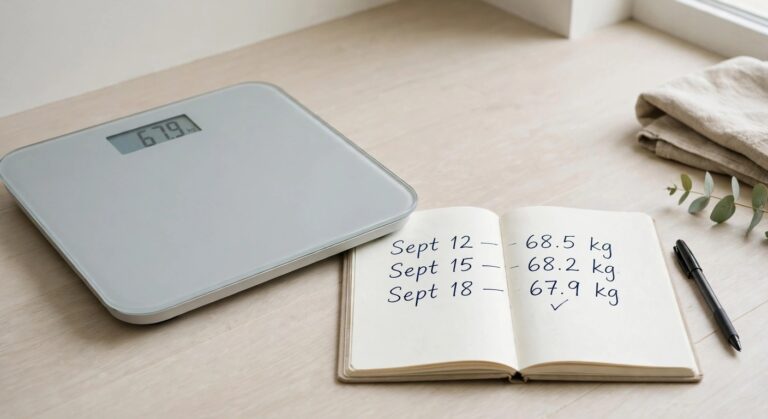
- Weight trend: aim to gain about 0.25 to 0.5 percent of your body weight per week. For an 80 kg lifter, that is about 0.2 to 0.4 kg per week. Weigh yourself daily under the same conditions and compare weekly averages, not single days.
- Waist check: measure your waist at the navel every 2 weeks. If your waist climbs more than about 0.25 inches (0.6 cm) per month, your surplus is too big and the extra food is becoming fat.
- Lifts improving: your lifts should go up steadily over weeks. If your weight is climbing but your lifts are stuck, the gain is probably fat, not muscle.
- Look and feel: clothes should fit a little tighter in the shoulders and chest, not only at the waist. Energy should be good. Constant bloating and sluggishness are signs the surplus is too large.
The 2-week calibration loop: run your surplus for 2 weeks, then look at the trend. If weight is flat and lifts are stuck, add 100 to 150 calories per day. If weight is climbing too fast or t This 2-week loop is how you fine-tune your answer to how many calories should I eat to gain muscle.he waist is climbing fast, cut 100 to 150 calories per day. Change one thing at a time so you know what worked.
Be patient. Two weeks is the minimum to see a real trend, because water weight and gut content can swing the scale by a kilogram or more from day to day. Judge the average, not the daily number. Trust the answer to how many calories should I eat to gain muscle, and give it time to work.
What If I Am Gaining Weight Too Fast?
Cut the surplus by 100-150 calories.
If the waist is climbing fast, the extra food is becoming fat, not muscle.
Why Your Surplus Shrinks as You Gain: TDEE Drift
The article’s 2-week loop adjusts by 100 to 150 calories, but it never says why the adjustment keeps being needed. The reason is TDEE drift: as you gain weight, your maintenance rises too, because a heavier body burns more at rest and costs more to move around. A surplus that started at 300 calories can quietly shrink to 100 calories after a few kilograms gained, and the bulk stalls even though nothing in your diet changed. This is one form of metabolic adaptation, the body’s general tendency to adjust its burn as weight and intake change.
The fix is systematic recalculation. Recalculate your maintenance every 4 to 6 weeks at your new body weight, using the same method you started with. Most TDEE estimates are built on the Mifflin-St Jeor equation for resting burn, multiplied by an activity factor, so a fresh calculation at your new weight gives a fresh target. The stakes of skipping this are larger than they look: a 200 calorie error in your maintenance estimate compounds to about 6,000 calories over a month, which is nearly 2 lb of expected gain that never arrives. Recalculate on schedule, and the stall in month 2 or 3 usually fixes itself.
If You Struggle to Eat Enough
The article’s hardgainer FAQ says to start at maintenance plus 300 to 500 calories and track, but gives no method for actually eating that much. Hard gainers usually fail on volume and appetite, not on knowledge, so the tactics are about energy density and frequency. Energy-dense foods pack more calories into each bite: oats with nut butter, rice with olive oil, trail mix, smoothies, and full-fat dairy all add calories without adding much bulk. Liquid calories help most of all, since a shake with fruit, milk, and protein powder can add 400 calories that a solid meal would struggle to fit.
Frequency is the second lever. Moving from 3 meals to 4 or 5 smaller meals, with a shake between them, spreads the same target across more sittings and keeps any single meal manageable. A few smaller habits help too: drink less water right before meals so you arrive hungry, keep ready snacks visible, and cook with oil and butter rather than steaming everything plain. If you still cannot gain after 2 weeks of honest tracking at the target, the problem is usually the target, not your appetite: recalculate your maintenance, because many hard gainers are simply more active than their estimate assumes.
Supplements: Only Creatine Earns a Paragraph
Supplements do not replace food or training, and most of them are not worth the money. One is. Creatine monohydrate is the most studied sports supplement available, and the International Society of Sports Nutrition position stand by Kreider and colleagues (2017) concludes it is both safe and effective for increasing high-intensity exercise capacity and lean body mass during training. The dose is 3 to 5 grams of creatine monohydrate per day. No loading phase is required: a daily 3 to 5 gram dose saturates muscle stores over about 3 to 4 weeks. An optional loading phase of about 0.3 grams per kilogram per day for 5 to 7 days fills stores faster, but the end point is the same.
Protein powder belongs in the same honest category: a convenience tool, not a necessity. It helps when a meal’s protein target is hard to hit from food, especially in the shake described in the sample day above, but it builds no more muscle than the same protein from chicken or yogurt. Everything else marketed to lifters, from testosterone boosters to mass gainers, is either unproven or an expensive way to buy calories you could get from food. Spend the money on food and sleep first.
Common Bulking Mistakes
Most failed bulks fail in the same few ways, and every one of them is avoidable. The first is the aggressive surplus: jumping to 1,000 calories over maintenance on day one, which mostly buys fat and a long cut later. The second is unstructured training, lifting without a plan or without progressive overload, so the surplus has no signal to follow. The third is skipping sleep, which cuts recovery and hormones at the same time. The fourth is inconsistent protein tracking, hitting the calorie target with carbs and fats while protein drifts below the range. The fifth is ignoring TDEE drift, running the same target for months while maintenance rises underneath it. The sixth is judging the bulk by daily scale weight, which swings by a kilogram or more from water and gut content, instead of by weekly averages. Fix any one of these and the bulk usually starts working again. Fix all six and it rarely stalls for long.
Tracking Beyond the Scale
The article tracks weight trend, waist, lifts, and look and feel, which is a good start, but scale weight alone cannot separate muscle from fat, and that separation is the whole question behind a bulk. Add three measurements. First, chest, arm, and thigh circumference every 4 to 6 weeks, measured at the same spots under the same conditions. Arms and chest growing while the waist holds steady is the shape of a working bulk. Second, progress photos once a month, same lighting, same poses, same clothing, so changes too slow to notice day by day become visible month by month. Third, a body-composition check such as a DEXA scan every 8 to 12 weeks, if you have access to one, as an optional confirmation rather than a necessity. The scale tells you how much you gained. Measurements and photos tell you what you gained. A bulk judged only by the scale is a bulk judged blind.
Can I Lean Bulk Without Counting Calories?
Yes, with less precision. Use hand portions as a guide: a palm or two of protein, a fist or two of carbs, and a thumb or two of fats at each meal, across 4 meals a day, then weigh yourself weekly and check your waist every 2 weeks.
If weight rises about 0.25 to 0.5 percent per week with a steady waist, the portions are right.
If weight stalls for 2 weeks, add a snack or a larger portion at one meal.
Counting is more reliable at first, because most people misjudge portions, but once you know what your target looks like on a plate, portions plus weekly weigh-ins can hold it.
Why Am I Gaining Fat Instead of Muscle?
This is the highest-anxiety moment in a bulk, and it has only three usual causes. Work through them in order. First, the surplus is too big: if weight climbs faster than about 0.5 percent of body weight per week and the waist climbs with it while lifts stall, cut the surplus by 100 to 150 calories. Second, protein is too low: if calories are on target but protein sits below 1.6 grams per kilogram, the surplus builds less muscle per calorie, so fix protein before changing calories. Third, training is not progressive: if the weights, reps, or sets have not risen in weeks, the muscle-building signal is missing, and no surplus can replace it. Check your training log before your food log on this one.
One pattern rules out all three causes at once: weight up, strength up, waist steady. That is a working bulk, even if the mirror changes feel slow. The opposite pattern, weight up, waist up fast, strength flat, is almost always cause one or three, not bad genetics. Diagnose before you overhaul. Most lifters who quit a bulk in frustration were one 150 calorie adjustment or one training fix away from it working.
Usually one of three causes: your surplus is too big, your protein is too low, or your training is not progressive.
If weight climbs faster than about 0.5 percent of body weight per week and your waist climbs with it while lifts stall, cut the surplus by 100 to 150 calories.
If protein sits below 1.6 grams per kilogram, fix protein before changing calories.
If weights, reps, or sets have not risen in weeks, the training signal is missing and no surplus can replace it.
When to End a Bulk and Switch to a Cut
How Long Should I Bulk For?
Typically 3-6 months.
Then reassess: keep going, maintain, or cut depending on body fat and goals.
The article says to bulk 3 to 6 months and then reassess, but gives no end criteria. Here they are. End the bulk when any of these arrive: your body fat reaches the cut-switch zone of about 18 to 20 percent for men or 26 to 28 percent for women; your waist has climbed steadily for a month while strength has stalled; or you have simply run the bulk for 4 to 6 months and feel uncomfortable carrying more fat. Those cutoffs are commonly used coaching guidelines, not medical lines, but they stop the classic error of bulking until a 6-month cut becomes necessary.
You have two exits, not one. The first is a full cut: switch to a modest deficit and keep protein high and training heavy to hold the muscle you built. Guidance for the deficit side lives in the calorie deficit guide. The second is a mini-cut: a short 4 to 6 week deficit inserted after a 12 to 16 week bulk, just long enough to trim the fat gained and restore insulin sensitivity and appetite, then back to bulking. Mini-cuts suit lifters who want to bulk for most of the year without drifting too far from leanness. Either way, the bulk ends on a decision, not on drift, and the next phase starts with the muscle you kept, not the fat you have to lose.
When Do I Switch From Bulking to Cutting?
Switch when your body fat reaches about 18 to 20 percent for men or 26 to 28 percent for women, when your waist has climbed steadily for a month while strength has stalled, or when you have bulked for 4 to 6 months and feel uncomfortable carrying more fat.
A shorter option is a mini-cut: 4 to 6 weeks in a modest deficit after a 12 to 16 week bulk, then back to bulking.
Either way, keep protein high and training heavy during the cut to hold the muscle you built.
How to Find Your Exact Number
Your exact calorie target is your TDEE plus the surplus that fits your experience level. The fastest way to get it is to use the calculators on this site. Start with the TDEE calculator to estimate your maintenance calories, then use the calorie calculator to set your daily target and the macro calculator to split it into protein, fat, and carbs. Check your protein with the protein intake calculator.
Two more tools help. The one-rep max calculator helps you plan progressive overload, which is the training signal that turns extra calories into muscle. The lean body mass calculator gives you a better picture of your composition than body weight alone.
For background reading, see what is TDEE for the full explanation of maintenance calories, and how much protein you need to build muscle for the protein side of the plan. This article answers the surplus question and the lean versus dirty bulk choice. Those guides cover the rest.
Once you have your number, keep it simple. Hit your calorie target most days, hit your protein target every day, train hard with progressive overload, and let the 2-week loop do the fine tuning. Consistency beats perfection. Once you have your personal answer to how many calories should I eat to gain muscle, the rest is consistency.
Give the plan at least 2 weeks before you change anything. Weigh yourself a few times a week, take the weekly average, and let the scale, the tape measure, and the barbell tell you what to do next. Stick with it, and the answer to how many calories should I eat to gain muscle will prove itself on the scale and the barbell.
A Note on Safety
This guide is general information, not medical advice. A calorie surplus is not right for everyone, and some readers should talk to a doctor or dietitian before starting one. That includes people with kidney disease, diabetes, digestive problems, a history of disordered eating, or anyone taking daily medication that affects weight, appetite, or metabolism. The same applies if you are pregnant, breastfeeding, under 18, or managing any condition where weight gain could complicate treatment. The numbers in this guide assume a healthy adult who trains regularly. If that is not you, get personal advice first and use this guide as background, not as a prescription.
Sources
- Schoenfeld BJ, Ogborn D, Krieger JW. Dose-response relationship between weekly resistance training volume and increases in muscle mass: a systematic review and meta-analysis. Journal of Sports Sciences, 2017. ResearchGate
- Schoenfeld BJ, Aragon AA. How much protein can the body use in a single meal for muscle-building? Implications for daily protein distribution. Journal of the International Society of Sports Nutrition, 2018. CUNY Academic Works
- Kreider RB, Kalman DS, Antonio J, Ziegenfuss TN, Wildman R, Collins R, Candow DG, Kleiner SM, Almada AL, Lopez HL. International Society of Sports Nutrition position stand: safety and efficacy of creatine supplementation in exercise, sport, and medicine. Journal of the International Society of Sports Nutrition, 2017.
- Jager R, Kerksick CM, Campbell BI, Cribb PJ, Wells SD, Skwiat TM, Purpura M, Ziegenfuss TN, Ferrando AA, Arent SM, Smith-Ryan AE, Stout JR, Arciero PJ, Ormsbee MJ, Taylor LW, Wilborn CD, Kalman DS, Kreider RB, Willoughby DS, Hoffman JR, Krzykowski JL, Antonio J.. International Society of Sports Nutrition position stand: protein and exercise. Journal of the International Society of Sports Nutrition, 2017.
- Barakat C, Pearson J, Escalante G, Campbell B, De Souza EO. Body recomposition: can trained individuals build muscle and lose fat at the same time? Strength and Conditioning Journal, 2020. ResearchGate
- Leproult R, Van Cauter E. Effect of 1 week of sleep restriction on testosterone levels in young healthy men. JAMA, 2011. PMC
Frequently Asked Questions
How many calories should I eat to gain muscle?
Your TDEE plus 200-350 calories for a lean bulk. Beginners can use 300-500; advanced lifters need only 150-250.
Can I gain muscle without a calorie surplus?
Beginners and overweight lifters sometimes can (recomposition), but a small surplus is far more reliable for most people.
Is 3,000 calories enough to gain muscle?
It depends on your TDEE. If your TDEE is 2,500, then 3,000 is a 500-calorie surplus, plenty. If your TDEE is 3,200, then 3,000 is a deficit and you will not gain.
How many calories to gain muscle without gaining fat?
Some fat gain is normal, but a 200-350 calorie surplus keeps it small. Expect roughly 80-90% of the gain to be lean mass on a lean bulk.
Should hardgainers eat more?
A hardgainer usually needs a real surplus with consistent tracking, not an extreme one. Start at TDEE + 300-500, track 2 weeks, then adjust by 100-150 calories.