
How to Lose Belly Fat: What Actually Works
Short answer: you cannot spot-reduce belly fat. No amount of crunches will melt the fat sitting on top of your abs. But here is the good news most people miss. Visceral fat, the deep, dangerous fat around your organs, is the first fat to go when you get into a calorie deficit. That means the fat that matters most for your health is also the fat that responds fastest. This article gives you the 5-lever plan that actually works: a moderate deficit, protein and fiber, exercise that targets visceral fat, sleep and stress, and cutting the drivers that push fat to your belly. No hacks, no detox teas, no waist trainers. Just the levers, the numbers, and a realistic timeline. Here is how to lose belly fat for good.
Before the plan, one quick reality check. Belly fat is not one thing. There are two types, and they behave very differently. The pinchable layer under your skin is subcutaneous fat. The deeper fat wrapped around your liver, intestines, and other organs is visceral fat. You cannot see visceral fat, and you cannot pinch it, but it is metabolically active. It releases inflammatory compounds straight into your liver through the portal vein, which is why it drives so much disease risk. The table in the next section lays out the difference. Keep it in mind as you read, because almost every lever in this plan works by shrinking visceral fat first.
Key takeaways
- You cannot spot-reduce belly fat, but visceral fat, the dangerous deep fat, is the first to go in a calorie deficit.
- Aim for a moderate deficit of 300 to 500 calories a day, protein at 1.2 to 2.0 grams per kilogram, and about 30 grams of fiber a day.
- Combine aerobic exercise with strength training twice a week. Together they beat either one alone for visceral fat.
- Protect sleep and manage stress, because cortisol pushes fat toward the belly.
- Cut the drivers: liquid sugar, refined carbs, trans fats, alcohol, and long sitting hours.
- Expect waist changes in 4 to 8 weeks and lower-belly changes at 12 weeks or more. Do not quit at week 6.
The Two Types of Belly Fat
Subcutaneous fat is the pinchable layer just under the skin. If you want to know how to lose belly fat, start by knowing which type you are fighting. It is the fat you can grab, and it is mostly a cosmetic issue. It is also relatively quiet metabolically. Visceral fat is different. It wraps around your organs, you cannot pinch it, and it is highly active. It releases inflammatory compounds into the liver through the portal vein, which helps explain why visceral fat is linked to about 5 times the risk of type 2 diabetes, plus higher risks of heart disease and stroke, fatty liver disease, and higher colorectal and breast cancer risk. That sounds alarming, and it should motivate action, but it is not a reason to panic. Visceral fat is also the most responsive fat in the body. When you create a steady calorie deficit, it is typically the first fat to come off.
| Feature | Subcutaneous fat | Visceral fat |
|---|---|---|
| Location | Just under the skin | Around the organs |
| Pinchable? | Yes, you can pinch it | No, it is deep inside |
| Health risk | Mostly cosmetic | High: diabetes, heart disease, fatty liver, cancer risk |
| Responsiveness | Slower to lose, often last to go | First to go in a calorie deficit |
| What to do | Lose overall body fat | Same levers, and it responds first |
Here is the encouraging part. Even 10 lbs of weight loss can cut visceral fat by up to 30 percent. And a 2019 clinical study found that a 5 to 7 percent body-weight reduction through diet alone significantly reduces both subcutaneous and visceral fat. You do not need a dramatic transformation to get a meaningful health win. That is why learning how to lose belly fat starts with this fact: a modest, steady loss moves the most dangerous fat first. That is why the scale and the tape measure tell different stories in the early weeks. The scale may move slowly, but your waist may already be shrinking, because visceral fat is leaving first.
Is Your Belly Fat Dangerous? Measure It First
The disease list in the section above is only useful if you can check where you stand, so here is how to measure, and the numbers that matter. You need a flexible cloth tape measure and two minutes. Stand straight and wrap the tape around your bare stomach just above your hip bone, which you can feel on both sides. Keep the tape level all the way around and snug against the skin, but not pressing into it. Stand relaxed, breathe out normally, and read the number without sucking in. Measure in the morning, once a week, in the same spot every time, because consistency matters more than any single reading.
| Measure | Elevated risk |
|---|---|
| Waist circumference, women | More than 35 inches (about 89 cm) |
| Waist circumference, men | More than 40 inches (102 cm) |
| Waist-to-height ratio, everyone | 0.5 or higher (waist at least half your height) |
For people of South Asian or East Asian ancestry, the commonly used waist cutoffs are lower: about 31.5 inches for women and 35.5 inches for men. If your number sits above the line for your sex, that is a prompt to act, not a verdict. Waist size is a screening clue, and your doctor can put it together with blood pressure, blood sugar, and cholesterol for the full picture.
A second number is worth knowing: the waist-to-hip ratio. Measure your hips at the widest part of your buttocks, keeping the tape level, then divide your waist number by your hip number, using the same unit for both. The World Health Organization classifies abdominal obesity as a ratio above 0.90 for men and above 0.85 for women. Waist-to-hip ratio is useful when waist alone is ambiguous, for example if you are tall or broad built, because it captures where fat sits rather than just how much of it there is. Use it alongside waist circumference, not instead of it.
Visceral belly fat is linked to about 5x diabetes risk, heart disease, stroke, fatty liver, and higher cancer risk. Subcutaneous fat is mostly a cosmetic issue.
Why Belly Fat Feels So Stubborn
The first reason belly fat feels stubborn is the spot-reduction myth. We want to believe that working a body part burns the fat on top of it. It does not. That is the first thing to accept about how to lose belly fat: you cannot choose where it comes from. In one 6-week study, people who did abdominal exercises saw no significant fat loss in the midsection. Crunches build the muscle underneath the fat. They do not burn the fat on top. That does not make ab training useless. A 2017 paper found that 10 weeks of abdominal training significantly increased ab thickness, so built abs show at a higher body fat percentage. Progressive overload on weighted ab work still helps. It just helps by building muscle, not by melting belly fat directly. Fat loss comes from an overall calorie deficit, and your body decides where it comes from.
The second reason is that where you store fat is set by genetics, hormones, age, and, for women, menopause. Women tend to carry less visceral fat than men before menopause, then fat storage shifts toward the belly afterward. You cannot change your genes, but the levers still work, and that is how to lose belly fat at any age. The third reason is the order of fat loss. The lower belly is usually the last stop on the fat-loss route, not a special stubborn problem. Most people quit around week 6, just when they are getting frustrated. The lower belly often starts to change at week 12 and beyond. That is not failure. It is an order-of-operations problem, and consistency beats hacks every time.
How to Lose Belly Fat: The 5-Lever Plan
No single lever does the job alone. Diet creates the deficit, protein and fiber make it livable, exercise preferentially burns visceral fat, sleep and stress keep your hormones from fighting you, and removing the drivers stops you from refilling the tank. Work all five together and the result is bigger than any one of them. This section walks through how to lose belly fat with each lever and the numbers that matter, so you can build a plan you will actually stick to.
1. Calorie Deficit
Everything starts with a calorie deficit: eating fewer calories than you burn, so your body makes up the difference from stored fat. Aim for a moderate deficit of 300 to 500 calories per day, which typically produces 0.3 to 0.5 kg of fat loss per week. The NICE CG189 guideline suggests a 500 to 600 kcal per day deficit for about 0.5 to 1 kg per week. Do not chase a bigger deficit to go faster. An extreme deficit is harder to sustain, costs more muscle, and usually ends in a rebound. A moderate deficit you can hold for 12 weeks beats a crash diet you quit in week 2.
Worked example: if your maintenance is 2,400 calories, a 400-calorie deficit puts your target at 2,000 per day. Over a week that is 2,800 calories, roughly 0.4 kg of fat. As your weight drops, your maintenance drops too, so recalculate every few weeks.
Find your numbers with our calorie-deficit calculator.
2. Protein and Fiber
Protein and fiber make a deficit livable. Protein has the highest thermic effect of the three macros, meaning your body burns more calories digesting it, and it protects muscle while you lose fat. A 2005 study found that doubling protein intake led people to eat fewer calories naturally and lose over 10 lbs in 12 weeks, mostly fat. For visceral fat work, aim for 1.2 to 1.6 grams of protein per kilogram of body weight per day. Fiber helps too. People who eat more fiber have about 3.7 percent lower visceral fat. Soluble fiber slows digestion and reduces hunger. A simple trick: eat vegetables first. Starting a meal with vegetables cuts total meal intake by about 12 to 23 percent, because you are already partly full before the calorie-dense foods arrive. That is a quiet, practical part of how to lose belly fat: make the deficit easier to hold.
Use our macro calculator to set protein, carbs, and fat for your deficit.
The article recommends 1.2 to 1.6 grams of protein per kilogram per day, while some guides recommend 1.6 to 2.0 grams. Both numbers are right for different situations, so here is how to reconcile them. Use 1.2 to 1.6 grams per kilogram as the floor for fat loss with light activity. Use the higher end, up to 2.0 grams per kilogram, when you are training hard and trying to preserve muscle, which is exactly the situation in the strength lever of this plan. The protein guide on this site uses 1.6 to 2.2 grams per kilogram for muscle building, which is consistent with the top of this range. Pick your point in the range by your training load, not by whichever single number you saw last. Full guidance on splitting the total lives in the protein for muscle guide.
Foods That Help (They Support the Deficit, They Do Not Burn Fat)
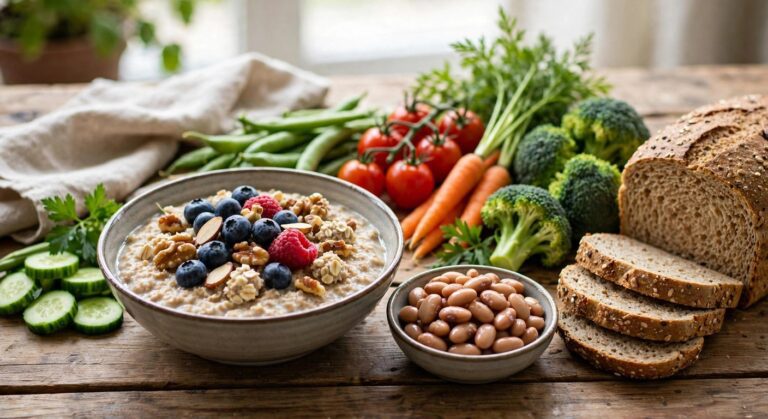
No food burns belly fat directly, and the article’s FAQ is right to say so. But a purely negative answer leaves readers asking what to actually eat, so here is the positive list, framed honestly. These foods help because they keep you full, steady your blood sugar, or replace something worse, not because they melt fat. Soluble-fiber foods: oats, flaxseed, avocado, and legumes. The article already notes that each 10 gram increase in soluble fiber is associated with about 3.7 percent lower visceral fat, and the daily target behind that number is about 30 grams of total fiber a day, which is the NHS guidance for adults. Protein at each meal: eggs, Greek yogurt, chicken, fish, legumes, and cottage cheese. Fatty fish: salmon and tuna, a few times a week. Probiotic foods: yogurt, kefir, sauerkraut, and kimchi, which support gut health as part of an overall pattern. Green tea: unsweetened tea is a useful swap for sugary drinks, not a fat burner in its own right. Build meals from these lists and the deficit in lever 1 gets much easier to hold.
3. Exercise That Targets Visceral Fat
Exercise does something diet alone cannot. It preferentially burns visceral fat. In Ross et al. 2000, a randomized trial with 52 participants published in Obesity Research, exercise-induced weight loss produced about 40 percent more visceral fat loss per kilogram lost than diet-only weight loss at the same total weight loss. A 2023 JAMA meta-analysis found that each 30 minutes per week of aerobic exercise independently reduces visceral fat by about 1.60 square centimeters. Exercise also reduces visceral fat and gains muscle even without weight loss, according to Harvard. Aim for a minimum of 150 to 200 minutes per week of moderate to vigorous activity, and add strength training twice a week to protect muscle. That is how to lose belly fat with exercise: consistent, hard enough, and paired with a deficit.
High-intensity interval training, or HIIT, is especially effective for belly fat. In Trapp et al. 2008, a randomized trial published in the International Journal of Obesity, HIIT produced significantly greater abdominal fat reductions than steady-state cardio at matched session duration. A 2023 study found that moderate-to-high intensity cardio and intervals work best because they raise catecholamines, which visceral fat responds to directly. Exercise above 75 percent of max heart rate was the effective zone.
Here is a concrete protocol you can start with. Warm up for 5 minutes. Then work hard for 30 seconds, recover easy for 90 seconds, and repeat for 6 to 10 rounds, 2 to 3 times per week. Good options are running, cycling, rowing, and the elliptical. On rest days, aim for 8,000 or more steps. Keep the hard days hard and the easy days easy.
See how many steps a day help with weight loss, and keep walking on rest days.
Combined Training and a Starter Routine
The article gives a HIIT protocol, but never names a winner between exercise types, so here it is: combined aerobic plus resistance training does best for visceral fat. Aerobic work burns visceral fat preferentially, and resistance work protects the muscle that keeps your daily burn up, so together they cover both sides of the problem. The trials behind the article’s timeline section, combining resistance training with at least 150 minutes of aerobic exercise per week, produced up to 36 percent visceral fat reduction. Here is a minimal starter routine that fits the article’s twice-a-week strength advice. Two to three full-body sessions per week, built on squats, lunges, push-ups, and rows, using bodyweight, resistance bands, or weights, 2 to 3 sets of 8 to 12 reps each, plus the HIIT protocol above on separate days. That is the whole routine. You do not need a gym membership or a complicated split to start, and you can add weight or reps as it gets easy. For the walking side of the plan, see the steps guide.
Sitting Is a Separate Lever
Exercise minutes are not the whole movement story. Prolonged sitting is its own lever, distinct from workouts, and it matters most for desk-bound readers. In the CARDIA study of 3,010 adults, each extra 1.5 hours of daily television viewing was linked with about 3.5 cm more visceral fat, even after accounting for physical activity. Other research finds the same pattern in reverse: shifting sedentary time to standing or walking time is linked with lower visceral fat. The practical fix is cheap. Stand up and move for a few minutes every half hour, take calls standing, use a standing desk for part of the day if you have one, and walk for 10 minutes after meals. None of this replaces the 150 to 200 minutes of weekly exercise in lever 3. It fills the other 15 hours of the day, which is where most sitting happens.
Does Walking Help, and What Is the Best Exercise for Belly Fat?
Yes. Walking 8,000 or more steps a day plus a calorie deficit chips away at visceral fat, and exercise reduces visceral fat even without weight loss.
The same exercise question comes up in a broader form.
For the best result overall, combine aerobic and resistance training. Aerobic work, including the HIIT protocol in this article, burns visceral fat preferentially, and resistance work protects the muscle that keeps your daily burn up.
Trials combining resistance training with at least 150 minutes of aerobic exercise per week produced up to 36 percent visceral fat reduction. Either type alone helps, but together they do best.
4. Sleep and Stress
Sleep and stress are the levers most people ignore when learning how to lose belly fat, and they quietly undo the other three. Getting less than 7 to 9 hours of sleep raises cortisol by up to 37 percent, disrupts hunger hormones, and increases cravings. Sleep restriction also increases activation of brain regions sensitive to food stimuli, according to a 2012 study in the American Journal of Clinical Nutrition. In other words, a tired brain is a hungry brain. Chronic stress does the same thing from another direction. Elevated cortisol pushes fat storage toward the abdomen. Protect your sleep with a consistent schedule, a dark cool room, and no late heavy meals. Manage stress with daily movement, a wind-down routine, and a short walk instead of a late-night snack.
5. Cut the Belly-Fat Drivers
The fifth lever is removing the things that push fat toward your belly. Start with sugar and fructose. Excess fructose is processed by the liver and converts directly to fat through de novo lipogenesis, which spills into visceral fat. Liquid sugar is the worst offender because it does not trigger satiety. You can drink 300 calories and still feel hungry.
Next, trans fats. Wake Forest research showed that trans fats add fat specifically to the belly and can even redistribute fat there from other areas. Check labels for partially hydrogenated oils and keep them out of your regular rotation. Alcohol adds calories and slows fat metabolism, so it pauses fat burning while your body clears the alcohol. Smoking is also linked to storing fat in the abdomen rather than the hips and thighs, one more reason to quit.
Alcohol deserves numbers, not just a warning. Pure alcohol carries about 7 calories per gram, nearly twice the 4 calories per gram of carbohydrate or protein, and it comes with almost no nutrition. Two glasses of wine in the evening can add roughly 250 to 300 calories, before any snacks that come with them. This is the classic “beer belly” pattern: regular drinking adds hundreds of liquid calories that do not fill you up, while the body pauses fat burning to clear the alcohol first. None of this means one drink ruins a plan. It means nightly drinking quietly erases a 300 to 500 calorie deficit, which is exactly the size of the deficit this plan relies on. If your waist is not moving and alcohol is a nightly habit, that is the first lever to check, before blaming your metabolism.
You do not need to overhaul everything at once. Diet-only tricks that work start with removing one high-calorie habit daily: one sugary drink saves about 150 kcal, one dessert about 200, one processed snack about 250. Use a smaller plate, 25 cm instead of 30 cm, which cuts servings by about 22 percent. Eat vegetables first, stop eating 2 to 3 hours before bed, and never eat straight from the packet, because portion sizes disappear when you do. Finally, consider your overall pattern. The Green Mediterranean diet produced a 14.1 percent visceral fat reduction over 18 months in a 2022 study in Gut, with extra green foods and less red meat. You do not need to follow it exactly, but its principles, more plants, less processed meat, steady portions, point in the right direction.
Does Beer Cause Belly Fat?
Beer does not target the belly, but the pattern behind “beer belly” is real. Alcohol carries about 7 calories per gram, two glasses of wine in the evening can add roughly 250 to 300 calories, and the body pauses fat burning while it clears alcohol.
Regular nightly drinking quietly erases a 300 to 500 calorie deficit, and that surplus, stored preferentially around the abdomen, is what builds a beer belly over time. Cutting back on nightly drinking is often the fastest single fix.
A Sample Day on a Belly-Fat Plan
Theory is easier to follow when you can see a day of it, so here is one built around the article’s own numbers: about 2,000 calories, which is the 2,400 maintenance example from lever 1 minus a 400 calorie deficit, with protein and fiber at every meal. Adjust portions to your own target from the calorie deficit calculator; the structure is what matters, not the exact foods.
| Meal | Example | About |
|---|---|---|
| Breakfast | Oats with milk, Greek yogurt, and berries | 450 calories |
| Lunch | Chicken breast, rice with olive oil, and vegetables | 600 calories |
| Snack | An apple with a handful of nuts | 250 calories |
| Dinner | Salmon, potatoes, and vegetables | 700 calories |
The pattern to copy is protein plus fiber at every meal, vegetables first where it fits, and no liquid sugar anywhere in the day. Swap freely within the lists in the foods section: eggs for yogurt, lentils for chicken, tuna for salmon. If you are hungry on this pattern, add vegetables and protein before adding refined carbs, because those two keep you fullest per calorie. If you are consistently over target, the usual culprit is not the meals. It is drinks, snacks eaten straight from the packet, and portions that crept up, which is why the tracking section matters as much as this table.
Beyond the 5 Levers: Fasting and Insulin Resistance
Two topics readers always ask about sit outside the 5 levers, so they get a direct verdict here rather than silence.
Intermittent Fasting: The Verdict
Intermittent fasting works when it creates a calorie deficit, and not because fasting itself melts belly fat. The best test of this is the TREAT randomized trial published in JAMA Internal Medicine in 2020. In that trial, 116 adults with overweight or obesity were assigned for 12 weeks to either eating only between noon and 8 pm, or eating three structured meals plus snacks across the day. Weight loss did not differ significantly between the groups, and the fasting group lost more lean mass. The honest verdict is that fasting is a scheduling tool, not a fat-burning shortcut. If an eating window helps you eat less without feeling miserable, it can support the deficit in lever 1. If it makes you ravenous, skip meals badly, or lose muscle, it is hurting the plan. Fasting is also not suitable for everyone: if you are pregnant, have a history of disordered eating, or take medication that affects blood sugar, talk to your doctor before trying it.
Refined Carbs and Insulin Resistance
Sugar is only half the story. Refined carbohydrates, white bread, white rice, pastries, and most breakfast cereals, digest fast and spike blood sugar, which drives insulin up. Insulin is the hormone that tells your body to store energy, and when insulin stays high for years, cells respond to it less well. That state is insulin resistance, and it pushes fat storage toward the belly while making further fat loss harder. This is why two diets with the same calories can feel very different: one built on whole grains, legumes, and vegetables keeps blood sugar steadier than one built on refined carbs. You do not need to cut carbs out. Swap the refined versions for whole ones most of the time, pair carbs with protein or fiber, and the insulin side of belly fat starts working with you instead of against you. For the full deficit-side picture, see the calorie deficit guide.
Does Intermittent Fasting Help Belly Fat?
Only through the deficit it creates. In the 2020 TREAT randomized trial, 116 adults eating only between noon and 8 pm lost no significantly more weight over 12 weeks than adults eating structured meals across the day, and the fasting group lost more lean mass.
If an eating window helps you eat less, it can support your plan. If it makes you ravenous or costs you muscle, it is hurting it. Fasting does not target belly fat specifically.
Bloating vs Belly Fat: The Honest 7-Day Answer
Can you lose belly fat in 7 days? Meaningful fat, no. At the article’s own pace of 0.3 to 0.5 kg per week, one week of a real deficit moves well under a kilogram of fat, and no diet changes that arithmetic. What can change in 7 days is bloating and water retention, and that alone can make your waist look and feel smaller. If your belly feels puffy rather than steadily large, try the bloating checklist for a week: cut back on sodium and alcohol, swap refined carbs for whole ones, drink water steadily through the day instead of in large bursts, move more, and eat slowly. Many people see the puffiness ease within days, and that is a real win, just not fat loss. Do not let a smaller-looking week 1 fool you into thinking the job is done, and do not let a flat week 1 fool you into quitting. Fat loss is measured in weeks, bloating in days, and confusing the two is how crash diets sell false hope.
Can You Lose Belly Fat in 7 Days?
Not meaningful fat, no. At a realistic pace of 0.3 to 0.5 kg per week, one week moves well under a kilogram of fat.
What can change in 7 days is bloating and water retention: cut back on sodium and alcohol, swap refined carbs for whole ones, drink water steadily, and move more, and your waist may look and feel smaller within days. That is a real improvement, just not fat loss. Judge fat loss over weeks, not days.
What Does NOT Work
Crunches alone do not burn belly fat, as the 6-week study showed. They build muscle under the fat, which is useful, but fat loss still needs a deficit. Detox teas and cleanses do not burn fat either. Any quick drop on the scale is mostly water, and it comes back. Ab gadgets and waist trainers do not burn fat. A waist trainer temporarily compresses your midsection and can make breathing and core function worse. The fasted cardio hack is not a magic bullet either. Training on an empty stomach does not meaningfully change total fat loss over weeks once calories are matched. What matters is total weekly activity and a sustained deficit, not the exact hour you train. Skip the gimmicks. That is how to lose belly fat: the deficit and the 5 levers are what work.
How Long Will It Take?
Set a realistic timeline for how to lose belly fat. Visceral fat goes first, so waist changes often show in 4 to 8 weeks even when the mirror has not caught up. At 0.3 to 0.5 kg per week, a 6 kg loss takes roughly 12 to 20 weeks. The lower belly is usually last, typically taking 12 or more weeks, so do not judge the plan at week 6. As your weight shifts, recalculate your deficit, because a lighter body burns fewer calories. After 40, the same levers still work. In clinical trials, combining resistance training with aerobic exercise of at least 150 minutes per week produced up to 36 percent visceral fat reduction. Patience is the strategy. The people who win are the ones still going at week 12.
Learn how many calories are in a pound of fat, so your weekly deficit makes sense.
Week by Week: What to Expect
| Weeks | What usually happens |
|---|---|
| Weeks 1 to 2 | The scale moves fastest, but much of it is water and glycogen, not fat. Your waist may already feel a little looser. |
| Weeks 2 to 4 | True fat loss starts to show. Waist measurements may begin to move before the mirror does. |
| Weeks 4 to 8 | Waist change typically becomes visible. This is the first point where the plan proves itself. |
| Weeks 8 to 12 | The lower belly often begins to change. This is where most people quit, and where patience pays most. |
| 12 weeks and beyond | Consolidation. Recalculate your deficit at your new weight, and judge the trend over months, not days. |
Two notes keep this table honest. First, these are typical patterns, not promises for any one person, because genetics, hormones, and starting point all shift the timeline. Second, a stall week is normal, especially around weeks 6 to 8, when water shifts and tracking drift hide real fat loss. Judge any stall over three to four weeks of waist measurements, not over a single weigh-in, and recalculate your deficit before assuming the plan has stopped working.
Belly Fat After Menopause, After 50, and After 60
This section is for readers who feel the standard plan was written for someone else. After menopause, falling estrogen changes where fat goes. A review of body composition across the menopause transition describes fat shifting from the hips and thighs toward the abdomen, with visceral fat rising even when the number on the scale barely moves. At the same time, declining estrogen impairs muscle maintenance, and less muscle means a lower daily burn. Sleep disruption and stress add cortisol on top, which pushes fat toward the belly further. None of this makes the 5 levers useless. It makes two of them more important: protein, to defend the muscle you have, and resistance training, to keep the burn up. The existing FAQ line on after 40 is true as far as it goes, but it does not say any of this, and readers in this situation deserve the mechanism, not just reassurance.
After 50 and after 60, the same logic applies with one addition: muscle loss accelerates with age, so the training lever matters even more and the deficit should stay moderate. A crash diet at 60 costs muscle you cannot easily rebuild, which lowers your burn and makes the next attempt harder. Keep the 300 to 500 calorie deficit, keep protein at the higher end of the range in the protein block, keep two strength sessions a week, and judge progress by waist and strength, not just the scale. If menopause symptoms, sleep problems, or a medication are driving weight gain, that belongs in a conversation with your doctor, not in a diet plan alone.
Can You Lose Belly Fat After 40 or Menopause?
Yes. Resistance plus aerobic exercise (150+ min/week) produced up to 36% visceral fat reduction in trials. Menopause shifts fat toward the belly, but the same 5 levers still work.
When to See a Doctor, and What About Shortcuts?
When to See a Doctor
Most belly fat responds to the 5 levers, but sometimes the cause is medical, and no amount of patience fixes a medical cause. Talk to your doctor if your belly fat bothers you physically or emotionally, if your weight has risen quickly without a clear reason, or if you suspect a medical condition. Specific flags include diabetes or blood sugar problems, thyroid problems, Cushing’s syndrome, polycystic ovary syndrome, and medications that promote weight gain, such as corticosteroids and some diabetes, antidepressant, and antipsychotic drugs. A doctor can check blood sugar, thyroid, and hormones, review your medications, and rule out causes that diet alone cannot address. This is also the right step if you have tried a steady deficit for 12 weeks with honest tracking and nothing has moved. ‘Try harder’ is not a diagnosis, and this article is not a substitute for one.
When Should I See a Doctor About Belly Fat?
See your doctor if your belly fat bothers you physically or emotionally, if your weight has risen quickly without a clear reason, or if you suspect a medical cause.
Flags include diabetes or blood sugar problems, thyroid problems, Cushing’s syndrome, polycystic ovary syndrome, and medications that promote weight gain, such as corticosteroids and some diabetes, antidepressant, and antipsychotic drugs. Also see a doctor if a steady deficit with honest tracking has moved nothing in 12 weeks. “Try harder” is not a diagnosis.
Supplements, Medication, and Surgery: The Boundaries
No supplement or medication speeds up metabolism in a way that targets the stomach, and no pill burns belly fat directly. Fat-burner supplements have not been shown to target belly fat specifically, and some carry real side effects, so treat bold claims on a label as marketing, not evidence. Prescription weight-loss medications in the GLP-1 class are a different matter: they reduce overall weight through appetite and blood sugar effects, under medical supervision, but they do not selectively remove belly fat, and they are not a shortcut around the levers. Surgery has a hard anatomical limit worth knowing. Liposuction removes subcutaneous fat, the pinchable layer, and cannot reach visceral fat, which sits inside the abdominal cavity around the organs. The same applies to non-surgical fat freezing, which targets the subcutaneous layer only. If your main problem is visceral fat, the dangerous kind, no procedure removes it. Only the deficit, training, sleep, and time do.
Do Fat-Burner Supplements or Liposuction Work for Visceral Fat?
No, neither reaches visceral fat. Fat-burner supplements have not been shown to target belly fat specifically, and some carry real side effects. Liposuction removes only subcutaneous fat, the pinchable layer, and cannot reach visceral fat inside the abdominal cavity. The same applies to non-surgical fat freezing.
Prescription GLP-1 medications reduce overall weight under medical supervision, but they do not selectively remove belly fat either. For visceral fat, the deficit, training, sleep, and time are the only routes that work.
How to Track Progress
When you are working on how to lose belly fat, track progress with more than the scale. Measure your waist on bare skin just above the hip bone, tape level all the way around, snug but not pressing into the skin, standing relaxed, after breathing out, without sucking in, once a week in the morning. Aim for a waist circumference less than half your height, which is the NICE waist-to-height guidance, so a ratio under 0.5. Take photos in the same light and pose every two weeks. Weigh yourself a few times a week and watch the weekly trend, not daily fluctuations, which mostly reflect water and food volume. If the waist is shrinking and the trend is down over a month, the plan is working, even if one weigh-in disappoints you.
Find your TDEE with our TDEE calculator.
Use our calorie calculator to estimate your daily needs.
Learn what TDEE means and how it is calculated.
Sources
- Mayo Clinic. Belly fat in women: Taking apple-shaped health risks seriously, and Mayo Clinic guidance on how to measure your waist.
- Harvard Health. Taking aim at belly fat, and guidance on waist circumference and health risk.
- Lowe DA, Wu N, Rohdin-Bibby L, et al. Effects of time-restricted eating on weight loss and other metabolic parameters in women and men with overweight and obesity: the TREAT randomized clinical trial. JAMA Internal Medicine, 2020. (Summary)
- World Health Organization. Expert consultation on waist circumference and waist-to-hip ratio: abdominal obesity above 0.90 for men and above 0.85 for women.
- NHS. Guidance on dietary fibre: adults should aim for about 30 grams of fibre a day.
- Ross R, Dagnone D, Jones PJH, et al. Reduction in obesity and related comorbid conditions after diet-induced weight loss or exercise-induced weight loss in men. Annals of Internal Medicine, 2000.
- Trapp EG, Chisholm DJ, Freund J, Boutcher SH. The effects of high-intensity intermittent exercise training on fat loss and fasting insulin levels of young women. International Journal of Obesity, 2008.
- National Institute for Health and Care Excellence. Guideline CG189: Obesity, identification, assessment and management.
- A 2022 study in Gut on the Green Mediterranean diet and visceral fat reduction over 18 months.
- A 2025 review of body composition and abdominal fat redistribution across the menopause transition. (PMC)
This guide is general information, not medical advice. If you have diabetes, thyroid problems, a hormone condition, take daily medication, or have any condition that affects weight, talk to your doctor before changing your diet or exercise routine, and use this guide as background, not as a prescription.
Frequently Asked Questions
Can you lose belly fat without exercise?
Yes, diet alone works: 5-7% weight loss significantly reduces both fat types. But exercise adds about 40% more visceral fat loss per kilogram lost, so both together are best.
Do crunches burn belly fat?
No. A 6-week study found no significant midsection fat loss from ab exercises alone. Crunches build the muscle under the fat; fat loss comes from an overall deficit.
How long does it take to lose belly fat?
Visceral fat goes first, so waist changes often show in 4-8 weeks. Lower belly fat is last and typically takes 12+ weeks at 0.3-0.5 kg per week.
Why is lower belly fat the last to go?
Fat loss order is set by genetics and hormones, and the lower belly is usually the last stop. It is not a special stubborn problem; it is an order-of-operations problem.
What foods burn belly fat?
No food burns fat directly. Protein and fiber help through satiety and a deficit. Sugar, fructose drinks, and trans fats push fat toward the belly.
The bottom line on how to lose belly fat is simple. You cannot spot-reduce belly fat, but you do not need to. Visceral fat is the first to go in a calorie deficit, and the 5 levers in this article are how you get there. Start with a moderate deficit, build meals around protein and fiber, train with a mix of strength and intervals, protect your sleep, and cut the drivers that refill your belly. Give it 12 weeks, track your waist, and do not quit at week 6. Your future self will thank you for starting today.